An overview of the state of Palestinian refugees in Lebanon throughout history, that covers the political make up of the refugee camps, the impact of the July 2006 war on the Palestinian refugees, the refugees' rights and legal status, and the local and international NGOs work
This Country Study is based on a full national report that is the first to draw a profile of poverty in Lebanon based on money-metric poverty measurements of household expenditures.
The Israeli July 2006 war exposed the Lebanese population to disastrous conditions. It has profoundly affected residents’ livelihoods through bringing down access to services, infrastructure and natural resources. Responding to these emerging problems poses further challenges for the Lebanese government and society. In this respect, different emergency measures have been undertaken to address the arising needs, starting with assessing physical, economic and social damages.
As a contribution to identifying short and medium term intervention needs, the World Bank initiated undertaking a Post...
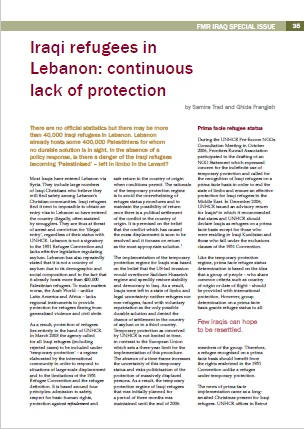
There are no official statistics but there may be more than 40,000 Iraqi refugees in Lebanon. Lebanon already hosts some 400,000 Palestinians for whom no durable solution is in sight.
“Moukhtar” booklet provides guidelines for municipality leaders and mayors, on how to effectively implement practices and procedures that would benefit the local community, whether in regular daily activities or in conflict situations.
As a consequence of the armed struggle between the Islamist group Fatah al-Islam and the Lebanese Army in and around the Nahr El-Bared Palestinian refugee camp north of Tripoli the past 3 weeks, the vast majority of its population has fled their homes and is now dispersed to
This article addresses the public policy concept of gender mainstreaming and the extent of its efficacy since the 1995 Beijing Platform for Action (PfA) and the UN's adoption thereof in 1997.
This report is the result of an assessment undertaken by the Danish Refugee Council (DRC) from March 28. to June 27, 2005 in Lebanon. The assessment was supported financially by the European Commission’s Humanitarian Aid department (ECHO).
This reference book includes chapters on resources, legal and integral frameworks, and the constitutional structure of NGOs. It aims at contributing to reinforce the role of civil society in the economic and social development of Lebanon.
In the framework of “Towards a National Dialogue on Corruption in Lebanon”, the United Nations Development Programme and the Lebanese Transparency Association were able to lay down the foundation of anti-corruption modules as translated into the document entitled “Towards a Na