DRC in Lebanon
The Danish Refugee Council began operating in Lebanon in 2004. Since then, the organization
has partnered with local and international NGOs to implement different programs that followed the
country’s needs. Today, DRC’s main focus is on assisting those affected by the Syrian crisis, including
refugees and members of the hosting communities. DRC also provides assistance to Palestinian
refugees, migrant domestic workers and women at risk.
DRC currently addresses the needs of four displaced population groups, as well as the affected
Lebanese communities:
-Syrian refugees feeling...
The Syrian crisis continues to provoke an ever increasing displacement across the border into Lebanon. According to the UNHCR, more than 569,000 Syrian refugees are now receiving protection and assistance from the Lebanese government, the UN and NGO’s. With no end to the crisis in sight, the number of Syrian refugees entering Lebanon is expected to rise to one million by the end of the year, posing a significant challenge to hosting communities around Lebanon. DRC and its partners continue to provide essential services to meet the needs of refugees and locals.
DRC’s emergency strategy focuses...
This report summarises the findings of Amel Association International’s latest Rapid Needs Assessment that was conducted from its Haret Hreik community centre in May 2013. It is hoped that the reader will benefit both from the summary of the target population’s needs and the analysis of how Amel Association International can best replicate such assessments in the future.
This report summarises the findings of the recent Rapid Needs Assessment at Amel Association International’s Burj el Barajneh (Baajour) community centre, which took place in late March 2013. It is hoped that the reader will benefit both from the summary of the target population’s needs and the analysis of how Amel Association International can best replicate such assessments in the future.
Sommaire :
Avant‐propos
I) Organigramme d’Adyan
II) Les réalisations par département
A) CCSD
B) SEC‐D
C) Média
D) Solidarité
III) Le Réseau des Volontaires
IV) Les Rencontres internationales
V) L’équipe administrative
VI) Budget et Résultat
VII) Faites un don
VIII) Adresse
IX) Web, 15
Table of content:
Forward
I) Adyan organizational chart
II) Key achievements by department
A) CCSD
B) SEC-D
C) Media D
D) Solidarity D
III) Volunteerism at Adyan
IV) Intercultural and International Meetings
V) Office and admin team
VI) Budget and Balance
VII) Support us
VIII) Address
IX) Web
The “Review of the Public Procurement Legal Framework in Lebanon” introduces the Sustainable Public Procurement (SPP) in Lebanon and elaborates on the legal of the country’s procurement and sustainability laws that may offer a legal possibility for the adoption of SPP principl
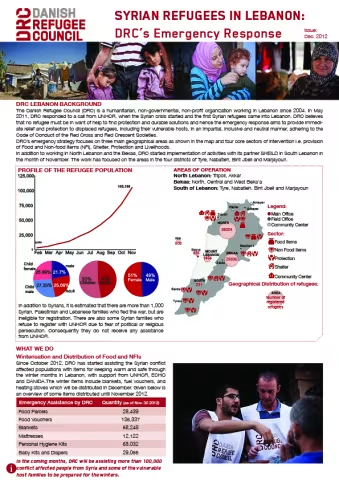
DRC LEBANON BACKGROUNDThe Danish Refugee Council (DRC) is a humanitarian, non-governmental, non-profit organization working in Lebanon since 2004. In May 2011, DRC responded to a call from UNHCR, when the Syrian crisis started and the first Syrian refugees came into Lebanon. DRC believes that no refugee must be in want of help to find protection and durable solutions and hence the emergency response aims to provide immediate relief and protection to displaced refugees, including their vulnerable hosts, in an impartial, inclusive and neutral manner, adhering to the Code of Conduct of the Red...
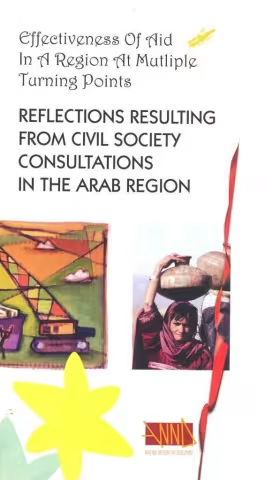
This book tackles key Issues of concern within the aid discussion. It outlines issues of particular importance for civil society in the Arab region and highlights the difference of prospectives between government representatives and CSOs.
The National Report for the United Nations Conference on Sustainable Development (Rio + 20) presents the current situation as is and highlights the achievements and failures, strengths and weaknesses, opportunities and risks.
The Strategic Planning is based on the findings of fieldwork carried out in several villages in Dinnieh, which aimed at identifying the major characteristics of the region in different fields.
The State and Trends of the Lebanese Environment report provides an overview of the current condition of natural resources and environmental management in the country. Furthermore, it gives an analysis of past and future developments across multiple different sectors.
This edition of the Global Education Digest (GED) explores the changing patterns in gender and schooling throughout the formal education system – from primary to tertiary education levels.
Review of marginalisation of people with disabilities in Lebanon, Syria and Jordan. Using a social exclusion conceptual framework, this paper identifies several causes of marginalization of people with disabilities in the context of the MENA region.
This Country Study is based on a full national report that is the first to draw a profile of poverty in Lebanon based on money-metric poverty measurements of household expenditures.
The Israeli July 2006 war exposed the Lebanese population to disastrous conditions. It has profoundly affected residents’ livelihoods through bringing down access to services, infrastructure and natural resources. Responding to these emerging problems poses further challenges for the Lebanese government and society. In this respect, different emergency measures have been undertaken to address the arising needs, starting with assessing physical, economic and social damages.
As a contribution to identifying short and medium term intervention needs, the World Bank initiated undertaking a Post...
“Moukhtar” booklet provides guidelines for municipality leaders and mayors, on how to effectively implement practices and procedures that would benefit the local community, whether in regular daily activities or in conflict situations.