This thesis investigates transnational campaigns from the international and state level to consider the existence of transnational activism in Lebanon’s women’s movement.
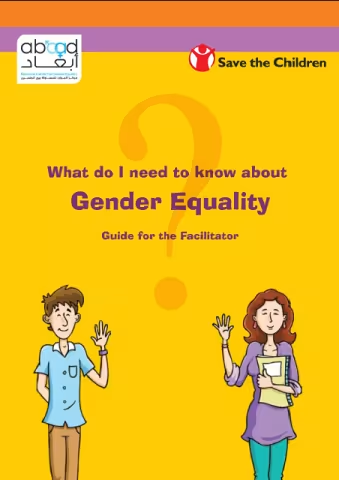
This guide has been published in 2013 by ABAAD – Resource Center for Gender Equality, with the support of Save The Children. It is a manual intended for the use of facilitators, to guide them in explaining notions relevant to gender and gender equality to children and youth.
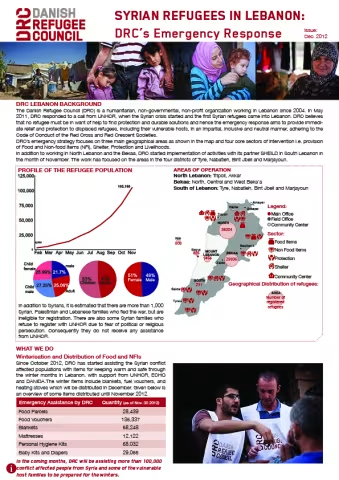
DRC LEBANON BACKGROUNDThe Danish Refugee Council (DRC) is a humanitarian, non-governmental, non-profit organization working in Lebanon since 2004. In May 2011, DRC responded to a call from UNHCR, when the Syrian crisis started and the first Syrian refugees came into Lebanon. DRC believes that no refugee must be in want of help to find protection and durable solutions and hence the emergency response aims to provide immediate relief and protection to displaced refugees, including their vulnerable hosts, in an impartial, inclusive and neutral manner, adhering to the Code of Conduct of the Red...
This report is a summary of the presentations given during the regional workshop on free trade agreements in the Arab region. The meeting was part of the two-year project on the “socio-economic impact of trade liberalization policies on the Arab region”.
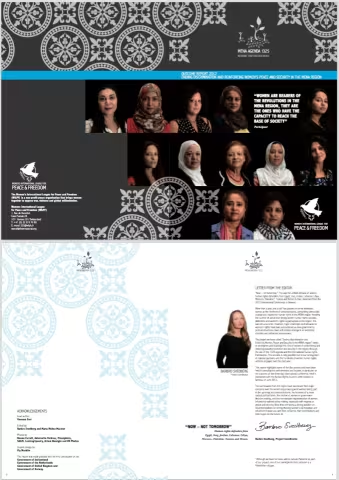
In late 2011, WILPF began to develop a programme to enhance the collective capacities of women’s rights organisations to respond to the unprecedented political events in the Middle East and North Africa (MENA).
This report will provide a description of the assessment conducted by IMC’s Mental Health and Psychosocial team in the region of Wadi Khaled following the displacement of Syrians into the northern villages between the Lebanese-Syrian borders as a result of the internal conflic
This brochure elaborates on the achievements of the UNDP’s 4 portfolios in Lebanon: Democratic Governance, Poverty & Social Development, Environment & Energy, and Crisis Prevention & Recovery.
The fourth National Human Development Report, “Toward a Citizen’s State”, addresses citizenship in Lebanon through three principle perspectives: citizenship and sectarian state, socio-economic citizenship and citizenship and culture and education.
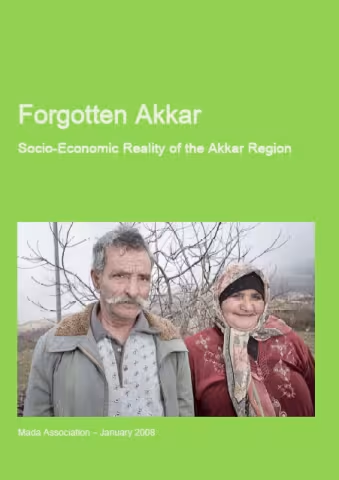
This study focuses on presenting the socio-economic reality of Akkar. It begins with a situational analysis, including an assessment measuring the impact of the July 2006 and Nahr al-Bared wars on the livelihoods of the people of Akkar.
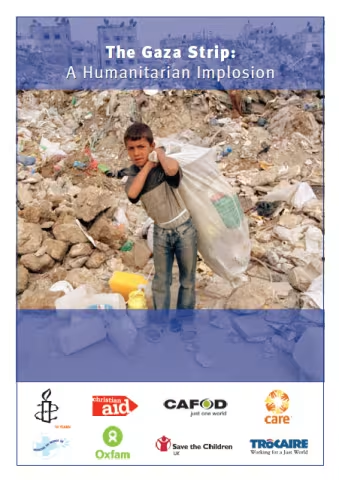
The situation for 1.5 million Palestinians in the Gaza Strip is worse now than it has ever been since the start of the Israeli military occupation in 1967.
Lebanon in Figures 2008 gathers number of social and economic indicators: About Lebanon, Population, Education, Employment, Tourism, Consumer Price Index, National Accounts...
The Israeli July 2006 war exposed the Lebanese population to disastrous conditions. It has profoundly affected residents’ livelihoods through bringing down access to services, infrastructure and natural resources. Responding to these emerging problems poses further challenges for the Lebanese government and society. In this respect, different emergency measures have been undertaken to address the arising needs, starting with assessing physical, economic and social damages.
As a contribution to identifying short and medium term intervention needs, the World Bank initiated undertaking a Post...
تهدف "دراسة الأحوال المعيشية للأسر للعام 2007 " إلى توفير قاعدة غنية من البيانات الإحصائية في المواضيع أدناه، وذلك بهدف التعرّف على الأوضاع المعيشية للأسر في العام 2007 ومدى تأثير عدوان تموز 2006عليها: • الخصائص الاجتماعية للأسر ولأفرادها • الخصائص الديموغرافية والتربوية لأفرا
Most theorists maintain that social exclusion is a process, not only the condition reflecting the outcome of that process. Yet few, if any, people ever reach the ultimate end of the imagined trajectory.
The National Survey of Household Living Conditions (The Multipurpose survey) provides a statistical database vital for the setting forth of national policies in various sectors.