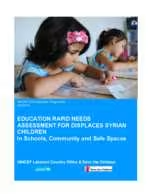
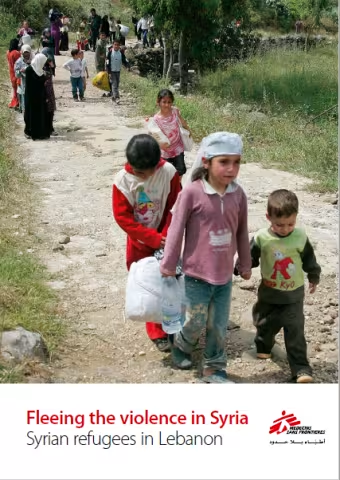
Since the unrest in Syria began in March 2011, the Bekaa Valley in Lebanon has hosted varying numbers of displaced Syrian families. Local actors such as municipalities and NGOs registered families for assistance received through regional and international donors.
28 refugee households were surveyed, which represented a total of 501 refugees, 48% male and 52% female, which is approximately 11% of the Syrian refugee population in North Bekaa.
Over 57,000 displaced Syrians are receiving protection and assistance in Lebanon through the efforts of the Government of Lebanon and UN and NGO partners.
Research and Policy Memo #10 | May 2011
Climate Change and Health Research in the Eastern Mediterranean Region (EMR)Rima R. Habib
Climate change is likely to aggravate the burden of disease in the Arab region currently suffering from political instability, natural disasters and humanitarian crises. The prevailing arid environment and the reliance on rain-fed food production exacerbate the situation. Therefore, governments and key stakeholders are encouraged to make further outlays to counteract new and increasing challenges to population health.
UNHCR, coordinating the operations in the North along side with the HRC (High Relief Commission) and DRC as its main implementing partner, requested from DRC to conduct a first rapid assessment in the Bekaa with the following objectives: a) To identify existing areas of displa
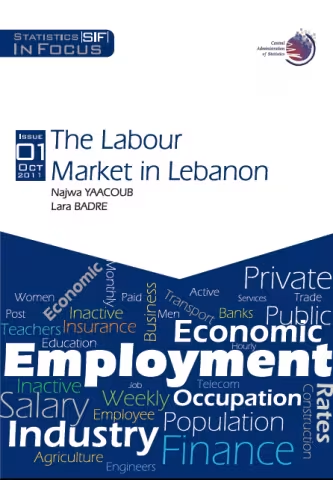
This issue of SIF looks briefly at the labour market key indicators and figures available from a number of surveys conducted by the Central Administration of Statistics (CAS) in Lebanon in recent years.
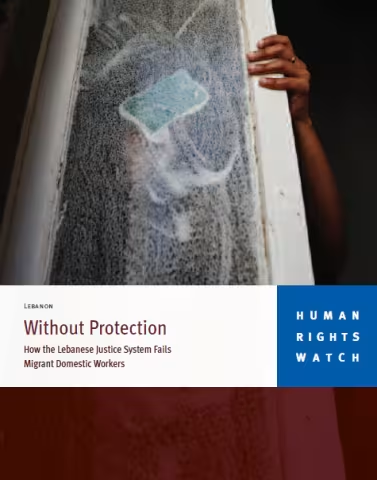
On December 9, 2009, a Lebanese criminal court sentenced a Lebanese woman to 15 days in jail for repeatedly beating Jonalin Malibago, her Filipina maid, three years earlier. Lebanese newspapers hailed the case a landmark victory for the country’s estimated 200,000 migrant domestic workers (MDWs), many of whom report abuse at the hands of their employers. The case illustrated the positive role that the judiciary can play in protecting MDWs, even though the sentence was lenient given the violation. But it also raised at least one significant question: was the Malibago verdict a rare instance of...
IFI Research and Policy Memo #1 | April 2010
The Transnational Tobacco Industry Effectively Hampers Tobacco Control Policy-Making in LebanonRima Nakkash
Lebanon is still considered one of the weakest countries in the region with regards to regulating tobacco use, despite having ratified the World Health Organisation’s Framework convention on Tobacco Control in 2005. Lebanon has failed numerous attempts to introduce a national tobacco control policy, including banning smoking in closed public areas, banning advertising and sponsorship, and placing large pictorial health warnings on tobacco...
The Central Administration of Statistics (CAS) and the World Bank organized a workshop entitled "Gender Statistics in Lebanon: Current Situation and Future Needs," which took place on June 17, 2010.
Information on the health service in Lebanon including availability of access and availability of drugs and treatment. Information on treatment of mental health issues such as anxiety, depression, post traumatic syndrome, including psychiatric treatment.
On December 9, 2009, a Lebanese criminal court sentenced a Lebanese woman to 15 days in jail for repeatedly beating Jonalin Malibago, her Filipina maid, three years earlier.
في 21 كانون الثاني/يناير 2009 اعتمد المجلس التنفيذي لمنظمة الصحة العالمية القرار م ت124 ق 4 الذي طلب إلى المديرة العامة لمنظمة الصحة العالمية أن توفد بعثة صحية متخصصة إلى غزة للوقوف على الاحتياجات الصحية و الإنسانية العاجلة بعد 22 يوماً من العمليات العسكرية الإسرائلية التي بدأ
This paper was produced by ANND and Christian Aid and contains five main sections: “Executive Summary: a crisis of multiple dimensions; the threat of explosive vulnerabilities and increasing insecurities”, “Vulnerability to poverty: the key challenges faced by the Arab region”