The report examines how economic and financial policies of the EU affect the economies of Southern Mediterranean countries. It’s interesting to note the shortcomings of these policies with regard to civil and political rights.
The second report is an evaluation of civil society initiatives on economic and social rights, including a series of civil society initiatives focusing on
“We Can Never Go Back to How Things were Before”* is a qualitative study carried out as a partner study to the International Men and Gender Equality Survey – Middle East and North Africa (IMAGES MENA).
The report entitled challenges for civil society and the promotion of economic and social rights, brings together recommendations from civil society actors and academics to strengthen Euro-Mediterra
This Policy Brief is based on research that explored the process of establishing and implementing Law 293, and on a policy dialogue that took place at the Institute on March 8, 2017 t
Lebanon provides a refuge for many women and teenagers driven away from neighbouring countries by wars and conflicts, as well as some who have come from other countries seeking better economic conditions.
Only a handful of studies in Lebanon have shed light on the changing gendered dynamics within the refugee families by comparing gender roles, expectations, and practices before and after displacement (as result of armed conflict).
With globalisation, the mobility of people has grown, and women are essential actors in this migratory phenomenon. This article focuses on the role of women in migration and the role of migration in advancing women’s rights to achieve gender equality.
Today, women in Lebanon are fighting for equal access to opportunities and rights without prejudice against their gender, their expectations and their careers.
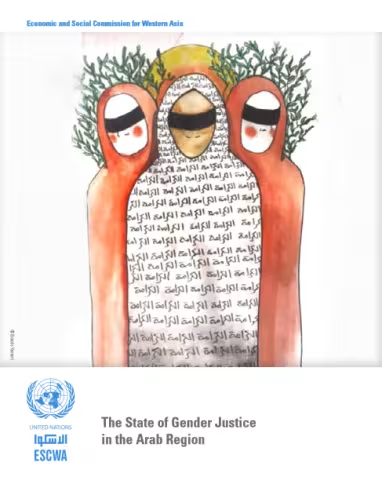
This study maps the current state of gender justice in the Arab region, documenting barriers as well as opportunities. Its primary research aim is to determine how to develop an environment, at the legal, policy, and social levels that is conducive to gender justice.
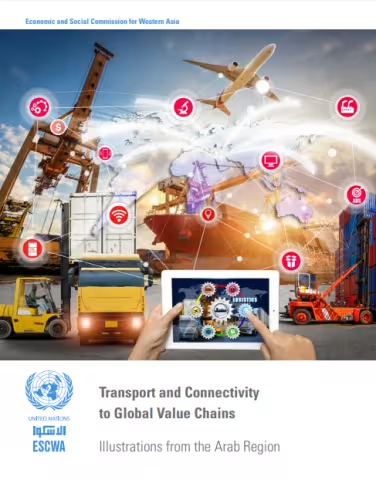
This report explores the impact of transport infrastructure and service availability and efficiency on the connectivity – the state of being connected – of GVCs.
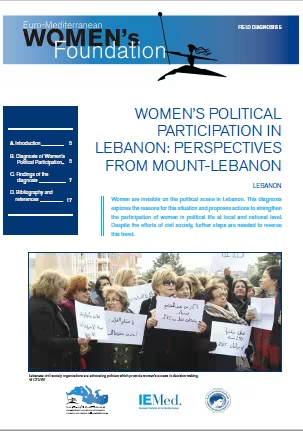
Although Lebanon is sometimes considered as the only democratic country in the Arab region with a free political environment and electoral system, the situation of women has not been strengthened enough for them to have a role on an equal footing with men. Lebanese women form a majority of 53% and they are actively participating in all aspects of Lebanese society. They enjoy equal constitutional rights with men and have the right to vote, hold public office, elect and be elected in municipal councils. Yet, this diagnosis, elaborated by the Committee for the Follow-Up on Women’s Issues (CFUWI)...
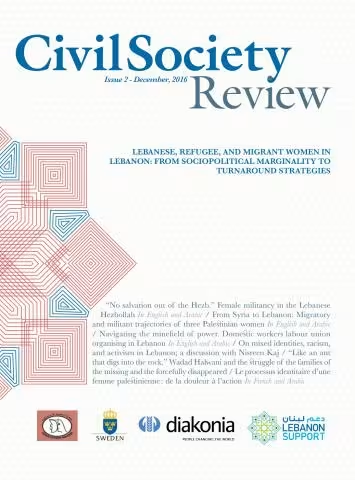
While women’s issues and rights have been at the forefront of public and civil society debate, academic, and activist publications, women’s inequalities and the discrimination women face in Lebanon have been notably undermined, whether as citizens, refugees, or migrants. However, if the publicising of the “issue of women in Lebanon” has prompted the production of more “gender-related” information and knowledge, it has oftentimes adopted the rhetoric of denunciation and victimisation. Hence, there is a scarcity of in-depth and sectoral studies on the logics of exclusion and discrimination in...
This study was undertaken by the Center for Women (ECW) at the United Nations Economic and Social Commission for Western Asia (ESCWA), in the context of a regional programme to review progress made in the implementation of the Beijing Declaration and Platform of Action in the
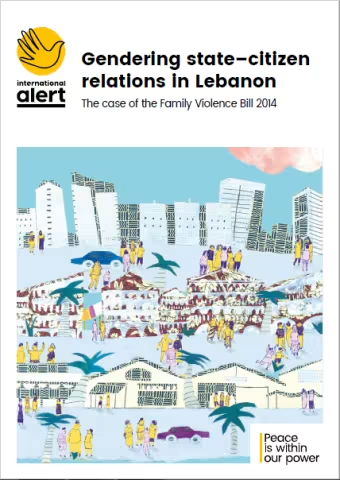
This report examines the nature of interaction and engagement between Lebanese citizens’ collectives and the state on gender-specific matters, through the case study of
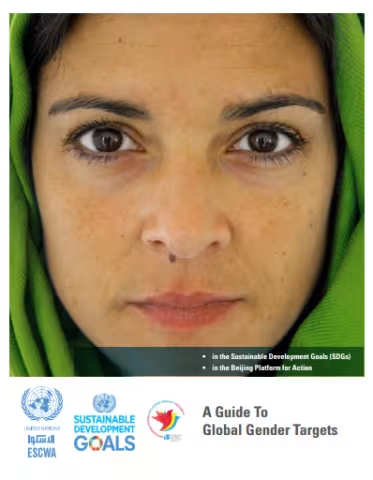
The present guide proposes to reconcile the gender-related targets in the Sustainable Development Goals with the objectives of the Beijing Platform according to various sub-topics. It is organized in two sections.