Resources

Theme
Displaying 21 - 40 of 125
National
Publishing Date

In the absence of a clear national plan for Integrated Waste Management (IWM), and due to various political and governmental issues, Lebanon has had to face a serious waste crisis in 2015.  The paper scrutinizes events leading up to the 17th of July 2015, and the impact of its aftermath on Lebanon’s environment, infrastructure, health and landscape. Parallels are drawn throughout the paper to a similar crisis faced by residents of Campania, Italy.


This paper thoroughly analyzes Lebanon’s “waste profile” and benchmarks it against a spectrum of countries to further understand global trends in...

National
Publishing Date
This Conflict Analysis Digest is composed of: I. Current conflict trends 1- Overview of mapped conflict incidents in Lebanon, with the villages where most incidents are mapped for each classification. (Between 1 July 2014 and 28 June 2015) 2- Mapped air strikes/ armed conflicts and violations classified as Syrian Border Conflicts. (Between 1 July 2014 and 28 June 2015) 3- Overview of mapped conflict incidents in the Matn. II. Brief thematic report Politics of security, discourses of fear and economic fatigue: the conflict dynamics in al-Matn Abstract: This short report provides an...
National
Publishing Date
This Conflict Analysis Digest is composed of: I.Current conflict trends - p.5 II.Brief thematic report - p.11 Spatial Fragmentation and rise in poverty: the conflict context in Saida Abstract: This short report provides a contextual and analytical summary of the conflict in the region of Saida, south of Lebanon, with a focus on spatial struggles and poverty growth. It describes the main conflict actors and how they have historically contributed to the shaping of conflictual dynamics in Saida from the fifties until today. Findings highlight that while most observers and media attention are...
National
Publishing Date

Research Report | April 2015
In this paper, we analyze the susceptibility of agricultural outputs to future climate change in Lebanon, and the extent to which it propagates to the economic system as a whole. We use a methodological framework in which physical and economic models are integrated for assessing the higher-order economic impacts of projected climate changes. By using this integrated modeling approach, we are able to quantify the broader economic impacts in the country by considering not only the temporal dimension but also the regional disaggregation of the results. Our estimates...

National
Publishing Date

Working Paper | March 2015
Sustainable Transportation and Mega Sporting Events in Arab Countries: the Case of Qatar by Robert Wittkuhn and Danyel Reiche
​Qatar has successfully developed into a hub for mega sporting events; the most prestigious of them will be the FIFA World Cup in 2022. Qatar promotes it as the “first completely carbon-neutral” and “most compact” World Cup. Such statements emphasize a very small impact of transport on the event’s carbon footprint; but they also raise questions about the understanding and applicability of carbon neutrality. As motive for hosting mega events...

National
Publishing Date

Working Paper | February 2015
Commuters’ Behavior towards Upgraded Bus Services in Greater Beirut: Role of Itinerary and Implications for Greenhouse Gas Emissions, Social Welfare and Transport Policy by Ali Chalak, Hani Al-Naghi, Alexandra Irani, and Maya Abou-Zeid
Climate change is one of the most critical environmental challenges facing the world today. The transportation sector alone contributes to 22% of carbon emissions, of which 80% are contributed by road transportation. In this paper, we investigate the potential greenhouse gas (GHG) emissions reduction and social welfare gains...

National
Publishing Date

Working Paper | February 2015
Economic Impacts of Adopting a Sustainable Transport System in Beirut by Mazen Omran, Johnny Ojeil, and Youssef Fawaz
​The work carried out in this paper demonstrates the economic benefit of a sustainable transport system. It compared a scenario with and without such system, and calculated loss time as a result of being held up in congestion during key peak hours mainly due to relying entirely on the private car. The work demonstrates that in addition to reducing congestion levels a sustainable transport system will generate benefits related to travel time...

National
Publishing Date

Working Paper | February 2015
Getting to Campus: Sustainable Public Transportation and Relocating the American University in Cairo by Richard Tutwiler, Hagar Eldidi, Yumna Kassim, and Andrew Petrovich
​Cairo is one of the most congested cities in the world, and public transportation is one of its greatest challenges. Government strategies to alleviate congestion have stressed horizontal expansion into the surrounding desert areas and the construction of more and ever larger motorways. This paper uses the experience of the American University in Cairo, which physically relocated in 2008 from...

National
Publishing Date

Working Paper | February 2015
Harnessing Motorists' Potential Demand for Hybrid-Electric Vehicles in Lebanon: Policy Options, CO2 Emissions Reduction and Welfare Gains by Alexandra Irani and Ali Chalak
Public concern over deteriorating air quality and the associated local and global impacts has grown significantly in the past decade. Air quality degradation is linked first and foremost to the transportation sector in the Arab region with about 90% of total emissions of carbon monoxide resulting from transportation activities. In Lebanon’s capital, Beirut, current levels of ozone and smog...

National
Publishing Date

Working Paper | February 2015
Sustainable Transportation in the Arab World: International Benchmarking on Sustainable Transport Policies and their Impacts by Issam Kaysi and Farid Chaaban
​The world’s transport sector still suffers from unsustainable trends that lead to increased levels of greenhouse gas (GHG) emissions. There have been efforts, in the Arab world, as well as the rest of the world, to tackle the issue. Work done in the US and Europe exceeds that of the Arab world, and their efforts have been successful, and have thus succeeded in reducing GHG emissions. In the Arab world, most...

National
Publishing Date
ترتّب المواطنة على الفرد/ المواطن مجموعة من الحقوق والواجبات التي تطبّق على الجميع، دون أي تمييز قائم على الاختلافات في القومية أو الجنس أو الجهة أو الموقع الاجتماعي أو الدين… وتحدد المواطنة شكل العلاقات التي يقيمها المواطن مع الدولة، والمجتمع، والفضاء المشترك. وفي هذا الجانب الأخير من العلاقات، تبرز أهمية التنمية المستدامة كقضية مواطنية بامتياز. في هذا الكتيب، تحاول الباحثة الإحاطة بمفهوم التنمية المستدامة، وبعلاقته مع المواطنة، وتفصّل العديد من القضايا البيئية الهامة، ثم تبيّن لنا ما يجب علينا، كمواطنين، فعله حيالها، لنحقق مواطنيتنا، من خلال التزامنا بالحق في البيئة السليمة للجميع....
National
Publishing Date
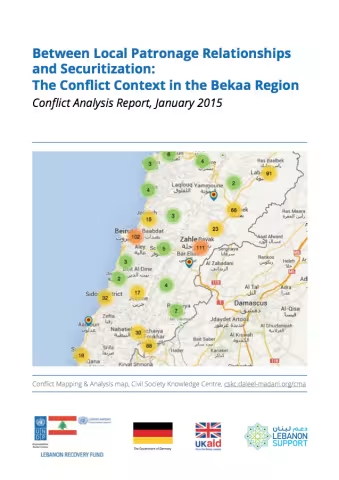
This report provides an analytical summary of the conflict context in the Bekaa region of Lebanon, with a focus on the relationships between the Syrian de facto refugees and the Lebanese host communities in the Baalbeck-Hermel area. It is based on a socio-political qualitative assessment and a conflict analysis that are primarily based on experiences and perspectives of key informants,2 as well as Lebanese and Syrian residents of the Bekaa. Unless otherwise noted, information in this report is based on these interviews. The report is intended as a quick reading of the field at a set point in...
National
Publishing Date
This working paper analyzes the susceptibility of agricultural outputs to future climate change in Lebanon, and the extent to which it propagates to the economic system as a whole. A methodological framework in which physical and economic models are integrated for assessing the higher-order economic impacts of projected climate changes is used. The researchers then quantify the broader economic impacts in the country considering not only the temporal dimension but also the regional disaggregation of the results. The results show that there are potential high costs and risks associated with a...
National
Publishing Date

Policy Brief | August 2014
Commuters’ Behavior towards Upgraded Bus Services in Greater Beirut: Role of Itinerary and Implications for Greenhouse Gas Emissions, Social Welfare and Transport Policy by Ali Chalak, Hani Al-Naghi,Alexandra Irani, and Maya Abou-Zeid
​Potential greenhouse gas (GHG) emissions reduction and social welfare gains can be achieved from upgrading the bus service in the Greater Beirut Area through a bundle of realistic bus service improvements in the short term. Such improvements will need to be comprehensive in scope and include both improvements in bus level of service...