Resources

Theme
Displaying 21 - 40 of 90
National
Publishing Date
This working paper analyzes the susceptibility of agricultural outputs to future climate change in Lebanon, and the extent to which it propagates to the economic system as a whole. A methodological framework in which physical and economic models are integrated for assessing the higher-order economic impacts of projected climate changes is used. The researchers then quantify the broader economic impacts in the country considering not only the temporal dimension but also the regional disaggregation of the results. The results show that there are potential high costs and risks associated with a...
National
Publishing Date

Policy Brief | August 2014
Commuters’ Behavior towards Upgraded Bus Services in Greater Beirut: Role of Itinerary and Implications for Greenhouse Gas Emissions, Social Welfare and Transport Policy by Ali Chalak, Hani Al-Naghi,Alexandra Irani, and Maya Abou-Zeid
​Potential greenhouse gas (GHG) emissions reduction and social welfare gains can be achieved from upgrading the bus service in the Greater Beirut Area through a bundle of realistic bus service improvements in the short term. Such improvements will need to be comprehensive in scope and include both improvements in bus level of service...

National
Publishing Date
Potential greenhouse gas (GHG) emissions reduction and social welfare gains can be achieved from upgrading the bus service in the Greater Beirut Area through a bundle of realistic bus service improvements in the short term. Such improvements will need to be comprehensive in scope and include both improvements in bus level of service attributes (access/egress time, headway, in-vehicle travel time, and number of transfers) and the provision of amenities, including air-conditioning and Wi-Fi. Moreover, such a service needs to be cheaply priced to achieve reasonably high levels of switching...
National
Publishing Date
The current congestion levels in the Beirut Central District (BCD) are not acceptable. These levels are expected to get worse with further development proposed in the BCD and New Waterfront District. Beirut will not be able to economically compete with other cities as it is lacking a comprehensive multi-modal transport system. One way to improve this situation is by introducing a more sustainable transportation system. In addition to reducing congestion levels a sustainable transport system will generate benefits related to: travel time, fewer accidents, a decrease in operational costs of...
National
Publishing Date

Policy Brief | August 2014
Economic Impacts of Adopting a Sustainable Transport System in Beirut by Mazen Omran, Johnny Ojeil, and Youssef Fawaz
​The current congestion levels in the Beirut Central District (BCD) are not acceptable. These levels are expected to get worse with further development proposed in the BCD and New Waterfront District. Beirut will not be able to economically compete with other cities as it is lacking a comprehensive multi-modal transport system. One way to improve this situation is by introducing a more sustainable transportation system. In addition to reducing...

National
Publishing Date
IFI’s Climate Change and Environment in the Arab World Program, launched in 2008, has been tracking and framing climate change international negotiations under the United Nations Framework Convention on Climate Change (UNFCCC) - in particular to what pertains to Lebanon and Arab countries. Key members of the program have attended nearly all the Conferences of the Parties (COP) as part of the official Lebanese delegation since COP 15 in Copenhagen, Denmark in 2009. From this exposure, it has become apparent that literature on the history of the involvement of key Arab countries in the past 20...
National
Publishing Date
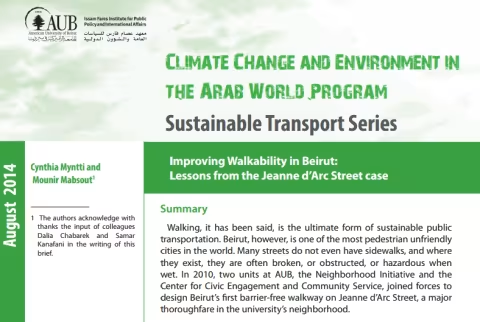
Walking, it has been said, is the ultimate form of sustainable public transportation. Beirut, however, is one of the most pedestrian unfriendly cities in the world. Many streets do not even have sidewalks, and where they exist, they are often broken, or obstructed, or hazardous when wet. In 2010, two units at AUB, the Neighborhood Initiative and the Center for Civic Engagement and Community Service, joined forces to design Beirut’s first barrier-free walkway on Jeanne d’Arc Street, a major thoroughfare in the university’s neighborhood. For more information check out IFI's Sustainable...
National
Publishing Date

Policy Brief | August 2014
Jeanne d’Arc Street; A Model Pedestrian-Friendly Street for all of Beirut by Cynthia Myntti and
Mounir Mabsout
Walking, it has been said, is the ultimate form of sustainable public transportation. Beirut, however, is one of the most pedestrian unfriendly cities in the world. Many streets do not even have sidewalks, and where they exist, they are often broken, or obstructed, or hazardous when wet. In 2010, two units at AUB, the Neighborhood Initiative and the Center for Civic Engagement and Community Service, joined forces to design Beirut’s first barrier-free walkway...

National
Publishing Date
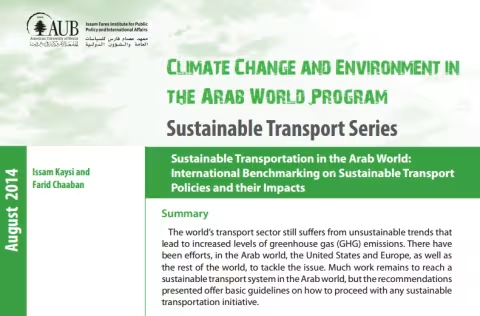
The world’s transport sector still suffers from unsustainable trends that lead to increased levels of greenhouse gas (GHG) emissions. There have been efforts, in the Arab world, the United States and Europe, as well as the rest of the world, to tackle the issue. Much work remains to reach a sustainable transport system in the Arab world, but the recommendations presented offer basic guidelines on how to proceed with any sustainable transportation initiative. For more information check out IFI's Sustainable Transportation Series
National
Publishing Date

Policy Brief | August 2014
Sustainable Transportation in the Arab World: International Benchmarking on Sustainable Transport Policies and their Impacts by Issam Kaysi and Farid Chaaban
​The world’s transport sector still suffers from unsustainable trends that lead to increased levels of greenhouse gas (GHG) emissions. There have been efforts, in the Arab world, the United States and Europe, as well as the rest of the world, to tackle the issue. Much work remains to reach a sustainable transport system in the Arab world, but the recommendations presented offer basic guidelines on how to proceed...

National
Publishing Date

Policy Brief | August 2014
Sustainable Transportation and Mega Sporting Events in Arab Countries: the Case of Qatar by Robert Wittkuhn and Danyel Reiche
​As a motive for hosting mega sporting events, Qatar is highlighting their catalyst effect for planned infrastructure developments. Qatar plans on building intra-city, inter-city and inter-state road and railway networks for the FIFA 2022 initially, and further national use. The planned transportation construction could potentially be sustainable, but the social and political buildup of Qatar hinders such a development; especially when...

National
Publishing Date

Research Report | July 2014
History of Climate Change Negotiations and the Arab Countries The Case of Egypt by Ibrahim Abdel Gelil
Even though Egypt’s share of Global Greenhouse Gases (GHGs) emissions is less than 1 %, Egypt has proved to be one of the most vulnerable countries to the potential risks of climate change. The most vulnerable sectors include coastal zones, water resources, and agriculture. Estimates show that a Sea Level Rise would lead to the permanent submersion of large areas of cropland in the Nile Delta, and accelerate the trend of desertification that is worsening the...

National
Publishing Date

Working Paper | June 2014
Climate Change in Lebanon: Higher-order Regional Impacts from Agriculture by Nadim Farajalla, Eduardo A. Haddad, Marina Camargo, Ricardo Lopes, and Flavio Vieira
This working paper analyzes the susceptibility of agricultural outputs to future climate change in Lebanon, and the extent to which it propagates to the economic system as a whole. A methodological framework in which physical and economic models are integrated for assessing the higher-order economic impacts of projected climate changes is used. The researchers then quantify the broader economic impacts in the...

National
Publishing Date

Research Report | April 2014
Impact of Population Growth and Climate Change on Water Scarcity, Agricultural Output and Food Security
This research project brought together several teams from across multiple countries to conduct a review and analysis on a wide range of complex, interconnected topics. Any one of these issues (e.g. climate change, population dynamics, food security and water security) can allow for vast and deep exploration. Seeking to integrate the concepts into unified analysis that is comprehensive and coherent is both exceptionally challenging and incredibly necessary. By...

National
Publishing Date

Research Report | April 2014
Impact of Population Growth and Climate Change on Water Scarcity, Agricultural Output and Food Security
This research project brought together several teams from across multiple countries to conduct a review and analysis on a wide range of complex, interconnected topics. Any one of these issues (e.g. climate change, population dynamics, food security and water security) can allow for vast and deep exploration. Seeking to integrate the concepts into unified analysis that is comprehensive and coherent is both exceptionally challenging and incredibly necessary. By...

National
Publishing Date

Working Paper | September 2013
Policy-making in Lebanon: Potential Offshore Oil and Gas Discoveries by Jeremy Arbid
This report follows the conclusion of the thesis research entitled “Policy-making in Lebanon: Potential Offshore Oil and Gas Discoveries” carried out with support from the Issam Fares Institute for Public Policy and International Affairs, United Nations in the Arab World Program at the American University of Beirut. The research aimed to clarify the inner workings of the policy-making process in Lebanon. Using the multiple streams framework of John Kingdon (2003), the research...

National
Publishing Date

Research Study | January 2013
Effect of Distributed Electric Power Generation on Household Exposure to Airborne Carcinogens in Beirut by Alan Shihadeh, Marc Al Helou, Najat Saliba, Sara Jaber, Nader Alaeddine, Elias Ibrahim,
Zahra Salahieh, Maher Chiit
Due to inadequate power production capacity, EDL has in recent years instituted a rotating power outage regimen in Lebanon. People and businesses have turned to privately-owned diesel generator sets for power during outages. Because these generators are located in dense urban areas, their emissions may significantly increase inhalation exposure...