We are reaching out to you—the visionaries, the tech architects, the diaspora, and the global believers—to join us as Founding Trustees ion the 961aiPivot. We don't want a "donation" that disappears into a temporary fix. We want a partnership that builds a permanent, sovereign infrastructure. We want you to stand with us as we decouple our talent from our troubles. When you partner with us, you aren't just funding a platform; you are anchoring a soul to its soil. You are proving that a nation’s spirit cannot be switched off by a power outage. You are helping us build a Lebanon that doesn't...
This package includes 3 maps pertaining to Lebanon's 2009 elections: - "confessional-distrib": showing the confessional geographic distribution of Lebanon's population - "election-results": showing the election results in West Bekaa/Rashaya and Metn areas. - "results&voters": showing the sectarian representation of parliamentary seats across Lebanon, the percentage of voters per electoral district, election results, and deputy representation per number of voters
This report aims to provide statistical and analytical tools for the recovery community working in North Lebanon, specifically those working with the Nahr el-Bared displaced and returnee population. The information will allow for better assessment of current needs and gaps, which will eventually support the development of appropriate strategies of intervention on both the short and long term.
Lebanon may witness a remarkable rise in the number of women serving in Parliament come May 2018 due to initiatives from women’s groups, “civil society” activists, and the substantial number of female candidates – 113 at the start of the election period. However, as this briefing paper shows, Lebanese women continue to face numerous challenges in entering government. The new electoral law passed in June 2017 does not provide women with equal opportunity to be elected, and it is yet to be seen whether it will increase female representation in Parliament. Nevertheless, the historic number of...
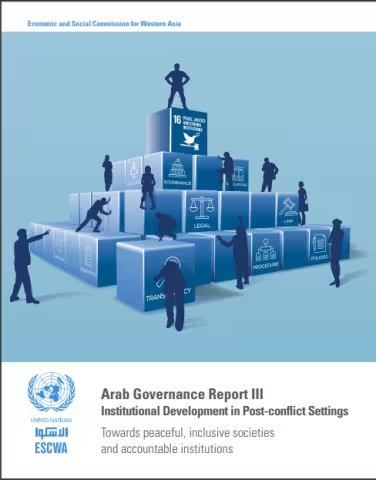
The third edition of the Arab Governance Report introduces post-war best practices from international and regional experiences. It suggests strategies and policies for Libya and Yemen that focus on the immediate aftermath once combat ceases and a future political settlement.
Economic integration is an important means to generate income and employment, to boost investment and to spur structural transformation toward more diversified and broad-based economic models.
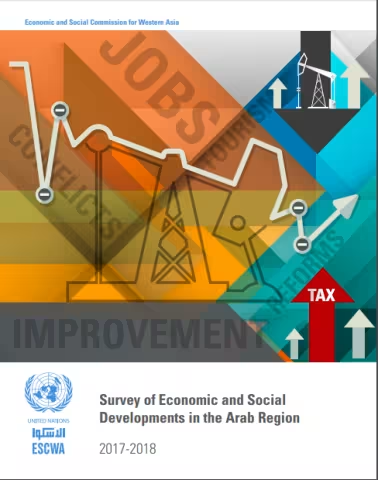
The Arab region continues to manage uncertainties on its path towards an inclusive and sustainable growth trajectory: geopolitical tensions persist, and global interest rates have soared.
The July war 2006, lasted 34 days, and led to the displacement of 915,762 (almost 25% of the Lebanese population) persons, relocating into public and private schools all over the country. With the coming into force of the cease fire in August 14th 2006, there was a rapid return of the displaced to the south.
The report examines how economic and financial policies of the EU affect the economies of Southern Mediterranean countries. It’s interesting to note the shortcomings of these policies with regard to civil and political rights.
The second report is an evaluation of civil society initiatives on economic and social rights, including a series of civil society initiatives focusing on
The report entitled challenges for civil society and the promotion of economic and social rights, brings together recommendations from civil society actors and academics to strengthen Euro-Mediterra
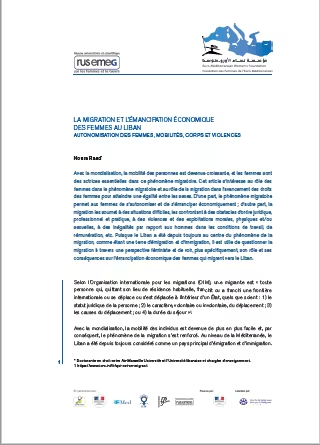
With globalisation, the mobility of people has grown, and women are essential actors in this migratory phenomenon. This article focuses on the role of women in migration and the role of migration in advancing women’s rights to achieve gender equality.
This report explores the impact of transport infrastructure and service availability and efficiency on the connectivity – the state of being connected – of GVCs.
The concept of resilience offers a framework that facilitates cross-institutional and cross-disciplinary dialogue and pushes us to examine systems that influence complex situations.
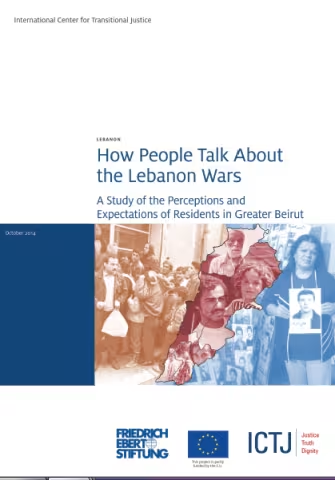
This report examines variations in wartime experiences and the attitudes of residents in Greater Beirut regarding measures to confront Lebanon’s legacy of political violence.