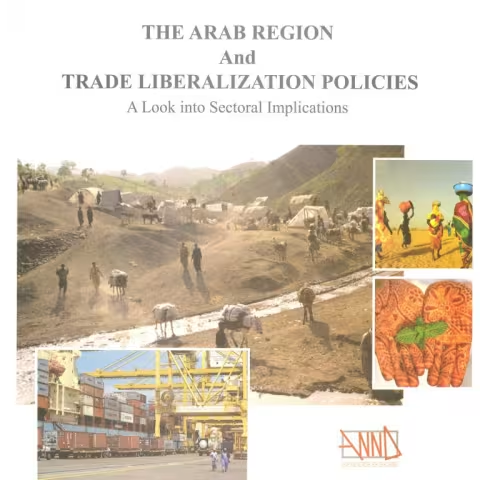
It contains 8 chapters: 1) an introduction to the general debate on trade and development, 2) an overview of the situation In the Arab region, 3) the engagement of Arab countries with the WTO, 4) Arab countries and the Euro-Mediterranean partnership, 5) Arab countries and free
UNDP, through the CEDRO project, and the Ministry of Energy & Water published the first version of the "National Wind Atlas of Lebanon" which will create a growing momentum in Lebanon towards strengthening and developing the renewable energy sector in the country.
This report will provide a description of the assessment conducted by IMC’s Mental Health and Psychosocial team in the region of Wadi Khaled following the displacement of Syrians into the northern villages between the Lebanese-Syrian borders as a result of the internal conflic
The Manual on the Internal Management of the Non Governmental Organizations (NGOs) in Lebanon aims at providing a practical tool to develop and build the capacities of the NGOs in Lebanon.
This paper seeks to explain why women remain marginal in the Lebanese economy. It conducts a thorough review of literature to shed light on the economic, social and legal context to identify barriers to their full participation.
This paper was produced by ANND and Christian Aid and contains five main sections: “Executive Summary: a crisis of multiple dimensions; the threat of explosive vulnerabilities and increasing insecurities”, “Vulnerability to poverty: the key challenges faced by the Arab region”
Following the Nahr EL Bared War, LPDC launched in 2008 a workshop mapping the recovery and development initiatives in the camp's area. They followed up in 2009 with another workshop reviewing the development projects that took place in the NBC area.
The fourth National Human Development Report, “Toward a Citizen’s State”, addresses citizenship in Lebanon through three principle perspectives: citizenship and sectarian state, socio-economic citizenship and citizenship and culture and education.
This paper examines the impact of a rise in the Value Added Tax (VAT) on poverty and inequality in Lebanon. It develops an empirical model based on consumer demand theory and uses only household survey data on expenditures and spatial price indexes.
The aim of the “Socio-Economic Assessment in Nahr el-Bared surrounding areas” report is to provide an assessment of the pre and post conflict conditions of households located in the vicinity of Nahr el Bared camp for a variety of livelihood aspects including: housing, health,
This brochure highlights UNDP’s contribution in the Early Recovery process of the Palestinian and Lebanese populations who were affected by the Nahr El Bared crisis.
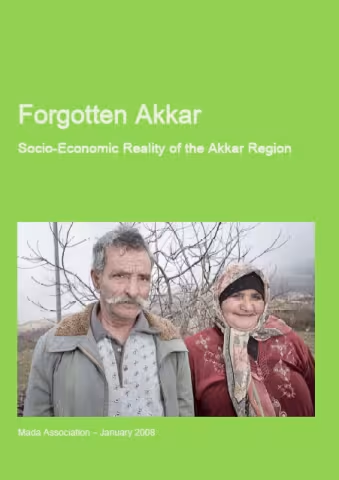
This study focuses on presenting the socio-economic reality of Akkar. It begins with a situational analysis, including an assessment measuring the impact of the July 2006 and Nahr al-Bared wars on the livelihoods of the people of Akkar.
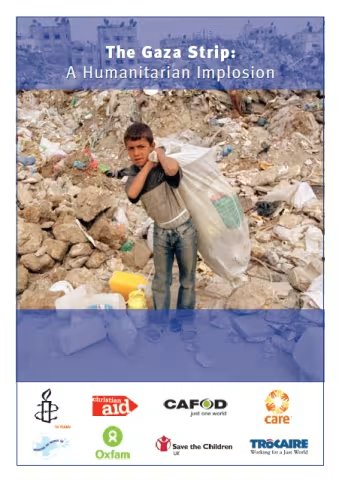
The situation for 1.5 million Palestinians in the Gaza Strip is worse now than it has ever been since the start of the Israeli military occupation in 1967.
Lebanon in Figures 2008 gathers number of social and economic indicators: About Lebanon, Population, Education, Employment, Tourism, Consumer Price Index, National Accounts...