Integrity’s research highlights that women’s networks and organisations in Syria are active across a range of service delivery sectors. In many cases these groups are either responding to gaps in services provided by other NGOs, civil society organisations (CSO), or other service delivery actors, or they are providing understanding and access to the specific needs of women and children beneficiaries that other groups cannot.
Women’s groups interviewed by Integrity are most active (62 per cent) in the education, skills training, and livelihoods sectors. These areas both help meet immediate...
This report is this first of a three-part series focusing on the current status and lessons learned relating to transitional justice and policing initiatives in opposition-controlled Syria. • Part I focuses on the effects of the departure of judicial and security elements of the Syrian state has had on conditions on the ground currently and on the nascent justice institutions that have emerged in this void (including levels of institutionalisation, Islamic law, and the legal systems currently being debated and trialed in some areas). • Part II examines the variety of institutions and...
Paris, le 13 février 2014 – Le CCFD-Terre Solidaire en partenariat avec l’Institut de relations internationales et stratégiques (IRIS), publie aujourd’hui la première édition du Baromètre des sociétés civiles – L’autre visage de la mondialisation. Ce rapport, auquel ont participé des chercheurs de l’IRIS, est le fruit de l’expertise du CCFD-Terre Solidaire qui soutient et accompagne depuis plus de 50 ans des organisations de la société civile (ONG, syndicats, organisations professionnelles, mouvements sociaux) à travers le monde et finance leurs projets.
Ce Baromètre prendra chaque année le...
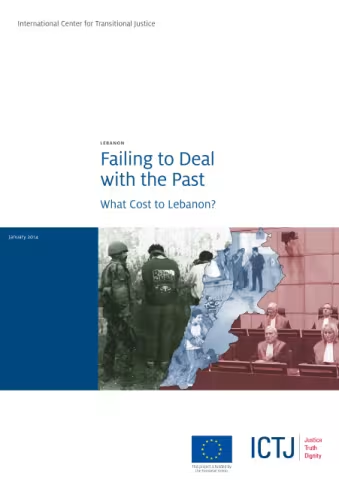
This paper examines the situation of impunity in Lebanon that has persisted since the 1975–1990 war. It highlights the price of the Lebanese authorities’ failure to address the legacy of past conflict.
This study recommends a holistic approach to crafting a comprehensive and victim-centered transitional justice process in Lebanon. An incremental approach to reform would be of value, given the likely challenges to pursuing accountability in the country. Programming must involve state and nonstate actors—political and community leaders, civil society, and the broader public. In addition, human...
Global civil society alliance, CIVICUS, has released a revised version of what is probably the world’s most comprehensive compilation of commitments made by governments on civil society rights.
Originally released in 2008, and now fully updated, the compendium consolidates various international standards and commitments made by governments at the regional and global levels to protect civil society and ensure participation in public processes.
In addition to collating relevant portions of major UN documents, the compendium also includes commitments made by regional bodies such as the Arab...
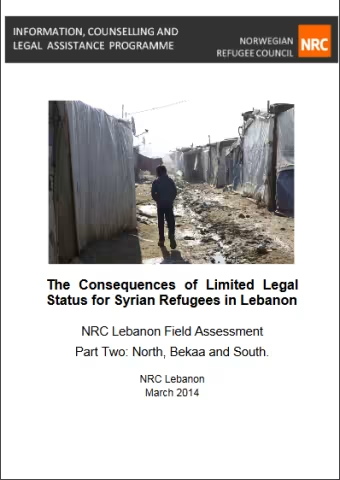
In December 2013, NRC launched a report entitled ‘The Consequences of Limited Legal Status for Syrian Refugees in Lebanon: NRC Field Assessment in Aarsal and Wadi Khaled’ (Part One) based on the findings of an assessment that NRC conducted between
Les politiques de coopération au développement des bailleurs étatiques placent de plus en plus le secteur marchand comme un acteur clé du développement, à la fois comme un partenaire financier ou opérationnel mais aussi comme un objectif en soi. Sa croissance dans les pays du Sud, que ce soit dans le domaine productif ou de la fourniture de services, y compris pour de la délégation de services publics ou l’offre de services bancaires, est considérée comme un indicateur positif. Les gouvernements des pays membres de l’UE cherchent ainsi à maximiser son rôle comme catalyseur ou «substitut» de...
Briefing papers on the preservation of cultural heritageInstitutions and individuals from the Middle East and North Africa experience many shortcomings in legislation, policies and current practices impeding the sustainable preservation of cultural heritage. In order to obtain a systematic overview and a sound basis for engaging in lobby and advocacy work for improved governance of the cultural sector, the Modern Heritage Observatory contracted local lawyers and researchers to analyze and assess current regulations, policies and practices concerning the preservation of cultural heritage in...
This report was prepared by ANND in cooperation with its member from 10 Arab countries. It is considered a result of the new direction that was followed after the revolution outbreak in the region. It is the first report of the Arab Watch for social and economic rights.
Briefing papers on the preservation of cultural heritage Institutions and individuals from the Middle East and North Africa experience many shortcomings in legislation, policies and current practices impeding the sustainable preservation of cultural heritage.
This report constitutes the final publication of the outcomes of the program "Development in Lebanon: Poverty Eradication, Gender Equity and Youth Participation; the Role of NGOs Civil Society and Other Actors".
The Manual on the Internal Management of the Non Governmental Organizations (NGOs) in Lebanon aims at providing a practical tool to develop and build the capacities of the NGOs in Lebanon.
The “Review of the Public Procurement Legal Framework in Lebanon” introduces the Sustainable Public Procurement (SPP) in Lebanon and elaborates on the legal of the country’s procurement and sustainability laws that may offer a legal possibility for the adoption of SPP principl
UNDP Strengthening Civil Peace in Lebanon Project has been supporting the process of the establishment of a national civil society platform on civil peace since 2011, consisting of 10 national organizations,taking into account past experiences and emerging lessons learnt.
This thesis investigates transnational campaigns from the international and state level to consider the existence of transnational activism in Lebanon’s women’s movement.
This book tackles key Issues of concern within the aid discussion. It outlines issues of particular importance for civil society in the Arab region and highlights the difference of prospectives between government representatives and CSOs.
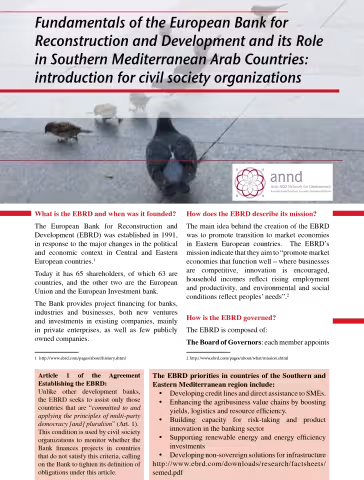
The European Bank for Reconstruction and Development (EBRD) was established in 1991, in response to the major changes in the political and economic context in Central and Eastern European countries.1 Today it has 65 shareholders, of which 63 are countries, and the other two ar