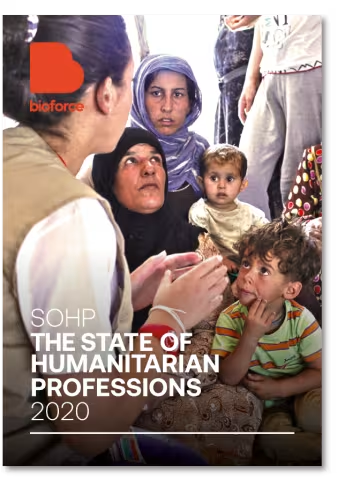
The State of Humanitarian Professions 2020 (SOHP) is the result of a year-long consultation with more than 1,500 humanitarian professionals. For the first time, this study gathers and analyses key figures on 24 humanitarian professions, as well as on recruitment practices and professional development in the sector. In addition, the SOHP study demonstrates the need to coordinate on the challenges of professionalising humanitarian teams, with 19 recommendations to be discovered in the final report.
The articles gathered in this dossier offer insights, based on case studies, into the transformation of the “associative sector” in Lebanon, a sector generally seen to be at the core of an increasingly active civil society.
The objective of the Civil Society Review is to bring civil society practitioners, experts, activists, and researchers together to develop knowledge, as well as to innovate new tools and practices so as to strengthen Lebanon’s civil society and its voice. The Civil Society Review produces evidence-based research and analysis and disseminates findings and recommendations to promote civic engagement, shape policies, and stimulate debate within civil society spheres in Lebanon.
This report presents qualitative data collected by ICTJ on how individuals in Greater Beirut talk about the Lebanon wars and the need for truth, justice, and an end to violence in their country.
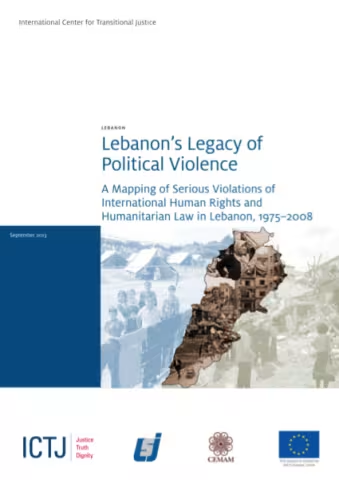
This report compiles information on hundreds of incidents of serious human rights violations that occurred in Lebanon from 1975 to 2008, including mass killings, enforced disappearances, assassinations, forced displacement, and the shelling of civilian areas.
The “Review of the Public Procurement Legal Framework in Lebanon” introduces the Sustainable Public Procurement (SPP) in Lebanon and elaborates on the legal of the country’s procurement and sustainability laws that may offer a legal possibility for the adoption of SPP principl
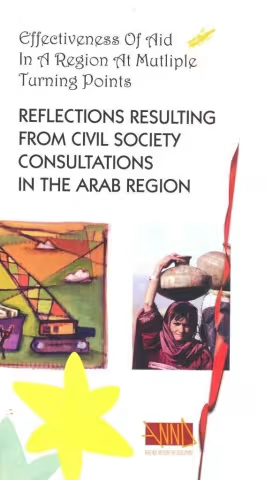
This book tackles key Issues of concern within the aid discussion. It outlines issues of particular importance for civil society in the Arab region and highlights the difference of prospectives between government representatives and CSOs.
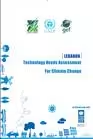
The report looks at different technologies related to the power, transport, agriculture and water sectors in Lebanon and assess their potential to reduce greenhouse gas emissions and increase resilience to climate change.
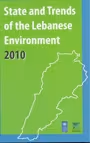
The State and Trends of the Lebanese Environment report provides an overview of the current condition of natural resources and environmental management in the country. Furthermore, it gives an analysis of past and future developments across multiple different sectors.
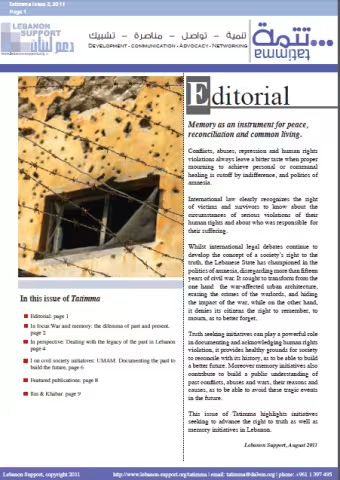
Conflicts, abuses, repression, and human rights violations always leave a bitter taste when proper mourning to achieve personal or communal healing is cutoff by indifference, and politics of amnesia.
This paper examines the impact of a rise in the Value Added Tax (VAT) on poverty and inequality in Lebanon. It develops an empirical model based on consumer demand theory and uses only household survey data on expenditures and spatial price indexes.
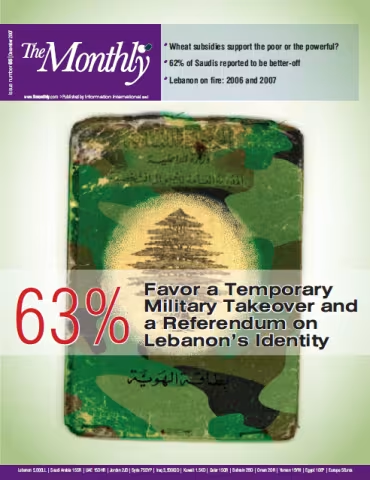
The Lebanese people are divided behind their zu'ama (leaders), who always disagree over national and critical matters in order to protect their status and interests.
“Moukhtar” booklet provides guidelines for municipality leaders and mayors, on how to effectively implement practices and procedures that would benefit the local community, whether in regular daily activities or in conflict situations.
The Universal Declaration of Human Rights, proclaimed by the United Nations General Assembly on 10 December 1948, grants to everyone the right to seek, receive and impart information and ideas through any media and regardless of borders (Article 19).
In the framework of “Towards a National Dialogue on Corruption in Lebanon”, the United Nations Development Programme and the Lebanese Transparency Association were able to lay down the foundation of anti-corruption modules as translated into the document entitled “Towards a Na