This report examines both the historical development and current situation of Syrians working in Lebanon through the analysis of policies established and implemented by the Lebanese government. While the report is not an assessment of these policies, it nevertheless reflects on its impact on Syrians’ working conditions and livelihoods. In this vein, this report notably focuses on emerging dynamics of increased informality, exploitation, and dependence.
It is part of a series of reports to be published in 2016, the 1st of which being "Formal Informality, Brokering Mechanisms, and Illegality...
يهدف هذا الدليل الثنائي اللغة للتزويد بالأدوات والمهارات لتأسيس مجموعة أومؤسسة وتنظيم عملها في لبنان، ونُشرَ ضمن مشروع قاعدة المعرفة حول المجتمع المدني، بالشراكة مع الوكالة السويسرية للشراكة والتعاون (SDC).
يجمع تصميم الدليل بين اللغتين العربية والانكليزية من أجل التأكد من وصوله لأكبر عدد ممكن من الفاعلين. وقد صمّمته نايلا يحيا.
This resource published within Lebanon Support's Humanitarian Knowledge Base, in partnership with the Swiss Agency for Development and Cooperation (SDC), aims to provide the tools and know-how to establish an organisation or collective and operate in Lebanon. It provides the basics relevant to establishing and running an NGO or unregistered group in Lebanon.
The Guidebook, designed by Nayla Yehia, presents the information in both English and Arabic so that it has a wider reach.
This resource published within Lebanon Support's Humanitarian Knowledge Base, in partnership with the Swiss Agency for Development and Cooperation (SDC)
Bringing together the years of regional and international experience within civil society activities, Besme was settled in Lebanon in September 2014, in order to contribute to the peaceful settlement of regional conflicts in Middle East. Through a route, which is full of difficulties, we managed to leave the year of 2015 behind, with successful and effective projects. We reckon 2015 as a year of investment for Besme. Reinvigorating the individual connections of management team at national, regional and international levels, we assume that a great step forward was taken for future. In the road...
The 2015 Global Humanitarian Assistance (GHA) Report highlights that in 2013, 147 countries received humanitarian assistance, with countries from the Arab region, particularly those affected by the Syrian crisis, being the highest beneficiaries of aid.
Local actors experience conflicts first hand. Therefore, they have an intimate understanding of what conflict dynamics need to be addressed in order to build sustainable peace.
Over 250,000 migrant women are employed by private households in Lebanon to carry out household tasks such as cleaning, cooking, and caring for children and the elderly.
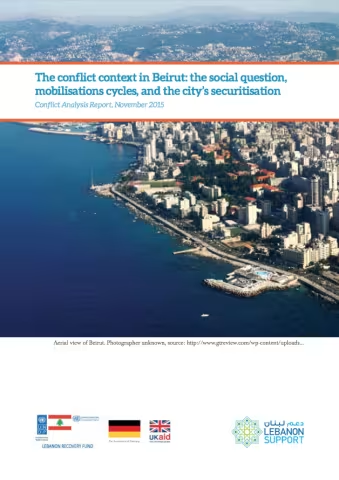
This report provides an analysis of the history and current situation of the conflict context, actors and dynamics in Beirut, Lebanon. The report seeks to shed light on the main actors, topics of contestation, conflict and mobilisation in its historical becoming as well as current expressions. The report includes a special focus on the social question, subsequent political and social mobilisation, gender issues, the securitisation of the city, as well as the interactions between the Lebanese host community and Syrian refugees and their unfolding within the last four years (since 2011).
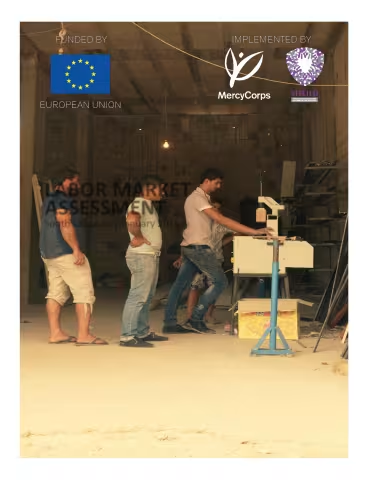
This study was based on a comprehensive assessment of the vocational needs as well as the labor absorption capacity mainly with business owners in the area of intervention and individual workers and vocational trainings candidates following different assessment and data collection methodologies such as key informant interviews, focus groups, and individual assessments
ينتمي مفهوم المجتمع المدني إلى تلك المجموعة من المفاهيم التي كلما زاد حضورها في حياة الناس زاد عليهم غموضها، ما يحوّلها إلى أيقونة يحتشد الناس انتصارا لها وينبرون للدفاع عنها، خاصة في بلدان الاستبداد حيث يُحاصر المجتمع المدني ويُضَيّق عليه الخناق حتى يكاد يختنق ويتلاشى. والواقع أن لمفهوم المجتمع المدني دلالات متغيرة بتغيّر الأوضاع التي تمر بها الدولة والمجتمع. كذا هو الحال في منتقطنا حيث تختلف دلالة المجتمع المدني إبان بداية أحداث العنف اختلافا جذريا عما كانت عليه قبلها وكذلك عما آلت إليه الأوضاع اليوم. لكن يبقى وجود مجتمع مدني حر وفاعل شرطا أساسيا لتحقيق الديمقراطية المنشودة، ولا يبدو هذا...
The objective of the Civil Society Review is to bring civil society practitioners, experts, activists, and researchers together to develop knowledge, as well as to innovate new tools and practices so as to strengthen Lebanon’s civil society and its voice. The Civil Society Review produces evidence-based research and analysis and disseminates findings and recommendations to promote civic engagement, shape policies, and stimulate debate within civil society spheres in Lebanon.
This paper is inspired by examples of domestic workers organizing themselves in different parts of the world through social and solidarity economy enterprises and organizations which have become more evident since the advent of the ILO Domestic Workers Convention 2011, (No.189
Launched on 12 December 2014, the Core Humanitarian Standard on Quality and Accountability (CHS) describes the essential elements of principled, accountable and quality humanitarian action.
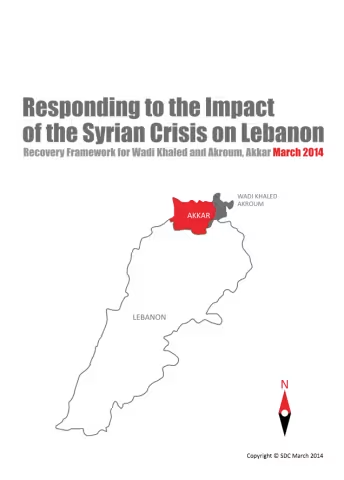
The Swiss Agency for Development and Cooperation (SDC) is pleased to share with you the report:
“Responding to the Impact of the Syrian Crisis on Lebanon: Recovery Framework for Wadi Khaled and Akroum, Akkar”, March 2014.
SDC facilitated a process to shed light on the impact of the Syria crisis at the national level but also on the local level. The formulation of a recovery framework for Wadi Khaled and Akroum is a process that can be replicated for other affected regions of Lebanon.
The findings and recommendations are based on consultations (between October 2013 and January 2014) with...