This paper examines the situation of impunity in Lebanon that has persisted since the 1975–1990 war. It highlights the price of the Lebanese authorities’ failure to address the legacy of past conflict.
This study recommends a holistic approach to crafting a comprehensive and victim-centered transitional justice process in Lebanon. An incremental approach to reform would be of value, given the likely challenges to pursuing accountability in the country. Programming must involve state and nonstate actors—political and community leaders, civil society, and the broader public. In addition, human...
This report examines the situation of impunity in Lebanon that has persisted since the 1975-1990 war through the lenses of core elements of transitional justice.
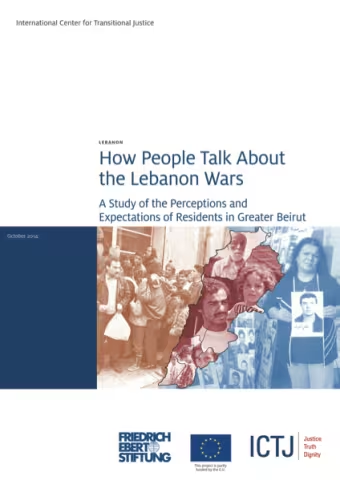
This report examines variations in wartime experiences and the attitudes of residents in Greater Beirut regarding measures to confront Lebanon’s legacy of political violence.
This report presents qualitative data collected by ICTJ on how individuals in Greater Beirut talk about the Lebanon wars and the need for truth, justice, and an end to violence in their country.
Over three years after it began, the Syria crisis continues to weigh extremely heavily upon Lebanon. Around a quarter of its population is now made up of refugees, whose needs remain dire even as the resources available to address them appear to be shrinking.
This paper discusses the risk of a renewed civil strife in Lebanon as a result of the Syrian Crisis. It argues that the security situation inside Lebanon could deteriorate due to three interrelated spillover effects stemming from Syria’s ongoing civil war.
تسعى هذه السلسة إلى أن تكون مدماكا في بنيان الذاكرة الجمعية السورية في زمن الأزمة الكبرى التي تعصف بها . السلسلة مفتوحة أمام الجميع دون أي تمييز في الميول السياسية أو الإيديولوجية .
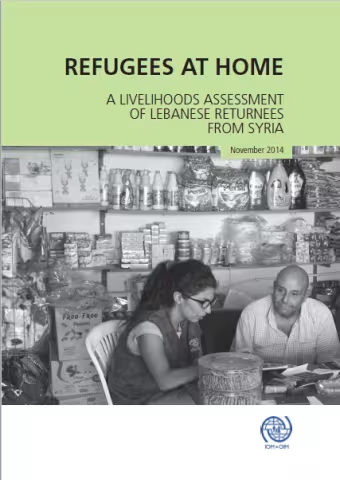
Since March 2012, several towns and villages in the North, the Bekaa and the South started receiving Lebanese families who fled Syria, against the backdrop of sectarian conflicts. Most of those families left their hometown decades ago and got Syrian citizenship.
The purpose of the needs assessment conducted in the Bekaa area is to identify the needs of Syrian refugees (SR), in terms of food, non food items (NFIs), shelter, water and education.
The average number of assisted families during the a/m period is 46% of the overall number of families reportedly arrived to DRC North Lebanon operational area (Akkar region).
The average number of assisted families during the a/m period is 35% of the overall number of families reportedly arrived to DRC Bekaa operational area.
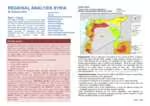
This Regional Analysis of the Syria Conflict (RAS) seeks to bring together information from all sources in the region and provide holistic analysis of the overall Syria crisis.