This report is the result of 4 weeks’ field work from April 22 to May 17 carried out in the two districts of Zgharta and Minieh-Dennieh by SOLIDARITÉS INTERNATIONAL’s (SI) outreach workers.
Since Syria’s Arab Spring events began in March 2011, the Syrian Observatory for Human Rights estimates that the death toll has surpassed 21,000 people, mostly civilians, who have been killed in unrelenting violence in certain areas of the country1.
This book tackles key Issues of concern within the aid discussion. It outlines issues of particular importance for civil society in the Arab region and highlights the difference of prospectives between government representatives and CSOs.
The human rights situation in the Syrian Arab Republic has deteriorated significantly since November 2011, causing further suffering to the Syrian people. Widespread violence and increasingly aggravated socio-economic conditions have left many communities in a perilous state.
28 refugee households were surveyed, which represented a total of 501 refugees, 48% male and 52% female, which is approximately 11% of the Syrian refugee population in North Bekaa.
The National Report for the United Nations Conference on Sustainable Development (Rio + 20) presents the current situation as is and highlights the achievements and failures, strengths and weaknesses, opportunities and risks.
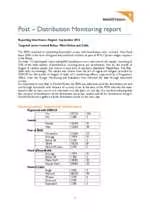
The PDM consisted of conducting household surveys with beneficiaries who received Non-Food Items (NFIs in the form of hygiene kits) and food vouchers as part of WVL's Syrian refugee response in the Bekaa.
The Strategic Planning is based on the findings of fieldwork carried out in several villages in Dinnieh, which aimed at identifying the major characteristics of the region in different fields.
The overall objective of the assessment was to identify emergency WASH needs and gaps of most vulnerable Syrian refugees and host families in five geographical areas, 4 collective centres and Bab al-Tebbaneh, Tripoli in North Lebanon.
UNHCR, coordinating the operations in the North along side with the HRC (High Relief Commission) and DRC as its main implementing partner, requested from DRC to conduct a first rapid assessment in the Bekaa with the following objectives: a) To identify existing areas of displa
The State and Trends of the Lebanese Environment report provides an overview of the current condition of natural resources and environmental management in the country. Furthermore, it gives an analysis of past and future developments across multiple different sectors.
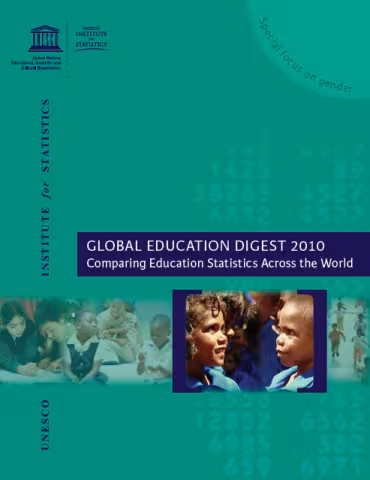
This edition of the Global Education Digest (GED) explores the changing patterns in gender and schooling throughout the formal education system – from primary to tertiary education levels.
Following the Nahr EL Bared War, LPDC launched in 2008 a workshop mapping the recovery and development initiatives in the camp's area. They followed up in 2009 with another workshop reviewing the development projects that took place in the NBC area.
Review of marginalisation of people with disabilities in Lebanon, Syria and Jordan. Using a social exclusion conceptual framework, this paper identifies several causes of marginalization of people with disabilities in the context of the MENA region.
This Country Study is based on a full national report that is the first to draw a profile of poverty in Lebanon based on money-metric poverty measurements of household expenditures.