Disability & Vulnerability Focal Point (DVFP) have been developed based on the observation that one of the greatest difficulties following a crisis is not only to identify and to access to vulnerable people including people with disabilities, but also to accompany them wit
The human rights situation in the Syrian Arab Republic has deteriorated significantly since November 2011, causing further suffering to the Syrian people. Widespread violence and increasingly aggravated socio-economic conditions have left many communities in a perilous state.
As of the end of April 2012, the number of Syrian families displaced in the Bekaa has increased to 2,800 households. Families registered with local partners receive kits of dry food, but they have requested more variety and choice in food items.
28 refugee households were surveyed, which represented a total of 501 refugees, 48% male and 52% female, which is approximately 11% of the Syrian refugee population in North Bekaa.
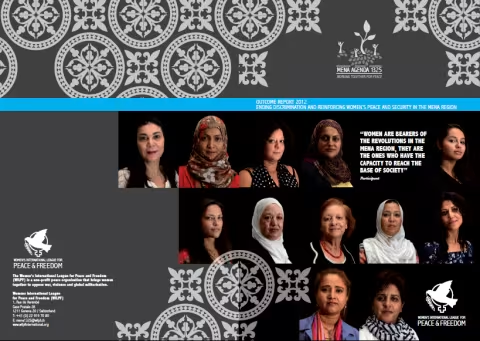
ABAAD-Resource Center for Gender Equality, in partnership with Women's League for International Peace and Freedom (WILPF) and in collaboration with the United Nations Interim Forces (UNFIL) in South Lebanon, organized the National Consultation Meeting on May 10th, 2012 at Holi
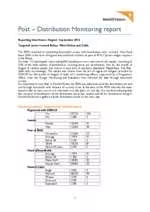
The PDM consisted of conducting household surveys with beneficiaries who received Non-Food Items (NFIs in the form of hygiene kits) and food vouchers as part of WVL's Syrian refugee response in the Bekaa.
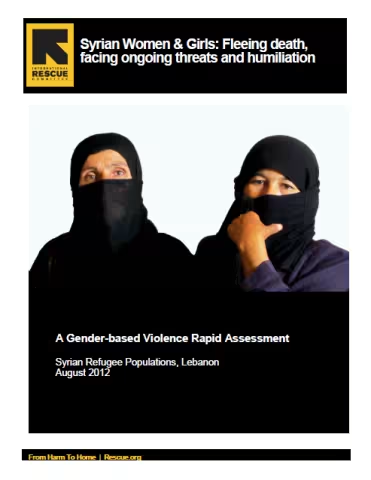
This Gender-based Violence Rapid Assessment conducted by International Rescue Committee in 2012 focuses on risks and violence faced by women and girls among the Syrian refugee population within Lebanon.
Research Paper | October 2011
A Case Study on Lebanon’s National Strategy for Forest Fire Management Elissar Harati and Hana A. El‐Ghali
The case study on Lebanon’s forest fire policy aims to trace the policy-formulation process which led to the National Strategy for Forest Fire Management. The policy represents a successful example of a civil society organization, namely a nongovernmental organization (NGO) specialized in reforestation activities, influencing policy-making through research and advocacy. The mandate of forest fires falls under the jurisdiction of a number of institutions...
Research Paper | October 2011
A Case Study on Lebanon’s National Strategy for Forest Fire Management Elissar Harati and Hana A. El‐Ghali
The case study on Lebanon’s forest fire policy aims to trace the policy-formulation process which led to the National Strategy for Forest Fire Management. The policy represents a successful example of a civil society organization, namely a nongovernmental organization (NGO) specialized in reforestation activities, influencing policy-making through research and advocacy. The mandate of forest fires falls under the jurisdiction of a number of institutions...
UNHCR, coordinating the operations in the North along side with the HRC (High Relief Commission) and DRC as its main implementing partner, requested from DRC to conduct a first rapid assessment in the Bekaa with the following objectives: a) To identify existing areas of displa
هذه الدراسة تم انجازها عام 2010، من قبل عزّة شرارة بيضون، بدعم من منظمتي أوكسفام برطانيا(OXFAM) و كفى عنف و استغلال و بتمويل من UNTRUSTED FUND ضمن إطار مشروع "تطوير مقاربات و استراتيجيات العمل مع الرجال لمناهضة العنف المنزلي في الشرق الاوسط".
The starting point for the present Report is that, since the publication of the first volume in the series, the region’s human development fault lines have grown more complex, and in some cases deepened.
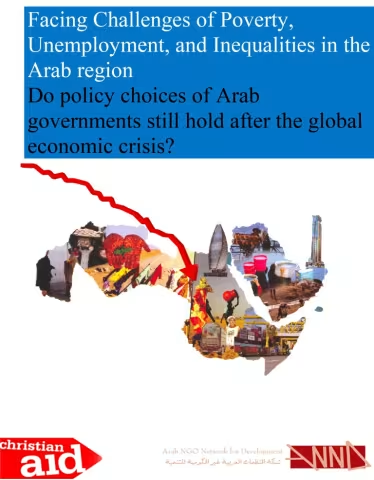
This paper was produced by ANND and Christian Aid and contains five main sections: “Executive Summary: a crisis of multiple dimensions; the threat of explosive vulnerabilities and increasing insecurities”, “Vulnerability to poverty: the key challenges faced by the Arab region”