The “Review of the Public Procurement Legal Framework in Lebanon” introduces the Sustainable Public Procurement (SPP) in Lebanon and elaborates on the legal of the country’s procurement and sustainability laws that may offer a legal possibility for the adoption of SPP principl
This book tackles key Issues of concern within the aid discussion. It outlines issues of particular importance for civil society in the Arab region and highlights the difference of prospectives between government representatives and CSOs.
The National Report for the United Nations Conference on Sustainable Development (Rio + 20) presents the current situation as is and highlights the achievements and failures, strengths and weaknesses, opportunities and risks.
The Strategic Planning is based on the findings of fieldwork carried out in several villages in Dinnieh, which aimed at identifying the major characteristics of the region in different fields.
The State and Trends of the Lebanese Environment report provides an overview of the current condition of natural resources and environmental management in the country. Furthermore, it gives an analysis of past and future developments across multiple different sectors.
Accountability has many meanings. Traditionally, it was understood as the was in which those who authorised others to act on their behalf made sure that authority was being used as agreed.
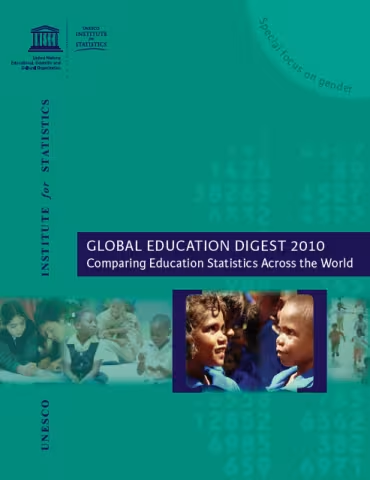
This edition of the Global Education Digest (GED) explores the changing patterns in gender and schooling throughout the formal education system – from primary to tertiary education levels.
The Manual on the Internal Management of the Non Governmental Organizations (NGOs) in Lebanon aims at providing a practical tool to develop and build the capacities of the NGOs in Lebanon.
Review of marginalisation of people with disabilities in Lebanon, Syria and Jordan. Using a social exclusion conceptual framework, this paper identifies several causes of marginalization of people with disabilities in the context of the MENA region.
This Country Study is based on a full national report that is the first to draw a profile of poverty in Lebanon based on money-metric poverty measurements of household expenditures.
The Israeli July 2006 war exposed the Lebanese population to disastrous conditions. It has profoundly affected residents’ livelihoods through bringing down access to services, infrastructure and natural resources. Responding to these emerging problems poses further challenges for the Lebanese government and society. In this respect, different emergency measures have been undertaken to address the arising needs, starting with assessing physical, economic and social damages.
As a contribution to identifying short and medium term intervention needs, the World Bank initiated undertaking a Post...
“Moukhtar” booklet provides guidelines for municipality leaders and mayors, on how to effectively implement practices and procedures that would benefit the local community, whether in regular daily activities or in conflict situations.
Pcode is an abbreviated term for 'Place Code'. P-codes are similar to zip codes and postal codes and are part of a data management system that provides unique reference codes to over a thousand locations in the Darfur region.
This article addresses the public policy concept of gender mainstreaming and the extent of its efficacy since the 1995 Beijing Platform for Action (PfA) and the UN's adoption thereof in 1997.
The Universal Declaration of Human Rights, proclaimed by the United Nations General Assembly on 10 December 1948, grants to everyone the right to seek, receive and impart information and ideas through any media and regardless of borders (Article 19).
Why would a reference book addressing non-governmental organizations (NGOs) of different sizes, interests, and functions begin with a discussion on development?
A simple answer to this very relevant question is that development is the ultimate aim and objective that underlies the work of each and every NGO, association, trade union, and civil society institution. In other words, development is a common ground for all these organizations, as well as the long-term goal that enables them to broaden their range of activities, to cooperate with others, and to expand their scope from the local to...
This reference book includes chapters on resources, legal and integral frameworks, and the constitutional structure of NGOs. It aims at contributing to reinforce the role of civil society in the economic and social development of Lebanon.