Severe weather struck the country this week, affecting Syrian refugees sheltered in the mountain region of Bekaa. Heavy rains and snowfall have flooded some settlements, and a number of refugee families were forced to seek shelter elsewhere.
The objective of the project is to improve the housing conditions of the most vulnerable people affected by the Syrian crisis and to reduce their vulnerability to face the winter season.
This report is the result of 4 weeks’ field work from April 22 to May 17 carried out in the two districts of Zgharta and Minieh-Dennieh by SOLIDARITÉS INTERNATIONAL’s (SI) outreach workers.
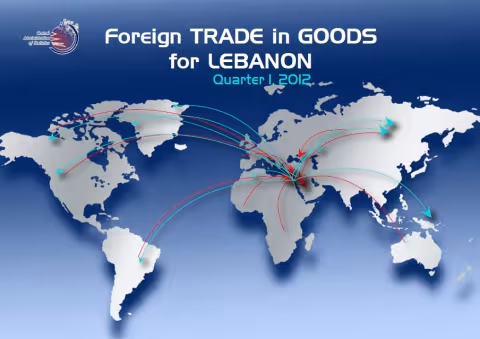
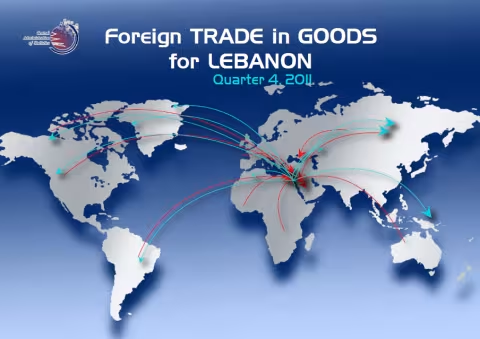
The value of Lebanese imports of goods in Quarter Q1 year 2012 was 9346 billion LBP. This was 518 billion LBP, 5.9% higher than imports in Q4 of previous year 2011, and 2162 billion LBP, i.e. 30% increase comparing to the same Quarter Q1 of year 2011.
The European Bank for Reconstruction and Development (EBRD) was established in 1991, in response to the major changes in the political and economic context in Central and Eastern European countries.1 Today it has 65 shareholders, of which 63 are countries, and the other two ar
The EIB is the European Union’s bank. It is the financing institution of the EU founded in 1958 by the Treaty of Rome and owned by the 27 EU member states. The EIB is headquartered in Luxembourg and has a network of local and regional offices in Europe and beyond.
28 refugee households were surveyed, which represented a total of 501 refugees, 48% male and 52% female, which is approximately 11% of the Syrian refugee population in North Bekaa.
The PDM consisted of conducting household surveys with beneficiaries who received Non-Food Items (NFIs in the form of hygiene kits) and food vouchers as part of WVL's Syrian refugee response in the Bekaa.
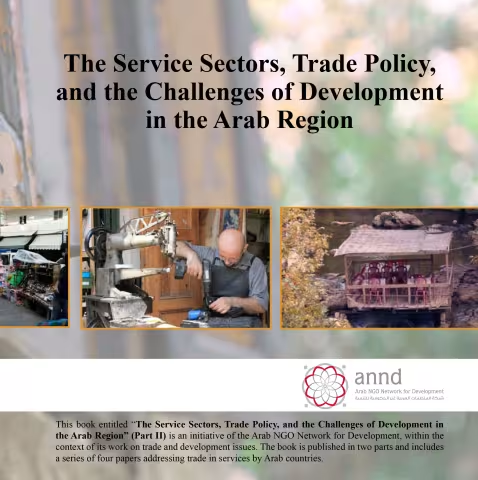
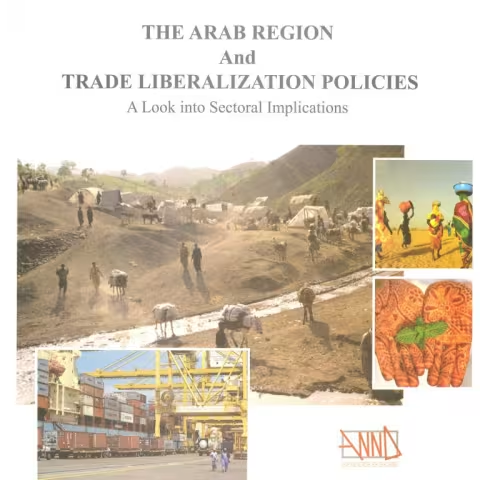
This book entitled “The Service Sectors, Trade Policy, and the Challenges of Development in the Arab Region” (Part II) is an initiative of the Arab NGO Network for Development, within the context of its work on trade and development issues.
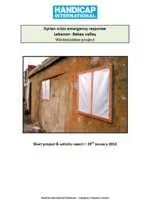
This mission was undertaken from 19 March to 5 April 2012 to assess the shelter options for displaced Syrians in West and Middle Bakaa. The shelter needs must be evaluated with respect to the current situation.
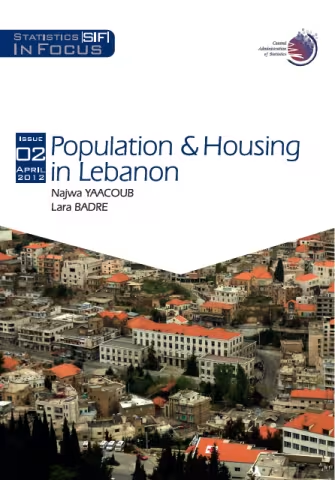
This issue of SIF looks briefly at the population and housing characteristics in Lebanon using key indicators and figures available from a number of surveys conducted by the Central Administration of Statistics (CAS) in Lebanon in recent years.
It contains 8 chapters: 1) an introduction to the general debate on trade and development, 2) an overview of the situation In the Arab region, 3) the engagement of Arab countries with the WTO, 4) Arab countries and the Euro-Mediterranean partnership, 5) Arab countries and free
This mission was undertaken between the 2nd and 18thof July 2011 to assess the shelter options for the Syrians displaced in Northern Lebanon (the Akkar region).
The value of exports from Lebanon in Quarter 4 2011, was LBP 2,052 billion. This was LBP 72 billion, 3.4%, lower than exports in Q3 2011 and LBP 148 billion, 6.7%, lower than exports in the same quarter last year.
UNHCR, coordinating the operations in the North along side with the HRC (High Relief Commission) and DRC as its main implementing partner, requested from DRC to conduct a first rapid assessment in the Bekaa with the following objectives: a) To identify existing areas of displa