The third toolbox: Institutionalizing Conflict Sensitivity at the Organizational Level aims to ensure that organizations working within the humanitarian and stabilization response in Lebanon can better integrate the concept of conflict sensitivity and its principles at all aspects and levels across an organization’s structure, procedures, and policies.
The three CS Guidance notes cover 3 essential areas; Getting started with CS in Lebanon; CS in Project Design Cycle; and CS Procurement, Recruitment, and accountability.
The three CS Guidance notes cover 3 essential areas; Getting started with CS in Lebanon; CS in Project Design Cycle; and CS Procurement, Recruitment, and accountability.
The three CS Guidance notes cover 3 essential areas; Getting started with CS in Lebanon; CS in Project Design Cycle; and CS Procurement, Recruitment, and accountability.
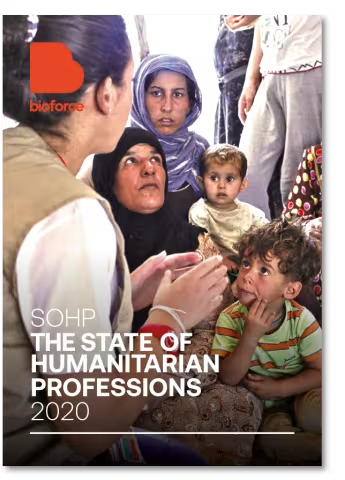
The State of Humanitarian Professions 2020 (SOHP) is the result of a year-long consultation with more than 1,500 humanitarian professionals. For the first time, this study gathers and analyses key figures on 24 humanitarian professions, as well as on recruitment practices and professional development in the sector. In addition, the SOHP study demonstrates the need to coordinate on the challenges of professionalising humanitarian teams, with 19 recommendations to be discovered in the final report.
Maps of businesses open in Nahr El Bared's adjacent area including food production businesses, construction and hardware industries, beauty and entertainment enterprises, and health, education and communication businesses.
Integrity’s research highlights that the truces agreed in several locations across Syria in the early months of 2014 do not represent the localised beginnings of a peacebuilding process. These agreements—and the negotiation and implementation processes that delivered them—were not built upon good practice and were significantly undermined by a lack of political will for peace from the outset. For opposition stakeholders, the truce agreements were a reaction to extreme levels of civilian suffering and a military capacity weakened by lengthy, government-enforced sieges. In all areas researched...
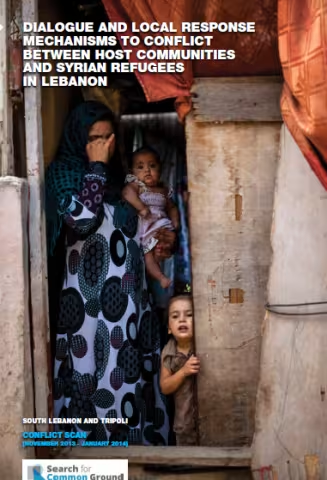
During the current conflict in Syria, Lebanon has borne the brunt of a severe refugee crisis. As the conflict in Syria rages and takes on new dimensions the number of Syrian refugees flowing into Lebanon continues to rise.
UNDP Strengthening Civil Peace in Lebanon Project has been supporting the process of the establishment of a national civil society platform on civil peace since 2011, consisting of 10 national organizations,taking into account past experiences and emerging lessons learnt.
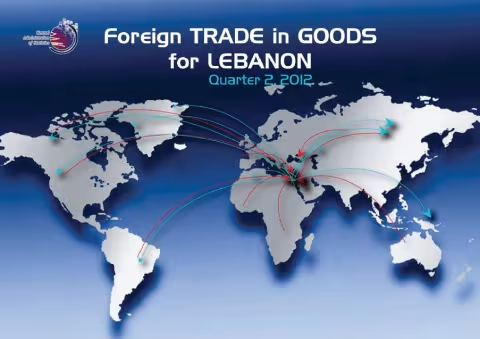
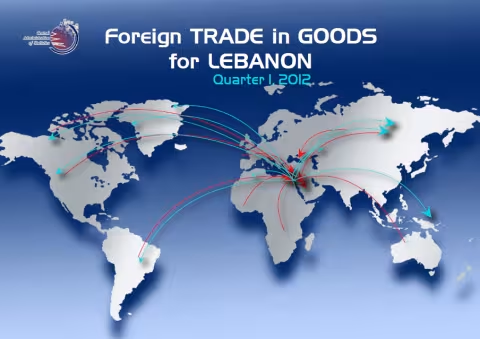
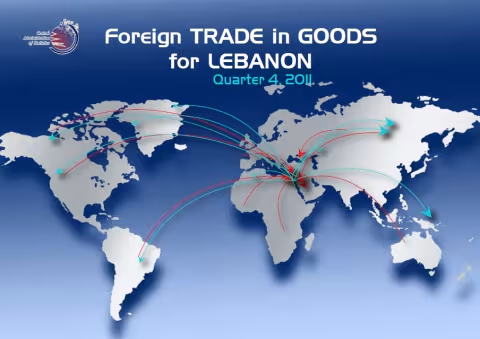
The value of Lebanese imports of goods in Quarter Q1 year 2012 was 9346 billion LBP. This was 518 billion LBP, 5.9% higher than imports in Q4 of previous year 2011, and 2162 billion LBP, i.e. 30% increase comparing to the same Quarter Q1 of year 2011.
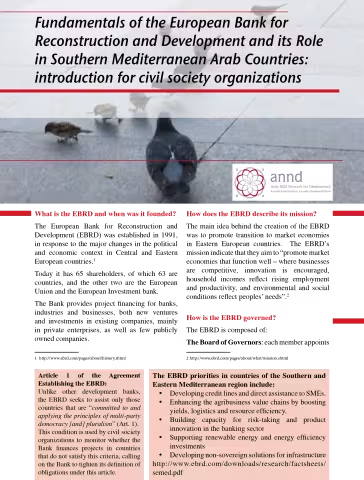
The European Bank for Reconstruction and Development (EBRD) was established in 1991, in response to the major changes in the political and economic context in Central and Eastern European countries.1 Today it has 65 shareholders, of which 63 are countries, and the other two ar
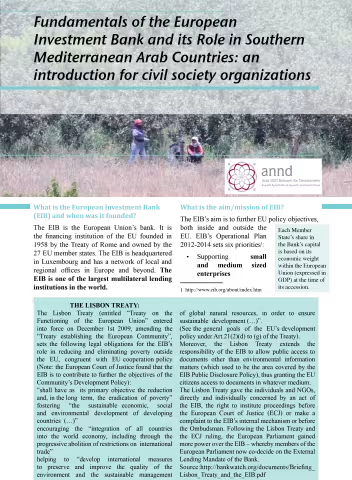
The EIB is the European Union’s bank. It is the financing institution of the EU founded in 1958 by the Treaty of Rome and owned by the 27 EU member states. The EIB is headquartered in Luxembourg and has a network of local and regional offices in Europe and beyond.
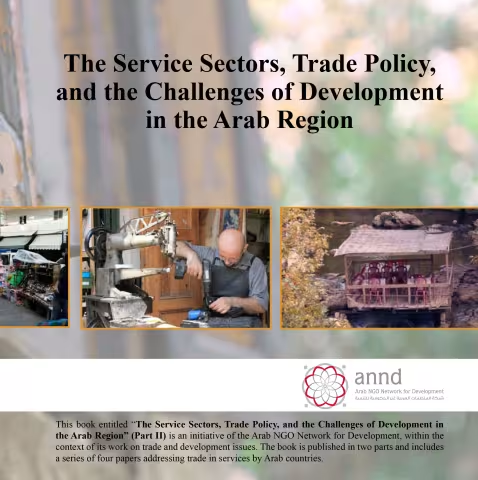
This book entitled “The Service Sectors, Trade Policy, and the Challenges of Development in the Arab Region” (Part II) is an initiative of the Arab NGO Network for Development, within the context of its work on trade and development issues.
The Strategic Planning is based on the findings of fieldwork carried out in several villages in Dinnieh, which aimed at identifying the major characteristics of the region in different fields.
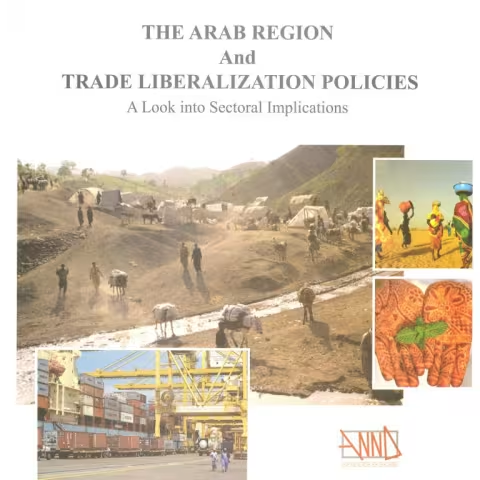
It contains 8 chapters: 1) an introduction to the general debate on trade and development, 2) an overview of the situation In the Arab region, 3) the engagement of Arab countries with the WTO, 4) Arab countries and the Euro-Mediterranean partnership, 5) Arab countries and free
The value of exports from Lebanon in Quarter 4 2011, was LBP 2,052 billion. This was LBP 72 billion, 3.4%, lower than exports in Q3 2011 and LBP 148 billion, 6.7%, lower than exports in the same quarter last year.