Research and Policy Memo #2 | October 2008
Palestinian Camps and Refugees in Lebanon: Priorities, Challenges and Opportunities AheadRichard Cook
PrioritiesAs a humanitarian agency, the United Nations Relief and Works Agency (UNRWA) is not mandated to play a political role. However, it views a political solution to the Palestinian-Israeli conflict and the related refugee crisis as paramount. Until a political solution is found, UNRWA will first and foremost continue to work on improving the status of the Palestinian refugee community in Lebanon.
UNRWA’s main priorities are to call for a change...
مذكرات للباحثين وصنّاع القرار (1) | حزيران 2008
على الدول المضيفة للاجئين معاملتهم بسياسات خاصة تميزهم لكن لا تعزلهمكارين أبو زيد
ذكرت المسؤولة العليا لشؤن للاجئين الفلسطينيين في الأمم المتحدة أنه على الدول العربية المضيفة لاجئين أن تقرن قوانينها وتشريعاتها المحلية بافضل الممارسات الموجودة عالمياً، بينما تحفظ، في الوقت ذاته، لاجئين هويتهم الجماعية المختلفة التي فرضتها ستون عاماً من المنفى. وأضافت أن القوانين المحليات التي تحكم حياة اللاجئين في عدة بلدان عربية تنطوي على انتهاكات لما يقره القوانين الدولي. كما تقيد من عمل المنظمات الإنسانية التي يبقى دورها ثانوياً بالمقارنة مع دور الدولة
هكذا...
Research and Policy Memo #1 | June 2008
Host Countries Must Respect International Law and Govern Palestinian Refugee Camps as Distinct but Not IsolatedKaren AbuZayd
Arab countries hosting Palestinian refugees must align their local laws with global best practices, while maintaining the distinct group-identity which sixty years of exile has forged for those refugees, the United Nations’ top official for Palestine refugee affairs has said. National laws governing refugee life in several Arab countries violate international standards and stifle the work of humanitarian agencies, whose role remains...
Research and Policy Memo #1 | June 2008
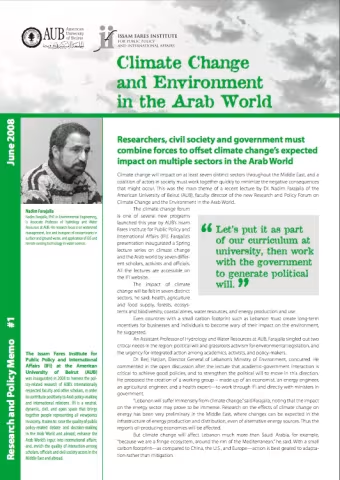
Researchers, Civil Society and Government Must Combine Forces to Offset Climate Change’s Expected Impact on Multiple Sectors in the Arab World Nadim Farajalla
Climate change will impact on at least seven distinct sectors throughout the Middle East, and a coalition of actors in society must work together quickly to minimize the negative consequences that might occur. This was the main theme of a recent lecture by Dr. Nadim Farajalla of the American University of Beirut (AUB), faculty director of the new Research and Policy Forum on Climate Change and the...
Research and Policy Memo by Nadim Farajalla, PhD in Environmental Engineering, who is an Associate Professor of Hydrology and Water Resources at AUB. The policy adresses climate change and environment in the Arab world, where Dr. Nadim Farajalla talked about in his lecture.
Climate change will impact on at least seven distinct sectors throughout the Middle East, and a coalition of actors in society must work together quickly to minimize the negative consequences that might occur.
India shifted to the side of US primacy in 2004, but since then its foreign policy has shifted once more to the middle. Sitting with a senior Indian diplomat, I mentioned that India seemed to be caught between two stools, US primacy and regionalism. “That’s an apt image,” he said, “except we have not fallen between the stools.” Things are more fraught now, and less clear. Talk of the peace pipeline and of linkages with Iran returned to the agenda after 2004. As US power enters a period of decline as a result of economic trials and two expensive and inconclusive wars, the moment of regionalism...
This paper highlights the specificity of the refugee crisis in the unstable Lebanese landscape and calls for the reconfiguring of current relief mechanisms by enabling decentralized local authorities to lead the process. Crisis Management Teams (CMTs), part of Mohafazat councils, will be responsible of collaborating with national and international agencies, planning and monitoring relief projects. The paper also draws on the experience gained by the Community Projects and Development unit (CDPu) – American University of Beirut (AUB), and recommends engaging refugees in municipal public works...
This study seeks to assess the relative weights of economic and political grievances across the uprisings in Bahrain, Egypt, and Tunisia. Highlighting the unique shared role of middle class youth, it contends that these constituencies have suffered from relative deprivation, despite deliberate efforts by authoritarian regimes to shield them through new targeted social protection initiatives. Nonetheless, economic grievances were not always the primary driving dynamic of protests and the importance of the middle classes has varied compared to the roles of the poor, labor, and pro-democracy...
This working paper analyzes the susceptibility of agricultural outputs to future climate change in Lebanon, and the extent to which it propagates to the economic system as a whole. A methodological framework in which physical and economic models are integrated for assessing the higher-order economic impacts of projected climate changes is used. The researchers then quantify the broader economic impacts in the country considering not only the temporal dimension but also the regional disaggregation of the results. The results show that there are potential high costs and risks associated with a...
IFI’s Climate Change and Environment in the Arab World Program, launched in 2008, has been tracking and framing climate change international negotiations under the United Nations Framework Convention on Climate Change (UNFCCC) - in particular to what pertains to Lebanon and Arab countries.
Key members of the program have attended nearly all the Conferences of the Parties (COP) as part of the official Lebanese delegation since COP 15 in Copenhagen, Denmark in 2009. From this exposure, it has become apparent that literature on the history of the involvement of key Arab countries in the past 20...