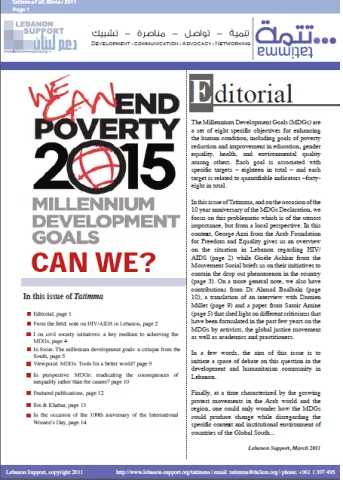
The Millennium Development Goals (MDGs) are a set of eight specific objectives for enhancing the human condition, including goals of poverty reduction and improvement in education, gender equality, health, and environmental quality among others.
This policy brief analyses the socio-political implications of the so-called October policies, and suggests legislative, political, and practical measures to improve the situation of Syrian refugees in Lebanon. It also aims to inform policy formulation regarding Syrian refugees from a human rights-based perspective, while discussing modalities for enhanced programming at the civil society level.
This policy brief is the fourth publication of a research project investigating the social effects of political and legal measures on Syrian refugees’ daily lives. The brief is based on a consultative...
This report aims to explore the fragmented organisation of healthcare services in Lebanon, for Syrian refugees. Although it is not an assessment of the Lebanese healthcare system, this report does nevertheless reflect on the challenges and underlying dynamics of the current Lebanese system, which are reproduced in the healthcare provision for Syrian refugees. In this sense, the report highlights the privatised, rather ad hoc, and irregular provision of healthcare in Lebanon, notably for Syrian refugees, which tends to take on a more curative rather than preventive approach, resulting in...
The 2015 Global Humanitarian Assistance (GHA) Report highlights that in 2013, 147 countries received humanitarian assistance, with countries from the Arab region, particularly those affected by the Syrian crisis, being the highest beneficiaries of aid.
This report examines both the historical development and current situation of Syrians working in Lebanon through the analysis of policies established and implemented by the Lebanese government. While the report is not an assessment of these policies, it nevertheless reflects on its impact on Syrians’ working conditions and livelihoods. In this vein, this report notably focuses on emerging dynamics of increased informality, exploitation, and dependence.
It is part of a series of reports to be published in 2016, the 1st of which being "Formal Informality, Brokering Mechanisms, and Illegality...
This report seeks to provide an overview of Lebanon’s current policy towards Syrian refugees, and to explore the new rules and regulations issued by General Security regarding the entry, residency, and departure of Syrian nationals. It also analyses the challenges pertaining to the current policy and its impact on the daily lives of Syrian refugees, with a special focus on their emerging illegality, their struggle for decent livelihood and working conditions, and increased informality and insecurity.
It is the first of a series of reports to be published in 2016, the 2nd report of the series...
The purpose of this policy brief is to inform policy formulation on local level security provision and refugee protection, and to propose modalities for upgrading the sys- tems of the Lebanese security institutions in a way that strengthens protection of the Lebanese communities and the Syrian refugees they host. Based on eld research conducted between February and May 2016 in three locations across Lebanon, this brief analyses the challenges to protecting local communities and refugees in a hybrid system, in which formal and informal security actors coexist and implement a mix of security...
This report aims to analyse how formal and informal security providers implement their respective social order agendas through a security “assemblage”. It also aims to inform the debate on refugee protection and security provision in urban settings, in the context of Lebanon’s hybrid security system. The accounts collected illustrate how state security institutions tacitly accept – or even rely on – informal security actors, managing at times to achieve their political and strategic goals through decentralised and/or illegal forms of control. In this vein, local municipalities imposed curfews...