تجاوز إلى المحتوى الرئيسي

موارد

Intervention Sectors
Displaying 21 - 40 of 52
National
Publishing Date
This report presents findings from a survey conducted from 3-11 July, 2017 with three distinct refugee groups in Lebanon: Syrian refugees; Palestine refugees from Syria; and Palestine refugees from Lebanon.
National
Publishing Date
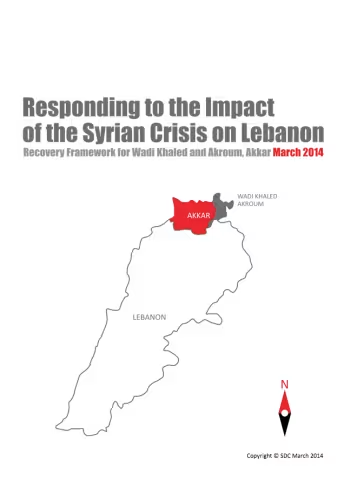
The Swiss Agency for Development and Cooperation (SDC) is pleased to share with you the report:  “Responding to the Impact of the Syrian Crisis on Lebanon: Recovery Framework for Wadi Khaled and Akroum, Akkar”, March 2014. SDC facilitated a process to shed light on the impact of the Syria crisis at the national level but also on the local level. The formulation of a recovery framework for Wadi Khaled and Akroum is a process that can be replicated for other affected regions of Lebanon. The findings and recommendations are based on consultations (between October 2013 and January 2014) with...
National
Publishing Date
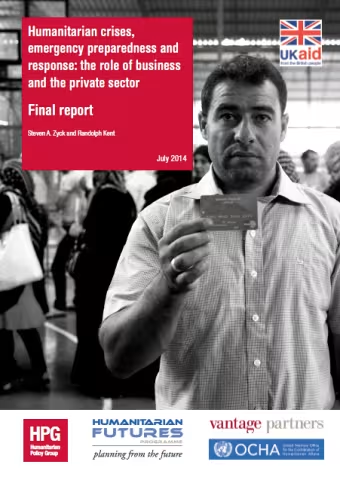
The private sector has long been a major contributor to humanitarian action. At the community level, businesses frequently use their materials and resources to aid people affected by crises. As local markets recover and supply chains are repaired, crisis-affected people are once again able to access basic goods and, in some cases, resume livelihoods. Large national, regional and multinational firms are also closely involved in supporting humanitarian objectives, whether indirectly, by resuming operations in crisis affected areas, or directly, by providing cash and in kind donations of goods or...
National
Publishing Date
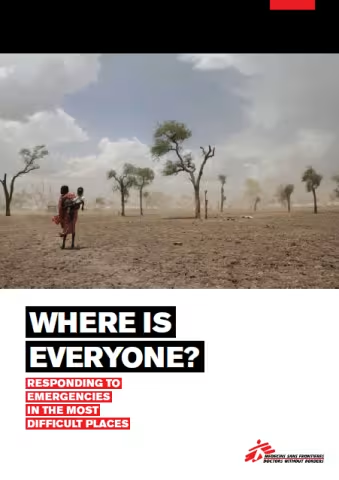
The humanitarian aid system is growing and expanding, and so surely its capacity to meet these challenges should also be growing. Yet despite the enormous resources, in the more complex, less high-profile and difficult contexts, MSF teams in the field have seen that humanitarian responses to displacement emergencies have not occurred in a timely and effective way. This is especially the case in conflict areas. These observations have prompted MSF to conduct this review, to better understand how the humanitarian system is responding to acute displacement emergencies. The review is based on...
National
Publishing Date
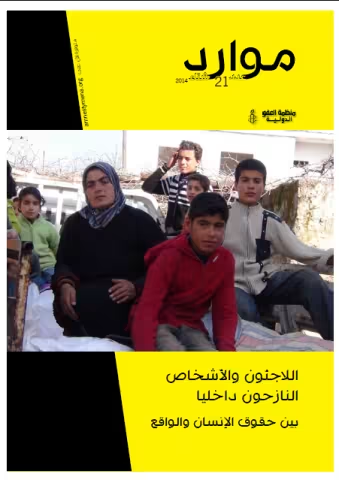
هذا هو العدد 21 من "موارد"، المجلة المتخصصة بالتربية على حقوق الانسان، التي يصدرها المكتب الإقليمي للشرق الأوسط و شمال أفريقيا بمنظمة العفو الدولية في بيروت. نخصص هذا العدد لموضوع اللاجئين والأشخاص النازحين داخليا، ويوفر العدد في هذا السياق مجموعة واسعة من الموارد.
National
Publishing Date
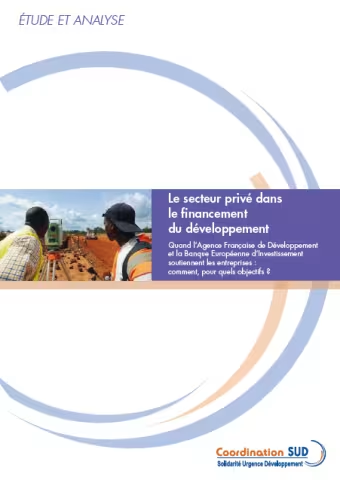
Les politiques de coopération au développement des bailleurs étatiques placent de plus en plus le secteur marchand comme un acteur clé du développement, à la fois comme un partenaire financier ou opérationnel mais aussi comme un objectif en soi. Sa croissance dans les pays du Sud, que ce soit dans le domaine productif ou de la fourniture de services, y compris pour de la délégation de services publics ou l’offre de services bancaires, est considérée comme un indicateur positif. Les gouvernements des pays membres de l’UE cherchent ainsi à maximiser son rôle comme catalyseur ou «substitut» de...
National
Publishing Date

Working Paper | August 2013
Displacement in the Middle East and North Africa: Between an Arab Winter and the Arab Spring by Shaden Khallaf
The Middle East and North Africa region has been rife with volatility and turmoil for decades due to inter-State conflict, military occupation, intra-State power struggles, international sanctions, strained economic systems, social transformations, high population growth, varying illiteracy rates, high unemployment and underemployment, poverty, gender inequalities, extremism, and an overarching lack of transparency in dealing with these daunting challenges...

National
Publishing Date
This thematic report provides an overview of available lessons identified from assessments undertaken concerning the humanitarian situation in Syria as well as the situation for Syrian refugees in host-countries.
National
Publishing Date
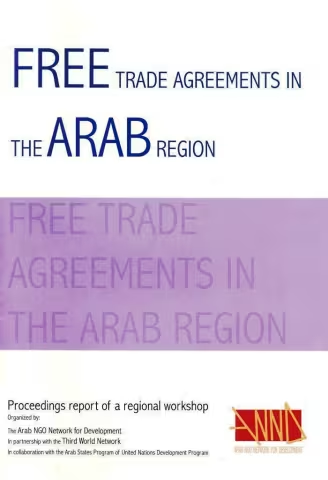
This report is a summary of the presentations given during the regional workshop on free trade agreements in the Arab region. The meeting was part of the two-year project on the “socio-economic impact of trade liberalization policies on the Arab region”.
National
Publishing Date
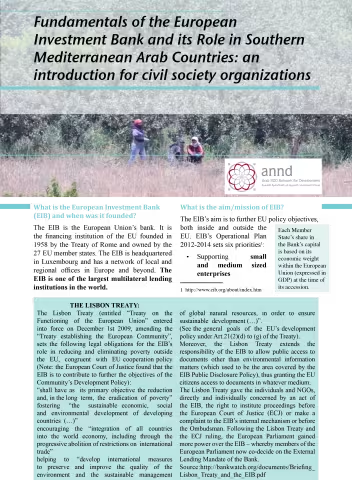
The EIB is the European Union’s bank. It is the financing institution of the EU founded in 1958 by the Treaty of Rome and owned by the 27 EU member states. The EIB is headquartered in Luxembourg and has a network of local and regional offices in Europe and beyond.