This report aims to acquire a comprehensive understanding of the barriers to education faced by Syrian youth, using both qualitative and quantitative data-collection methods.
The report entitled challenges for civil society and the promotion of economic and social rights, brings together recommendations from civil society actors and academics to strengthen Euro-Mediterra
This report presents issues within tertiary education for young Syrian refugees in Lebanon. It is part of a broader regional study commissioned by UNESCO.
This report presents findings from a survey conducted from 3-11 July, 2017 with three distinct refugee groups in Lebanon: Syrian refugees; Palestine refugees from Syria; and Palestine refugees from Lebanon.
The Building a Better Response project, together with the UN Office for the Coordination of Humanitarian Affairs (OCHA) and the International Humanitarian City, launched the Building a Better Response (BBR) e-learning course in Arabic with a panel discussion in Dubai on the role of local non-governmental organizations (NGOs) in humanitarian response. The event came in advance of the World Humanitarian Summit, set to take place in Istanbul in May 2016, where much of the conversation is expected to focus on placing local actors at the center of humanitarian response.
Our work cannot be as...
The Lebanon Host Communities Support Project (LHSP) is a multi donor programme aimed at increasing stability and building the capacity of communities affected by the Syrian crisis to address tensions, prevent conflict and ensure peaceful co-existence.
This working paper seeks to document and analyse collaboration mechanisms between local authorities and humanitarian actors in addressing the Syrian refugee crisis in urban and peri-urban settings in Lebanon.
Since the Syrian conflict began in 2011, 11 million people have been internally displaced or have fled to neighboring states. This has put an incredible strain on the hosting societies, particularly in Lebanon,Jordan, Iraq and Turkey.
This is an analytical report based on data and statistics collected from public schools and aiming at detecting the effect of the Syrian refugees crisis on the public education sector and the priorities and needs for the public schools in the best interest of the Lebanese and refugees students.
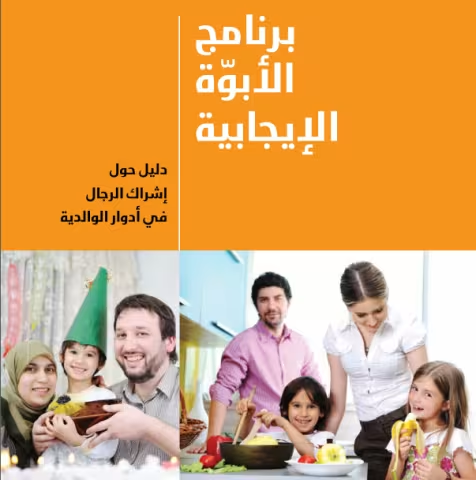
The adapted version of the Global "Program P" manual provides concrete strategies and activities to engage men in active positive fatherhood, from their partner’s pregnancies through their children’s early years. It identifies best practices on engaging men in maternal and child health, care-giving, and preventing violence against women and children on basis of equality and non-violence.
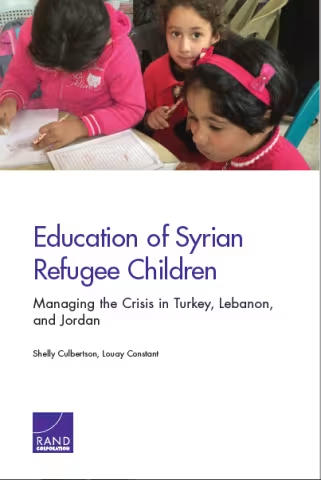
This scoping study is intended to contribute to the ongoing policy discussions among governments, donors, and United Nations agencies about the education of Syrian refugees in Lebanon, Turkey, and Jordan (the three countries with the largest populations of Syrian refugees),
Widening Access to Quality Education for Syrian Refugees: The role of private and
NGO Sectors in Lebanon
Authors
Maha Shuayb, Nisrine Makkouk and Suha Tuttunji
September 2014
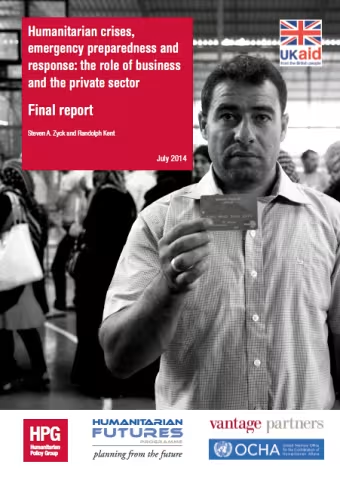
The private sector has long been a major contributor to humanitarian action. At the community level, businesses frequently use their materials and resources to aid people affected by crises. As local markets recover and supply chains are repaired, crisis-affected people are once again able to access basic goods and, in some cases, resume livelihoods. Large national, regional and multinational firms are also closely involved in supporting humanitarian objectives, whether indirectly, by resuming operations in crisis affected areas, or directly, by providing cash and in kind donations of goods or...
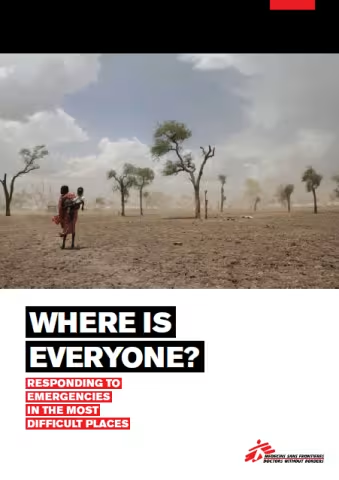
The humanitarian aid system is growing and expanding, and so surely its capacity to meet these challenges should also be growing.
Yet despite the enormous resources, in the more complex, less high-profile and difficult contexts, MSF teams in the field have seen that humanitarian responses to displacement emergencies have not occurred in a timely and effective way. This is especially the case in conflict areas.
These observations have prompted MSF to conduct this review, to better understand how the humanitarian system is responding to acute displacement emergencies. The review is based on...
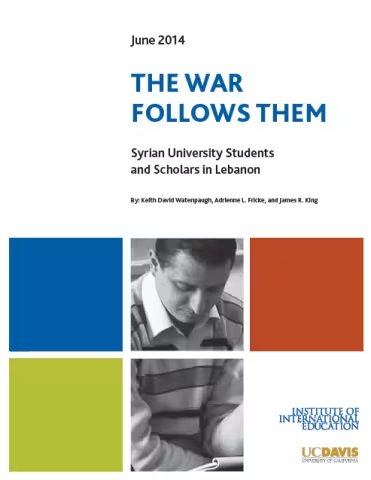
The crisis in Syria continues to have a devastating impact on professors, university students, and the education sector, not only in Syria but also in the neighboring countries that are hosting so many displaced Syrians. In this report, the Institute of International Education (IIE) and its Syria Consortium for Higher Education in Crisis looks at the conditions and educational needs of Syrians university students and scholars in Lebanon. “The War Follows Them: Syrian University Students and Scholars in Lebanon,” is based on first-hand research and interviews conducted in Lebanon in March 2014...
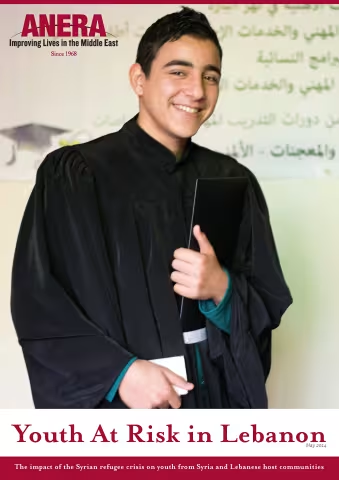
The Syrian conflict, now in its fourth year, has taken a heavy toll on Lebanon’s society.
Among those most affected are young men and women in refugee camps and marginalized communities. Young people are increasingly confronting violence and discrimination. They are missing out on education and work opportunities. The rising number of unemployed and disenfranchised youth in Lebanon could become a security risk for both Lebanese and refugee communities.
A society’s well-being relies on its youth, who can help revitalize the economy when education, health care and job opportunities are available...
The crisis in Syria has entered its fourth year. Children have been on the front-line from the outset. They have experienced or witnessed horrific acts of indiscriminate