LONDON CONFERENCE – LEBANON STATEMENT OF INTENT Presented by the Republic of Lebanon: Supporting Syria & The Region
Summary: The Government of Lebanon affirms that the success of the Conference in London will depend on how international partners respond to this vision and support Lebanon to uphold the central pillars of providing humanitarian assistance, education for all, and the expansion of economic opportunities and jobs. The Government urges that the international community provide multi-annual funding of $4.9bn to cover this year’s Lebanon Crisis Response Plan and plans set out in this...
This study was undertaken by the Center for Women (ECW) at the United Nations Economic and Social Commission for Western Asia (ESCWA), in the context of a regional programme to review progress made in the implementation of the Beijing Declaration and Platform of Action in the
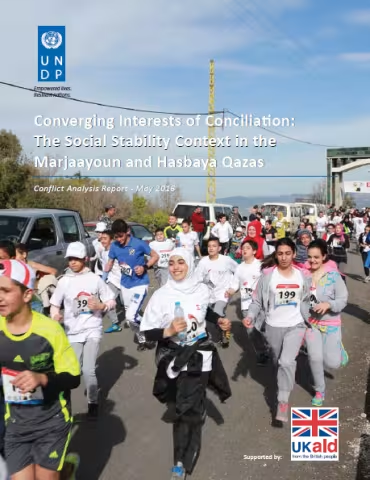
This report summarizes the conflict context of the Hasbaya and Marjaayoun Qazas of the Nabatieh Governorate, a religiously and politically diverse area which has for decades been at the forefront of regional dynamics and conflicts.A long history of coexistence between diverse
The influence of terrorist groups operating on the Lebanese-Syrian border, Hezbollah’s involvement in Syria, and the increasing sense of humiliation and powerlessness amongst Sunnis since Hezbollah’s takeover of west Beirut in 2008 is breeding concern about the radicalization
The Gender Dictionary, published by Lebanon Support, is a practical bilingual tool, based on multidisciplinary research and consultations with local gender actors (academics, experts, activists, practitioners).
This report examines the nature of interaction and engagement between Lebanese citizens’ collectives and the state on gender-specific matters, through the case study of
This cross sectional survey was conducted among Syrian refugees living in Lebanon, to monitor access to and utilization of key health services. Refugees in Lebanon are predominantly living in urban areas and informal settlements and there are no refugee camps.
The present guide proposes to reconcile the gender-related targets in the Sustainable Development Goals with the objectives of the Beijing Platform according to various sub-topics. It is organized in two sections.
The Lebanon Host Communities Support Project (LHSP) is a multi donor programme aimed at increasing stability and building the capacity of communities affected by the Syrian crisis to address tensions, prevent conflict and ensure peaceful co-existence.
In October 2014, Lebanon’s Council of Ministers adopted a comprehensive policy on Syrian displacement, one explicit goal of which is to decrease the number of Syrians in Lebanon by reducing access to territory and encouraging return to Syria.
The Syrian conflict has forcibly displaced more than 11 million people to neighbouring countries such as Turkey, Lebanon, Jordan, Iraq and Egypt, and elsewhere both regionally and globally.
This report aims to present a general overview of the current local gender actors and their interventions in Lebanon. It also aims to shed light on the complex relationship between women’s organisations in Lebanon and their donors. In this context, it is important to ask to what extent the funding tends to shape project design at a local level? And moreover, does funding of short-term and service-oriented projects edulcorate the political change that these organisations could bring?
Based on a survey done by Lebanon Support during 2015, it gives an overview of the main gender actors, their...
Lebanon has had an ambiguous approach to the more than one million Syrians seeking protection in the country since 2011. The country is neither party to the 1951 Convention relating to the Status of Refugees, nor does it have any national legislation dealing with refugees.
This working paper seeks to document and analyse collaboration mechanisms between local authorities and humanitarian actors in addressing the Syrian refugee crisis in urban and peri-urban settings in Lebanon.