Beyond the mere provision of healthcare, the right to health is entrenched in human rights and encompasses underlying determinants of health (including gender equality, right to food, right to housing for example), freedoms and rights, and entitlements such as equal opportunity to access the highest attainable standards of health.
الحقّ في الصحّة هو حقٌّ مُكرَّس من حقوق الإنسان، ولا يقتصر على الرعاية الصحّية. يتضمّن مجموعة من المُحدِّدات الأساسية للصحّة (بما في ذلك المساواة الجندرية، والحق في الغذاء، والحق في السكن على سبيل المثال)، والحريات والحقوق والاستحقاقات مثل تكافؤ الفرص للوصول إلى أعلى...
In Jordan, while the majority of the population has access to a wide range of public healthcare services, coverage and reach is still limited, unequal, and lacking in terms of quality. Vulnerable groups particularly, and more specifically unregistered refugees have limited access to healthcare benefits.
في الأردن، في حين يتمتع غالبية السكان بإمكانية الوصول إلى مجموعة واسعة من خدمات الرعاية الصحية العامة، لا تزال التغطية والوصول محدودة، غير متساوية، ونوعية متدنية
لقد تكون هذه التغطية محدودة خاصةً للفئات المهمّشة وبينهم اللاجئين غير المسجلين
The healthcare system in Lebanon is fragmented, exclusionary, and highly privatised.
Although there are multiple social protection schemes offering access to different healthcare benefits, some segments of the population, including unemployed, elderly, workers in the informal sector, migrants workers, and refugees have limited and unequal access to healthcare benefits and coverage.
نظام الرعاية الصحية في لبنان مجزأ، باهظ الكلفة ومخصخص إلى حد كبير. رغم وجود العديد من برامج الحماية الإجتماعية التي تغطي كل منها تقدمة مختلفة في مجال الرعاية الصحية، إلا أن بعض شرائح السكان، بما في ذلك العاطلين عن...
“More than 60% of Syrian refugees households comprise a person with disabilities and 1/5 Syrian refugees has a disability in Lebanon and Jordan”, shows a large study conducted by Humanity & Inclusion (HI) and iMMAP.
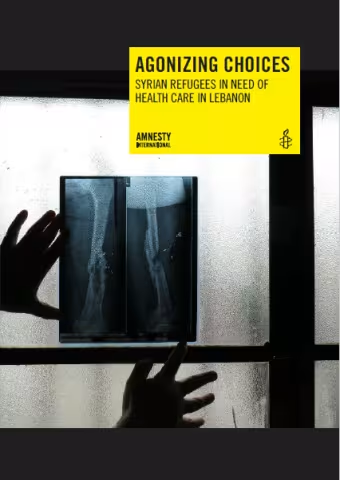
This report aims to explore the fragmented organisation of healthcare services in Lebanon, for Syrian refugees. Although it is not an assessment of the Lebanese healthcare system, this report does nevertheless reflect on the challenges and underlying dynamics of the current Lebanese system, which are reproduced in the healthcare provision for Syrian refugees. In this sense, the report highlights the privatised, rather ad hoc, and irregular provision of healthcare in Lebanon, notably for Syrian refugees, which tends to take on a more curative rather than preventive approach, resulting in...
This cross sectional survey was conducted among Syrian refugees living in Lebanon, to monitor access to and utilization of key health services. Refugees in Lebanon are predominantly living in urban areas and informal settlements and there are no refugee camps.
This study sought to characterize the physical and emotional conditions, dietary habits, coping practices, and living conditions of this elderly population arriving in Lebano
The continuing unrest in Syria is resulting in a growing influx of Syrian refugees to Lebanon. The United Nations High Commissioner for Refugees has registered over 57,000 Syrian refugees in Lebanon (September 7, 2012) while many refugees are awaiting registration.
The number of Syrian refugees registered in Lebanon has more than quadrupled over the past six months. On January 1, 2013 Lebanon was hosting some 130,000 refugees; today that figure stands at more than 600,000.
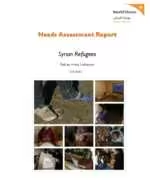
The purpose of the needs assessment conducted in the Bekaa area is to identify the needs of Syrian refugees (SR), in terms of food, non food items (NFIs), shelter, water and education.
This operational guidance note is anchored on the principles of universal health care for all persons of concern fleeing the ongoing conflict in Syria and in need of international protection in Lebanon.