This report brings together insights gathered through extensive desk-based research conducted as part of the Fair Game project 2024 across six diverse countries: Italy, Lebanon, Morocco, Palestine, Portugal, and Romania. The main goal was to explore the complex challenges that excluded and vulnerable youth face in these unique national contexts.
The research involved a thorough examination of existing interventions aimed at addressing these challenges. By evaluating their effectiveness, the study aims to establish a foundation for developing targeted training programs and recommending...
This report aims to provide a contextual understanding of migration governance in the Lebanese context, as well as its implications for refugees and migrants.
In May 2015, the Lebanese authorities instructed UNHCR to temporarily suspend registration of Syrian refugees, including individuals already in the country and new arrivals.
This report is this first of a three-part series focusing on the current status and lessons learned relating to transitional justice and policing initiatives in opposition-controlled Syria. • Part I focuses on the effects of the departure of judicial and security elements of the Syrian state has had on conditions on the ground currently and on the nascent justice institutions that have emerged in this void (including levels of institutionalisation, Islamic law, and the legal systems currently being debated and trialed in some areas). • Part II examines the variety of institutions and...
This paper examines the situation of impunity in Lebanon that has persisted since the 1975–1990 war. It highlights the price of the Lebanese authorities’ failure to address the legacy of past conflict.
This study recommends a holistic approach to crafting a comprehensive and victim-centered transitional justice process in Lebanon. An incremental approach to reform would be of value, given the likely challenges to pursuing accountability in the country. Programming must involve state and nonstate actors—political and community leaders, civil society, and the broader public. In addition, human...
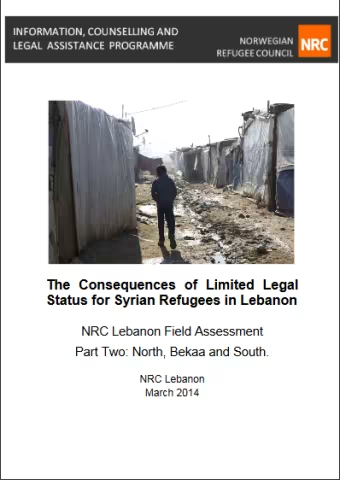
In December 2013, NRC launched a report entitled ‘The Consequences of Limited Legal Status for Syrian Refugees in Lebanon: NRC Field Assessment in Aarsal and Wadi Khaled’ (Part One) based on the findings of an assessment that NRC conducted between
Briefing papers on the preservation of cultural heritageInstitutions and individuals from the Middle East and North Africa experience many shortcomings in legislation, policies and current practices impeding the sustainable preservation of cultural heritage. In order to obtain a systematic overview and a sound basis for engaging in lobby and advocacy work for improved governance of the cultural sector, the Modern Heritage Observatory contracted local lawyers and researchers to analyze and assess current regulations, policies and practices concerning the preservation of cultural heritage in...
This report constitutes the final publication of the outcomes of the program "Development in Lebanon: Poverty Eradication, Gender Equity and Youth Participation; the Role of NGOs Civil Society and Other Actors".
The “Review of the Public Procurement Legal Framework in Lebanon” introduces the Sustainable Public Procurement (SPP) in Lebanon and elaborates on the legal of the country’s procurement and sustainability laws that may offer a legal possibility for the adoption of SPP principl
This report places the spotlight on children, hearing from them the biggest challenges they face each day. We visited with 100 Syrian children, aged 7-13 in Central and West Bekaa.
Severe weather struck the country this week, affecting Syrian refugees sheltered in the mountain region of Bekaa. Heavy rains and snowfall have flooded some settlements, and a number of refugee families were forced to seek shelter elsewhere.
UNHCR’s Policy Development and Evaluation Service (PDES) is committed to the systematic examination and assessment of UNHCR policies, programmes, projects and practices.
This case study book entitled “Cases of Femicide before Lebanese Courts” was written by Azza Charara Baydoun and published by KAFA (enough) Violence & Exploitation in 2011.
Although Lebanon is known in the Middle East for its relative political openness and for the degree of freedom Lebanese women enjoy, it paradoxically has one of the lowest rates of women’s political engagement in the region.
On December 9, 2009, a Lebanese criminal court sentenced a Lebanese woman to 15 days in jail for repeatedly beating Jonalin Malibago, her Filipina maid, three years earlier. Lebanese newspapers hailed the case a landmark victory for the country’s estimated 200,000 migrant domestic workers (MDWs), many of whom report abuse at the hands of their employers. The case illustrated the positive role that the judiciary can play in protecting MDWs, even though the sentence was lenient given the violation. But it also raised at least one significant question: was the Malibago verdict a rare instance of...