This report brings together insights gathered through extensive desk-based research conducted as part of the Fair Game project 2024 across six diverse countries: Italy, Lebanon, Morocco, Palestine, Portugal, and Romania. The main goal was to explore the complex challenges that excluded and vulnerable youth face in these unique national contexts.
The research involved a thorough examination of existing interventions aimed at addressing these challenges. By evaluating their effectiveness, the study aims to establish a foundation for developing targeted training programs and recommending...
يهدف هذا البحث العمليّ المنحى إلى إعلام الممارِسين وصانعي القرار بشأن وضع الحماية الاجتماعيّة واحتياجاتها والثغرات الموجودة فيها، وذلك بالنسبة إلى العاملين في قطاع المجتمع المدنيّ. يقدّم هذا البحث توصيات مستهدَفة تهدف إلى تعزيز وصول العاملين في قطاع المجتمع المدنيّ إلى الحماية الاجتماعيّة، كما تستهدف الدولة، جماعة المانحين والمنظّمات غير الحكوميّة الدّولية، والمنظّمات غير الحكوميّة المحليّة.
This action-oriented research aims to inform practitioners and decision makers on social protection status, needs and gaps of workers in the civil society sector. It formulates targeted recommendations that aim at enhancing access to civil society workers to social protection, and that target the Lebanese state, the donor community and international NGOs, and local NGOs.
More than a decade after the United Nations’ adoption of the Convention on the Elimination of All Forms of Discrimination against Women, which is adopted by many countries including Lebanon, these countries returned in 2015 to commit themselves to achieve gender equality and t
UNFPA on behalf of UNDP and UN Women organized a national workshop on gender-related laws, policies and practices in Lebanon, which was held in Beirut on the 7th and 8th of August, 2018.
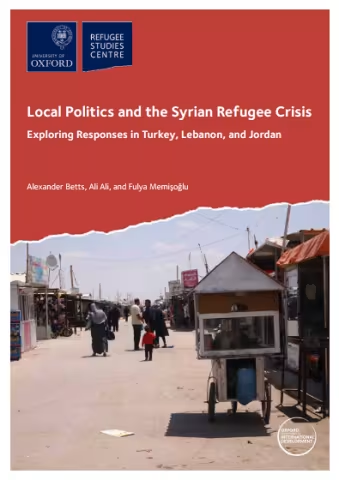
Refugee protection is inherently political. While international law and values inevitably influence governments’ decisions about how to respond to refugees, so too do power and interests.
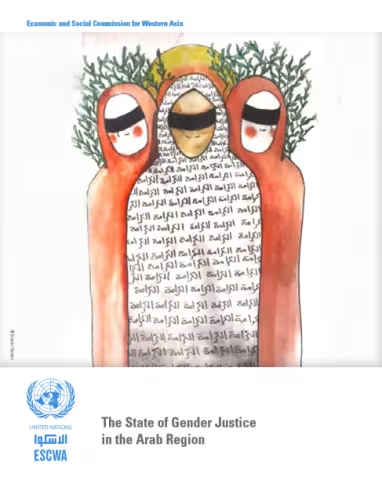
This study maps the current state of gender justice in the Arab region, documenting barriers as well as opportunities. Its primary research aim is to determine how to develop an environment, at the legal, policy, and social levels that is conducive to gender justice.
This policy brief analyses the socio-political implications of the so-called October policies, and suggests legislative, political, and practical measures to improve the situation of Syrian refugees in Lebanon. It also aims to inform policy formulation regarding Syrian refugees from a human rights-based perspective, while discussing modalities for enhanced programming at the civil society level.
This policy brief is the fourth publication of a research project investigating the social effects of political and legal measures on Syrian refugees’ daily lives. The brief is based on a consultative...
This document is an adaption of a speech delivered on May 12, 2015 at the launch of a report by the Syrian Justice and Accountability Center (SJAC) entitled ”A Step Towards Justice: Current Accountability Options for Crimes under International Law Committed in Syria.” The repo
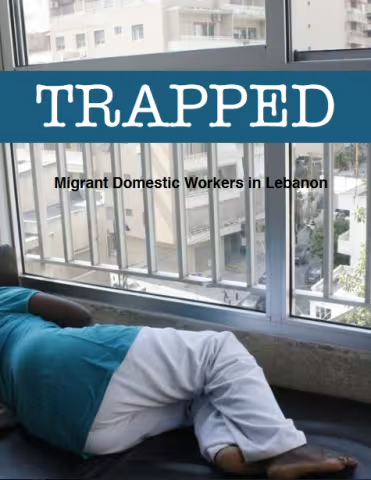
Over 250,000 migrant women are employed by private households in Lebanon to carry out household tasks such as cleaning, cooking, and caring for children and the elderly.
The concept of resilience offers a framework that facilitates cross-institutional and cross-disciplinary dialogue and pushes us to examine systems that influence complex situations.
The right to freedom of movement forms one of the cornerstones of the international human rights regime and the Lebanese legal system. It is a right that everyone ought to enjoy regardless of race, national origin, residence status, religion or any other criteria.
In most Arab countries, family matters including Domestic Violence continue to be handled by religious courts as civil legislation does not criminalise acts of violence within the family.
The “Review of the Public Procurement Legal Framework in Lebanon” introduces the Sustainable Public Procurement (SPP) in Lebanon and elaborates on the legal of the country’s procurement and sustainability laws that may offer a legal possibility for the adoption of SPP principl
The research will provide better understanding on the legislations and laws that authorities are using to control or oppress any movement or any type of activism on gender and sexuality issues in JORDAN.