This report brings together insights gathered through extensive desk-based research conducted as part of the Fair Game project 2024 across six diverse countries: Italy, Lebanon, Morocco, Palestine, Portugal, and Romania. The main goal was to explore the complex challenges that excluded and vulnerable youth face in these unique national contexts.
The research involved a thorough examination of existing interventions aimed at addressing these challenges. By evaluating their effectiveness, the study aims to establish a foundation for developing targeted training programs and recommending...
Findings in the "Analysis on Stunting Among Syrian Refugee Children" showed that risk factors perceived to be contributing to stunting levels among Syrian refugee children included those at the individual and household level with poor maternal nutrition, household food insecurity and inadequate complementary feeding practices as the factors perceived to be contributing the most to stunting among Syrian children. On the other hand, at the institutional and community level, market food prices, poverty, income, employment and livelihoods were the factors perceived to be contributing the most to...
This is an assessment done in the detention centers and prisons in south Lebanon in coordination with the prisons department in the ministry of interior through which the WASH situation inside these prisons and centers was detected, needs and priorities were defined and possible rehabilitation and enhancement explored.
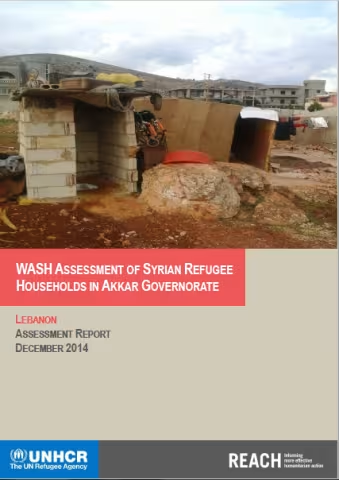
As the Syrian Crisis enters its fourth year, numerous water, sanitation, and hygiene (WASH) needs remain to be filled among Syrian refugees living in Lebanon, who now number more than 1.1 million.
As part of the assessment support mission, capacity assessment requested by the WASH partners to be carried out, the assessment team developed a Capacity Assessment Tool designed to collect information covering aspects, such as, profile, WASH response, WASH activities, transpo
This report constitutes the final publication of the outcomes of the program "Development in Lebanon: Poverty Eradication, Gender Equity and Youth Participation; the Role of NGOs Civil Society and Other Actors".
This report is the result of 4 months of field data collection from April to August 2013 carried out in the Informal Tented Settlements (ITS) of the two districts of Zgharta and Minieh-Dennieh by SOLIDARITÉS INTERNATIONAL’s (SI) outreach workers.
This thematic report provides an overview of available lessons identified from assessments undertaken concerning the humanitarian situation in Syria as well as the situation for Syrian refugees in host-countries.
Swiss Solidar undertook a multi-sectoral needs assessment in August 2013 to assess the humanitarian needs of Syrian refugees residing in Nabatieh and Jezzine Districts in Southern Lebanon.1 Prior to undertaking its field assessment, Solidar undertook a detailed documentation r
This report places the spotlight on children, hearing from them the biggest challenges they face each day. We visited with 100 Syrian children, aged 7-13 in Central and West Bekaa.
Severe weather struck the country this week, affecting Syrian refugees sheltered in the mountain region of Bekaa. Heavy rains and snowfall have flooded some settlements, and a number of refugee families were forced to seek shelter elsewhere.
The objective of the project is to improve the housing conditions of the most vulnerable people affected by the Syrian crisis and to reduce their vulnerability to face the winter season.
UNHCR’s Policy Development and Evaluation Service (PDES) is committed to the systematic examination and assessment of UNHCR policies, programmes, projects and practices.
This report is the result of 4 weeks’ field work from April 22 to May 17 carried out in the two districts of Zgharta and Minieh-Dennieh by SOLIDARITÉS INTERNATIONAL’s (SI) outreach workers.
Since Syria’s Arab Spring events began in March 2011, the Syrian Observatory for Human Rights estimates that the death toll has surpassed 21,000 people, mostly civilians, who have been killed in unrelenting violence in certain areas of the country1.
The human rights situation in the Syrian Arab Republic has deteriorated significantly since November 2011, causing further suffering to the Syrian people. Widespread violence and increasingly aggravated socio-economic conditions have left many communities in a perilous state.