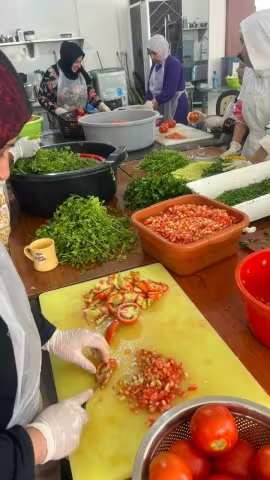
In the wake of Lebanon’s compounded humanitarian crisis, the Community Kitchen Initiative emerged as a localized, life-saving response to ensure that food-insecure populations had access to hot, nutritious, and culturally appropriate meals. Operational since March 2025 till present, this intervention served as a vital daily service across Nabatiyeh, South Lebanon, Mount Lebanon, and Baalbek-Hermel. Led by SPHERE Building Tomorrow (SBT), the project leveraged community-based kitchens and volunteer networks to deliver food assistance while promoting livelihoods and strengthening local food...
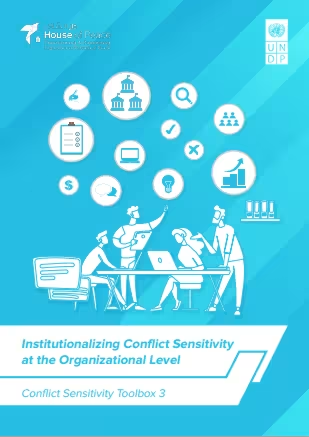
The third toolbox: Institutionalizing Conflict Sensitivity at the Organizational Level aims to ensure that organizations working within the humanitarian and stabilization response in Lebanon can better integrate the concept of conflict sensitivity and its principles at all aspects and levels across an organization’s structure, procedures, and policies.
The three CS Guidance notes cover 3 essential areas; Getting started with CS in Lebanon; CS in Project Design Cycle; and CS Procurement, Recruitment, and accountability.
The three CS Guidance notes cover 3 essential areas; Getting started with CS in Lebanon; CS in Project Design Cycle; and CS Procurement, Recruitment, and accountability.
The three CS Guidance notes cover 3 essential areas; Getting started with CS in Lebanon; CS in Project Design Cycle; and CS Procurement, Recruitment, and accountability.
مساعدة ذوي الإعاقة العقلیّة (الإخوة) في جمیع مجالات حیاتھم من خلال توفیر الدعم العملي والعاطفي بتوجیه من مسؤول البيت، والمساعدة في تطویر مقدراتھم بخلق بیئة محفزة ورعایة مناسبة.
Findings in the "Analysis on Stunting Among Syrian Refugee Children" showed that risk factors perceived to be contributing to stunting levels among Syrian refugee children included those at the individual and household level with poor maternal nutrition, household food insecurity and inadequate complementary feeding practices as the factors perceived to be contributing the most to stunting among Syrian children. On the other hand, at the institutional and community level, market food prices, poverty, income, employment and livelihoods were the factors perceived to be contributing the most to...
دليل.فيلم هو مصدر مفتوح من تصميم بيروت دي سي وشركائها، يهدف إلى مساعدة صنّاع الأفلام العرب على إنتاج أفلام تصل إلى الجماهير على امتداد المدن العربية والعالم وتكون مراعية لمعايير الحفاظ على البيئة
daleel.film is the guide of guides: an open resource made by Beirut DC and partners to help Arab filmmakers make great socially and environmentally engaged films that reach audiences in every Arab city and the world
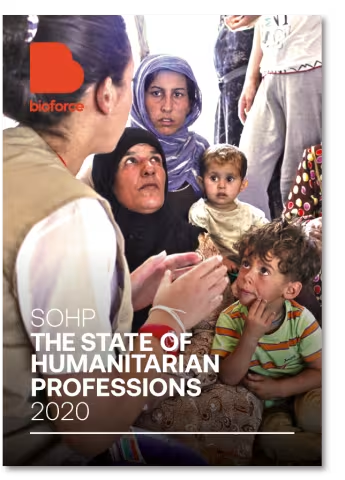
The State of Humanitarian Professions 2020 (SOHP) is the result of a year-long consultation with more than 1,500 humanitarian professionals. For the first time, this study gathers and analyses key figures on 24 humanitarian professions, as well as on recruitment practices and professional development in the sector. In addition, the SOHP study demonstrates the need to coordinate on the challenges of professionalising humanitarian teams, with 19 recommendations to be discovered in the final report.
“More than 60% of Syrian refugees households comprise a person with disabilities and 1/5 Syrian refugees has a disability in Lebanon and Jordan”, shows a large study conducted by Humanity & Inclusion (HI) and iMMAP.
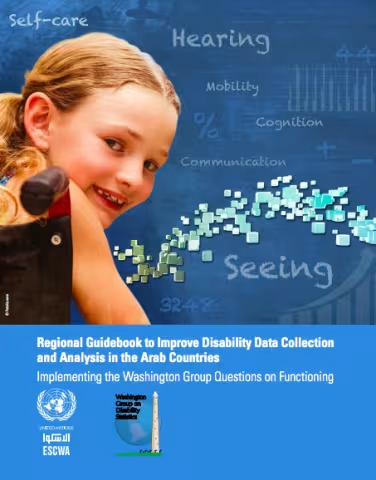
This regional Guidebook explores the different approaches in design, implementation and analysis of disability data collection in the Arab countries, in view of improving the standardization and implementation of the Washington Group Short Set on Functioning and related indica
GVC and YAB have implemented a pilot initiative in 6 public schools in order to provide directors, teachers, special educators and social workers with technical tools and expertise to encourage the inclusion of children with special needs. Almost 60 children have been included in regular classes all along the implementation (2012-2015). At the same time, the project involved parents and communities where the 6 schools are located to raise culture of diversity and respect and to enhance participation of children with special needs at all levels of social and cultural life.
Integrity’s research highlights that the truces agreed in several locations across Syria in the early months of 2014 do not represent the localised beginnings of a peacebuilding process. These agreements—and the negotiation and implementation processes that delivered them—were not built upon good practice and were significantly undermined by a lack of political will for peace from the outset. For opposition stakeholders, the truce agreements were a reaction to extreme levels of civilian suffering and a military capacity weakened by lengthy, government-enforced sieges. In all areas researched...