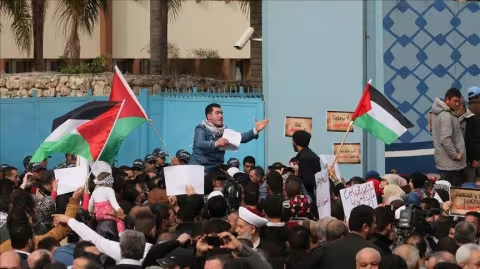
ككل عام تطلق المؤسسة الفلسطينية لحقوق الانسان (شاهد) تقريرها السنوي للعام 2023 حول واقع اللاجئين الفلسطينيين في لبنان، تطرح فيه الأرقام والوقائع الموثقة وتضعها بين يدي صانع القرار المحلي والدولي.
هذا التقرير هو خلاصة للجهود البحثية والمتابعات الميدانية لفريق عمل مؤسسة (شاهد) خلال عام كامل.
The three CS Guidance notes cover 3 essential areas; Getting started with CS in Lebanon; CS in Project Design Cycle; and CS Procurement, Recruitment, and accountability.
إنّ فهم الموارد المالية الخاصّة بمنظمات المجتمع المدني هو أمر أساسي لضمان اتخاذ قرارات صائبة في أنشطة منظمتكم وضمان توافق عملياتكم وآلياتكم المالية مع الخطوط التوجيهية والمبادئ المالية والمحاسبية، كما يمكن في نهاية المطاف أن يوفر لكم الدعم في ضمان استدامة منظمتكم بصورة عامّة.
يشكّل هذا الدليل عن الادارة المالية أداةً أساسية لمساعدة المحاسبين والمدراء الماليين في اتخاذ قرارات مدروسة في ما يخصّ إدارة منظمات المجتمع المدني.
Understanding your Civil Society Organisation’s finances is essential to guarantee proper decision-making in your organisation’s activities and to ensure that your financial operations and processes are in line with the financial and accounting guidelines and principles. It can also ultimately support the sustainability of your organisation as a whole.
This Financial Management Guide is a basic tool to assist accountants and financial managers with making well-in- formed decisions regarding CSO management.
يقدّم هذا الدليل أدوات تسهّل عملية صياغة مقترحات المشاريع والحصول على التمويل، من خلال توضيح ما يتم الاستناد إليه في أغلب المنظمات المانحة، مع الأخذ في الاعتبار الفوارق البسيطة بين مانح وآخر. يتألف هذا الدليل من قسمين لكلٍ منهما أهميته الخاصة. في القسم الأول، يتم التركيز على مفهوم المنح المالية، وكيفية تحديد حاجتنا للتمويل، وكيفية اختيار الشريك الممول لهذا المشروع أو ذاك، وكيفية استهداف الشريك وإقناعه بالفكرة المطروحة. أما القسم الثاني، فيستعرض المراحل الضرورية لبناء مقترح مشروع متكامل، والمحاور الأساسية التي يجب العمل عليها وآلية صياغة الأفكار والأهداف والنتائج المتوقعة، وصولاً إلى صياغة...
This guide provides you with the tools needed to facilitate the proposal writing process and securing funds, by explaining the criteria upon which most donors base their decisions to provide funding, while taking into account the subtle differences between one donor and another. In the first section, we focus on defining the concept of funding grants, in addition to how to identify our funding needs, how to select funding partners for a said project, and how to target partners and persuade them of the proposed idea. In the second section, we present the phases needed to formulate a...
The State of Humanitarian Professions 2020 (SOHP) is the result of a year-long consultation with more than 1,500 humanitarian professionals. For the first time, this study gathers and analyses key figures on 24 humanitarian professions, as well as on recruitment practices and professional development in the sector. In addition, the SOHP study demonstrates the need to coordinate on the challenges of professionalising humanitarian teams, with 19 recommendations to be discovered in the final report.
“More than 60% of Syrian refugees households comprise a person with disabilities and 1/5 Syrian refugees has a disability in Lebanon and Jordan”, shows a large study conducted by Humanity & Inclusion (HI) and iMMAP.
The report examines how economic and financial policies of the EU affect the economies of Southern Mediterranean countries. It’s interesting to note the shortcomings of these policies with regard to civil and political rights.
The second report is an evaluation of civil society initiatives on economic and social rights, including a series of civil society initiatives focusing on
The report entitled challenges for civil society and the promotion of economic and social rights, brings together recommendations from civil society actors and academics to strengthen Euro-Mediterra
This report presents findings from a survey conducted from 3-11 July, 2017 with three distinct refugee groups in Lebanon: Syrian refugees; Palestine refugees from Syria; and Palestine refugees from Lebanon.
The Lebanon Host Communities Support Project (LHSP) is a multi donor programme aimed at increasing stability and building the capacity of communities affected by the Syrian crisis to address tensions, prevent conflict and ensure peaceful co-existence.
This working paper seeks to document and analyse collaboration mechanisms between local authorities and humanitarian actors in addressing the Syrian refugee crisis in urban and peri-urban settings in Lebanon.
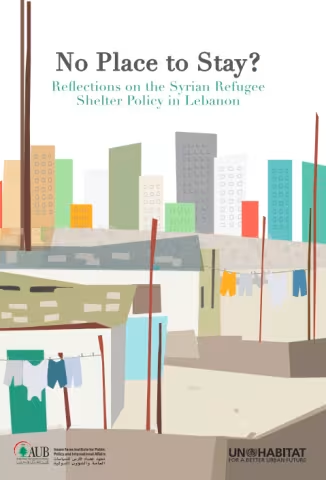
Since the Syrian conflict began in 2011, 11 million people have been internally displaced or have fled to neighboring states. This has put an incredible strain on the hosting societies, particularly in Lebanon,Jordan, Iraq and Turkey.
In Lebanon, the question of hosting and ensuring protection for Syrian refugees in light of the government stance against the erection of camps has created many deliberations concerning different proposed and implemented shelter options and solutions. UN-Habitat, in partnership with the American University of Beirut’s (AUB) Issam Fares Institute for Public Policy and International Affairs (IFI), initiated a research study in July 2014 to address solutions for hosting and ensuring protection for refugees specifically on the subject of erecting camps to address the Syrian crisis. The study...
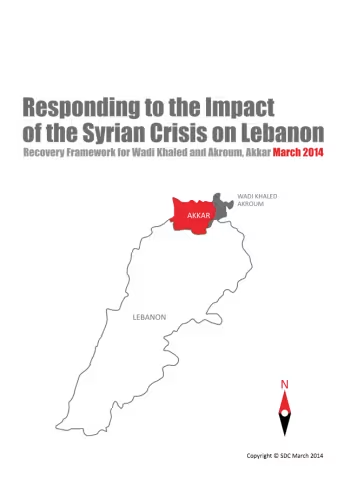
The Swiss Agency for Development and Cooperation (SDC) is pleased to share with you the report:
“Responding to the Impact of the Syrian Crisis on Lebanon: Recovery Framework for Wadi Khaled and Akroum, Akkar”, March 2014.
SDC facilitated a process to shed light on the impact of the Syria crisis at the national level but also on the local level. The formulation of a recovery framework for Wadi Khaled and Akroum is a process that can be replicated for other affected regions of Lebanon.
The findings and recommendations are based on consultations (between October 2013 and January 2014) with...