
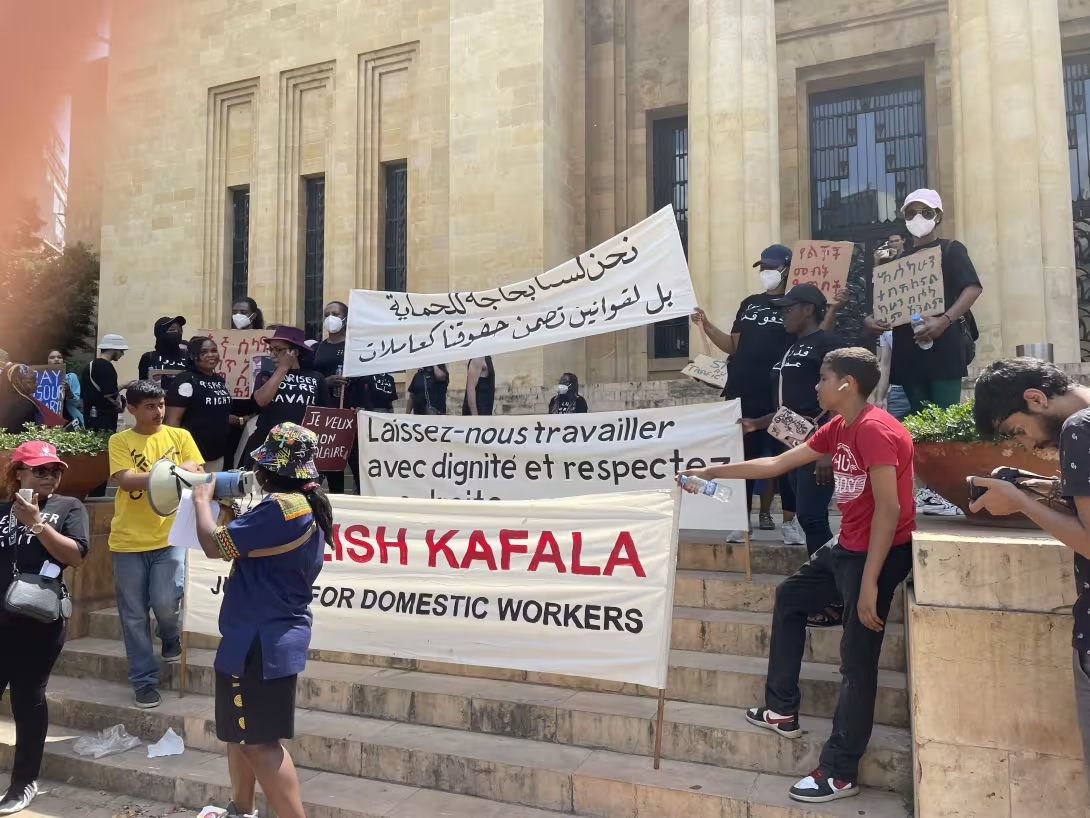
Stories documenting the difficult lives of migrant workers in Lebanon have become well-known in recent years. Trapped within the kafala system, these workers are denied basic labour and personal rights, effectively rendering their employers as their sole guardians. The experiences of migrant domestic workers in Lebanon are often marked by violence, discrimination, and exploitation. Many face forced confinement, excessively long working hours, no days off, underpayment or non-payment of wages, and various forms of abuse and harassment—verbal, emotional, psychological, physical, and sexual.
According to research conducted by Egna Legna Besidet and the Lebanese American University in 2022, 68% of migrant domestic workers reported experiencing some form of sexual harassment, while 11.7% reported incidents of sexual assault.
Discriminatory treatment faced by migrant domestic workers was strikingly visible during the war in Lebanon last autumn, which had contributed to the displacement of an estimated 1.3 million people within the country and into neighbouring states. As many Lebanese families fled, numerous migrant domestic workers were left behind—trapped in their employers’ homes, surrounded by shelling and conflict. Others were merely abandoned on the roadside, without money, support, or a place to go.
Although shocking, these images and stories are unfortunately not new. Little, however, is known about the lives of these migrant workers after they leave Lebanon and return “home”—often years or decades later. The kafala contract is technically meant to be renewed annually, suggesting it is designed for short-term employment. In reality, many migrant domestic workers remain in Lebanon for extended periods, either working for multiple and/or successive employers (while having one kafeel) or as live-in employees for many years.
I spoke informally with some of them in the spring of 2025. Their reasons for returning home are diverse. Most of the workers I spoke with had decided to leave Lebanon after working there for decades, mainly for financial reasons—especially in the wake of the economic crisis that began in 2019.
“Salaries decreased significantly while the cost of living kept rising. At some point, it was no longer worth it for me. I have a family in Bangladesh who depends on me,” says Dina, who left Lebanon in 2021. “I decided to leave and eventually try to go to a Gulf country [but] the agencies here tell me I’m too old for the Gulf States,” says the 48-year-old.
Dina has been in Bangladesh ever since, but has struggled to find stable employment and has not been able to emigrate for work again. In her own words, “It’s hard to make ends meet and live decently, even after so many years of work.”
Others leave Lebanon because their employers refuse to renew their contracts, or because they are no longer physically able to meet the demands of domestic work. In some cases, the Lebanese General Security refuses to renew a migrant worker’s residency permit. The reasons provided are vague or arbitrary, often based on tenuous legal grounds such as accusing workers of not living with their kafeel or of having children. Many of these workers are only given a few days to leave the country.
For Christina from the Philippines, one of the women I spoke to, General Security justified their decision not to renew her permit by claiming she no longer lived with her kafeel. However, Christina believes the decision was in retaliation for her active engagement in her community: organising events and workshops for migrant domestic workers, and raising awareness about their rights and the ongoing violations they face.
“ I was given one week to leave Lebanon—the place where I had lived and worked for 24 years.”
Whether the decision to leave Lebanon is voluntary or forced, returning to their home countries often means a continuation of the hardship these women endured while in Lebanon. The kafala system is not only exploitative during their employment but also offers no protection, rights, nor benefits once the contract ends. Migrant domestic workers in Lebanon are not only expected to support their families back home, but to also save for their own future, particularly for the time when they are no longer able to work.
In many cases, however, those savings are quickly depleted, leaving women without income or financial security. All of the women I spoke to for this article shared that the money they had saved—intended to last them through old age—was gone within two to three years of their return.
Almaz, who spent 15 years in Lebanon before returning to Ethiopia, explains:
“I used to send money to my brother for his kids’ education and for a house I was building. I also gave money monthly to our church here. Then I stopped after my employer told me they were taking too much of me. When I came back to Ethiopia, I discovered that my brother was lying to me about the house. He used most of the money for himself and did only the bare minimum. I had to spend most of my savings just to make the house livable. Eventually, I had to resort to renting out a room to a family. Today, I survive on small amounts of money that some friends and my previous employer in Lebanon send me once a month or every other month.”
After returning to the Philippines, Christina tried several ways to sustain herself. Eventually, she started a small farm, growing vegetables and fruit that she sold at the local farmers’ market. Though she struggles to make ends meet, the income allows her to maintain a modest, simple lifestyle. In the autumn of 2024, severe floods that hit the northern part of the archipelago destroyed much of her farm. “Only through the help of my friends in Lebanon was I able to rebuild parts of it,” she says.
Financial hardship is a daily reality for many returned migrant workers. But beyond the economic struggles, the women also spoke of deep loneliness, depression, and the emotional difficulty of reintegrating into their home countries.
Almaz, who returned to Ethiopia after 15 years in Lebanon, shared how trust in her family had been broken:
“I think people here have changed—they didn’t use to be like this. They’re cold now, they don’t care about anyone. Since I came back, I’ve realised my family doesn’t support me. On the contrary, they exploited me. Now I am completely alone. I only go to church—other than that, I don’t have anyone.”
Angela spent 39 years in Lebanon, including 25 years with the same family.
“I had a good life with them, and a very good salary. They’re a very rich family. But I was also loyal to them.”
When she visited the Philippines for a holiday in December 2023, the government issued an entry ban to Lebanon due to the war.
“I thought I would just wait a bit and then go back. But my family in Lebanon paid 6,500 USD to hire another maid. They didn’t even ask about me or try to wait until I returned. I had been with them for 25 years, and they dropped me like a hot potato.”
Since then, Angela has battled severe depression. She has been hospitalised several times and is on strong antidepressants. She now lives with her brother, who cares for her, but she feels like a stranger in her own country.
“I just can’t get used to life here. Everything feels different. I have no friends, no job, no money. All I can think about is how my family in Lebanon abandoned me, and how I want to sell my house and return. But they say I’m too old.”
For these women, not only did the kafala system exploit them for years as underpaid and undervalued labour, it also robbed them of a dignified and secure retirement in their old age. Now, back in their home countries, many face financial uncertainty, emotional isolation, and a profound sense of displacement. Unable to return to Lebanon and struggling to reintegrate into their own societies, they are left in a painful limbo between two places that no longer feel like home.
Date of publication