
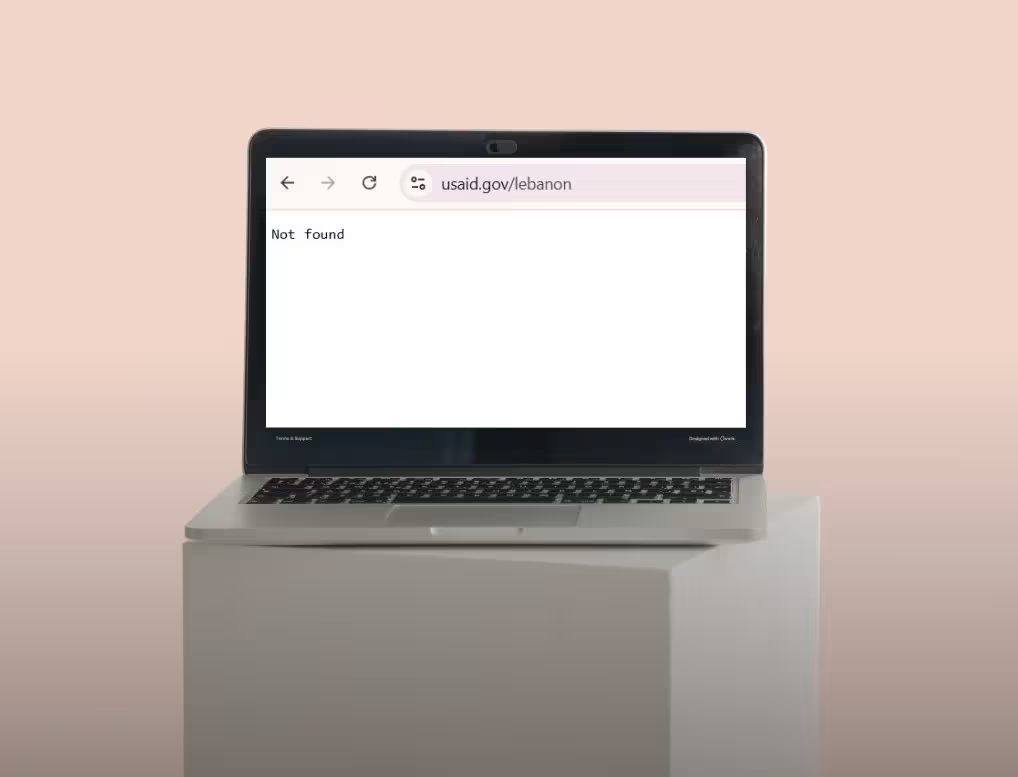
Screenshot from the USAID website.
On January 24th, 2025, Donald Trump signed an Executive Order freezing all US foreign aid funds around the world, with the exception of food and military aid for Egypt and Israel. USAID constituted 22% of Lebanon’s total aid, making it the biggest donor in the country. The impact is already considerable, and we have yet to see accurate figures, but beyond numbers and figures, this blog sheds light on people’s stories. Those who are still in Lebanon weathered many challenges, including multiple crises, and most recently, the Israeli war on Lebanon.
USAID employees in Lebanon are uncertain whether they will get paid or even have a job after the three-month freeze. Their households are directly affected by the loss of income. According to reports, at least 600 students between the American University of Beirut (AUB) and the Lebanese American University (LAU) alone, lost their scholarships, amounting to 20,000$ per student on average and jeopardizing the course of their education.
Organisations contacted for this article were not permitted to disclose any information. Those who wanted to share their story made sure the organisation was not mentioned and did so while remaining anonymous.
A 30-year-old woman, working in an organization in the agriculture sector for two years, stopped getting paid and revealed that NGOs and INGOs have been secretive about the loss of funding and layoffs. They are unsure of the extent of the losses, nor how permanent they will be. Considering that, in some cases, the funding was paused and not cancelled, pending an evaluation from the Department of State, they’ve decided to remain silent in the hope that the funding will be reinstated. According to the woman interviewed, "there is a decision not to discuss this. The less people know about what’s happening the less they can talk about it. The management didn't even schedule meetings with us explaining what happened. They only sent emails saying there is no more funding". Given that she pays for her education and supports her household, she expressed that remaining unemployed is not an option: “[I would be able to last] zero months. It was a sudden layoff, ten of us received the same notice. I didn't receive my February salary and I'm not hopeful about March".
Losing one's income in Lebanon is not an individual problem, it's almost always a whole household’s ability to survive day-to-day that is threatened.
A young father of one, who works on a project basis, recounts that he was suddenly informed about the funding cuts in two different jobs that were exclusively funded by USAID. “I have savings ready because I know I am working on a project basis. Even while implementing a project, a serious organization should be actively looking for funding otherwise no job is guaranteed. What I am really worried about is that so many people are now looking for work, I'm not even receiving rejection emails from jobs I'm applying to. The market was already saturated and now it will become even more competitive. I remain optimistic, nonetheless. I feel at my age the blow is less severe than for people in their late 40s, I think they have much more to lose.”
Yet, for the youth, Lebanon is notoriously not the place to dream. In 2020, 77% of the people in Lebanon aged between 18 and 24 said they were seeking an opportunity to leave the country. However, some with the opportunity to leave still choose to stay in Lebanon and be at the risk of the impact of its crises. A young Lebanese man, holding an American passport, recently finished his Master's degree and was in the final stages of the recruitment process in an institution that relied heavily on US funding, when he was informed the process was halted due to the cuts.
When looking for those indirectly impacted, the situation becomes more bleak. The principal of a school known for its program for children with special needs explains: "A Lebanese NGO was offering our staff and students post-war mental-healthcare sessions. The staff received their sessions, but the cut happened before the students received theirs, and the NGO is no longer able to move forward with any of its projects currently. Some of the students lost their homes, and others, family members during the war".
As a response to the instability, and in an attempt to take control, the desire to establish small side gigs or businesses is growing. According to a MasterCard article, there is a clear entrepreneurial shift among the youth in the region, with many starting their own businesses to make more money and take control of their livelihood. Entrepreneurship can be exciting and sometimes needed in times of crises, as in the case of Lebanon, but it cannot in the short term constitute a reliable source of financial stability for young people.
While the world attempts to recover from the Trump Administration's decisions, organisations operating in the global south are compelled to consider fresh and innovative solutions to make up for the gap that the USAID cuts have caused in view of achieving more sustainability.
Date of publication
Location
Lebanon