
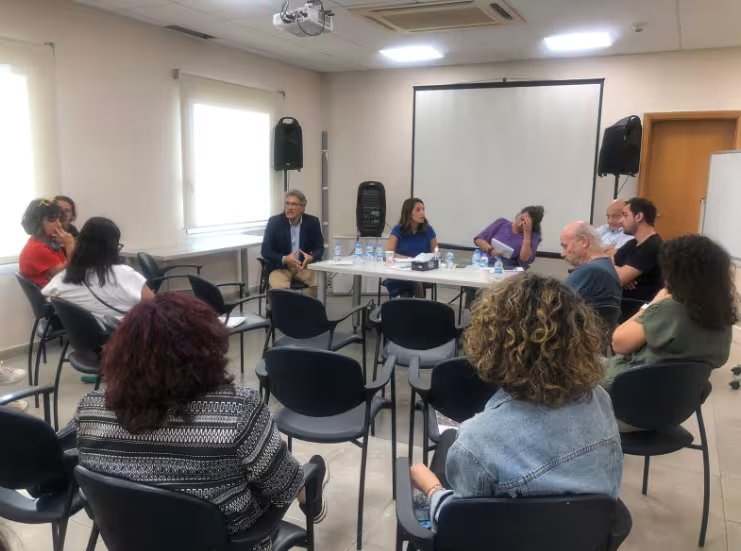
September 25, 2025 — Organized by CeSSRA- Moderator Sobhiya Najjar
On September 25, 2025, CeSSRA convened a roundtable discussion titled “The End of the Grant Era: Implications and Potential for Civil Society Actors in Lebanon,” bringing together local civil society actors to reflect on the shifting funding landscape and its impact on the sector. Against a backdrop of shrinking civic space and declining donor support, panelists examined how organizations in Lebanon can move beyond dependence on international grants toward more creative, resilient, and solidarity-based models of operation. The discussion, featuring interventions from Farah Salka (Anti-Racism Movement), Ziad Abdel Samad (Arab NGO Network for Development), Nadim Abdo (Arc en Ciel), and Jean Kassir (Megaphone), underscored both the urgency and opportunity of rethinking sustainability and collaboration in this evolving context.
The discussion unfolded at a moment of historic contraction in international aid. Major donors have scaled back sharply: the U.S. slashed USAID programs by 83 percent, the U.K. reduced its budget by 40 percent, France by 37 percent, while the EU announced a €2 billion cut to its cooperation budget for 2025–2027, with further reductions still under debate.
Lebanon mirrors this global crisis with devastating clarity. In 2023, $935 million in grants were disbursed while $189 million remained suspended. By 2025, UNICEF’s humanitarian appeal for Lebanon was cut by nearly a third, leaving three in ten children without access to essential medicines and almost four million people in need of assistance.
Against this backdrop, Lebanese civil society remains both indispensable and under immense strain. The sector continues to shoulder roles that extend far beyond emergency relief — advocating for rights, scrutinizing public spending, and holding institutions to account. Yet the abrupt shrinking of resources has exposed deep vulnerabilities, leaving organizations to navigate uncertainty, rising competition, and a growing disconnect between donor agendas and community needs.
This panel gathered leading voices, Farah Salka (Anti-Racism Movement), Ziad Abdel Samad (Arab NGO Network for Development), Nadim Abdo (Arcenciel / Lebanese Social Enterprises Association), and Jean Kassir (Megaphone) to confront this new reality. Their interventions moved between stark warnings and practical alternatives, offering pathways for survival and reinvention in what many called the “post-grant era.”
[[{"type":"media","fid":"109193","view_mode":"default","instance_fields":"override","field_file_image_alt_text[und][0][value]":"","field_file_image_title_text[und][0][value]":""}]]
Ziad Abdel Samad’s Intervention – Arab NGO Network for Development (ANND)
Ziad Abdel Samad framed the crisis of shrinking aid within broader global dynamics: wars, economic slowdowns, and donor retrenchment are driving states to cut development budgets, prioritizing military and security spending instead. This shift, he noted, is deepening public debt across the Arab region and eroding investment in health, and humanitarian interventions in conflict areas, education, and social protection leaving civil society squeezed between rising needs and shrinking support.
Yet, Abdel Samad rejected a narrative of victimhood. He argued that funding civil society should not be seen as charity, but as a right: organizations and citizens are entitled to resources that allow them to play their role in accountability, democracy, and development. Austerity measures, he warned, hit marginalized groups hardest, making NGOs’ advocacy and watchdog roles more crucial than ever, and lack of funding will reduce the influence of CSO thus weakening social cohesion and stability.
His intervention focused on turning to Arab and regional alternatives. He pointed to the Arab Monetary Fund, the Gulf Cooperation Council, and wealthy local actors as untapped sources of support, stressing that resources exist within the region but remain underutilized due to weak coordination and lack of political will. Civil society, he urged, must strategically engage with these institutions instead of relying exclusively on Northern donors, however stability and prosperity is in the interest of local and regional investors as well.
Finally, Abdel Samad underlined that regional cooperation is no longer optional. Shared challenges, including food security, energy, water, and human security cannot be addressed by fragmented national approaches. He also tied the funding squeeze to wider geopolitical instability, from Israeli expansionism to conflicts in Sudan, Libya, and Somalia, all of which demand collective Arab strategies.
His message was cautiously optimistic: the “end of the grant era” does not have to spell the decline of civil society. Instead, it should mark the beginning of a more autonomous, regionally rooted model, built on solidarity, rights-based funding, and the mobilization of Arab resources.
Nadim Abdo – Arcenciel
Nadim Abdo placed the current funding crisis in perspective: for Arcenciel, the volatility of grants has never been a surprise. Since its founding more than four decades ago, the organization has worked on the principle that donor money cannot guarantee survival. Instead, it deliberately built a hybrid model blending service delivery, revenue generation, advocacy, and environmental responsibility. This approach has enabled continuity while strengthening trust with communities.
He stressed that sustainability begins with communities. Arcenciel co-designs services with marginalized groups, a practice that has anchored its legitimacy and translated grassroots engagement into structural change most notably through its role in advocating for Law 220/2000, which recognized the rights of people with disabilities.
To reduce dependency on external aid, Arcenciel developed self-financing streams. By generating and reinvesting income from its services, the organization gained autonomy and the ability to prioritize its mission over donor cycles.
For Abdo, resilience depends on solidarity. Arcenciel has built referral systems and partnerships across sectors, recognizing that no single actor can meet all needs. This cooperative model avoids duplication and maximizes collective impact.
Arcenciel also links financial sustainability with environmental responsibility. Projects like La Brocante and La Boutique Sociale turn waste into income while promoting reuse, while initiatives in renewable energy, water management, and biopesticides lower costs and reinforce ecological resilience.
Abdo distilled his message into four insights: sustainability is built, not granted; civil society must innovate as social entrepreneurs; solidarity ensures survival while competition weakens the sector; and resilience comes from aligning economic models with values and accountability.
He reframed the “end of the grant era” as a chance for reinvention rather than decline. Arcenciel’s experience shows that hybrid models, innovation, and cooperation are not optional but essential foundations for a more autonomous civil society.
Farah Salka; Anti-Racism Movement (ARM)
Farah Salka argued that the decline and collapse of traditional donor/ grant support models should be treated as a wake-up call. Rather than surrendering to exhaustion and fragmentation, she urged serious civil society groups to seize this moment to read the room well, and redefine our relationship with donors where we can and while we can, through standing our ground, strengthening our independence, and naming our non-negotiables.
Her suggestions began with well defined and fleshed out “red lines” related to donor relationship and funding policies: organizations must decide internally and strategically - always politically - and weigh which compromises they can accept and which they cannot, keeping in mind what each decision can entail. Building candid relationships with donor focal points, pushing back against false and performative claims of “flexibility,” and holding funders accountable to their own mandates are essential steps and necessary parts of the work. Salka stressed that advocacy should not only be directed at governments but also donors, governmental, feminist organisations, foundations, or INGOs, they all must be pressured to share responsibility and labour, reiterating that the responsibility to push back cannot fall on grassroots groups alone.
For sustainability, she called for collective imagination and experimentation. Among the models she mentioned:
- Sustainability funds built through savings, memberships, or in-kind contributions,
- Engaging diaspora and young philanthropists, including alternative profiles to rely on,
- Securing land or property as long-term assets,
- Pooling resources across movements, and remembering that “standalone projects will never change the world but movements have and do" so we need to focus on what's important and reasonable given all limitations coming at us from all sides.
Finally, she underscored the importance of resource redistribution, particularly toward migrant-led initiatives and other heavily under-resourced and systematically marginalized communities. ARM is already piloting flexible support initiatives, opening its community space for collective use in secure and safe ways, and actively facilitating direct donor links with grassroots actors.
For Salka, the path forward revolves around what we know for sure: civil society must stop letting donor systems dictate its priorities and its life, death, success, impact and potential. By keeping work grounded and political, defining non-negotiables and keeping them up to date always, building creative cooperative models or other forms of alternative models that can withstand these incredibly harsh transitions (that are meant to break us), and investing in community-driven possibilities, organizations can reclaim their mandates and ensure their contributions to their movements, with least possible bureaucratic and admin distractions, their relevance and their chance at continued life and impact can continue to be a possibility.
Jean Kassir – Megaphone
Jean Kassir shared reflections on how independent media, like Megaphone, is navigating the funding squeeze. He traced the outlet’s journey: born as a small volunteer-driven initiative, it grew after the October 17 uprising into one of Lebanon’s leading alternative media voices. To sustain that growth, Megaphone relied heavily on grants but only those without editorial strings attached or political interference.
Today, around 80% of Megaphone’s budget comes from grants, with the rest drawn from services, editorial trainings, video production, donations, and limited crowdfunding. Yet Kassir stressed that survival requires diversification.
Three main strategies are being explored:
- Regional alliances: forging unions or agreements with other Arab independent media outlets, with the aim of creating joint funding channels.
- Diaspora partnerships: mobilizing progressive Lebanese abroad in collaboration with local civil society actors, ensuring resources reflect Megaphone’s values.
- Membership program: set to launch with the new website, encouraging readers and followers to directly finance the outlet.
Additional income will also come from media services such as video production. But Kassir warned the timeline is critical: within two years, many independent outlets could disappear if alternative resources aren’t secured. For him, diaspora support is key and urgent. Without it, Lebanon risks losing the few platforms still able to challenge dominant narratives that control the mainstream landscape as they are supported by important financial resources. In order to counter these, or propose alternative narratives, resources are also required.
[[{"type":"media","fid":"109194","view_mode":"default","instance_fields":"override","field_file_image_alt_text[und][0][value]":"","field_file_image_title_text[und][0][value]":""}]]
Conclusion
The discussion was not limited to the panelists alone; the audience echoed similar concerns. Participants shared their own experiences of shrinking resources and rising pressures, underlining that the crisis is felt across the entire sector. The discussion was lively, but also sobering: everyone recognized the need to pause, to think collectively, and to imagine new beginnings. The call was not only for resilience, but for fresh models of grant-making, resource generation, and sustainability that can safeguard organizations and, above all, protect the communities they serve.
Though each speaker approached the crisis from a different angle, their interventions revealed four clear points of convergence.
First, they all agreed that traditional donor dependency is no longer viable. Whether through Arcenciel’s hybrid model, Megaphone’s diversification strategies, ARM’s push for cooperative ownership, or ANND’s call for Arab-led funding, each underscored the urgency of building financial autonomy beyond grants.
Second, there was a shared insistence on solidarity over fragmentation. From Abdo’s referral networks to Salka’s collective imagination, from Abdel Samad’s regional cooperation to Kassir’s media alliances, the message was consistent: competition weakens, but cross-regional and South-South collaboration across organizations and sectors strengthens the sector’s credibility and survival.
Third, all four stressed that legitimacy must come from communities, not donors. Civil society will only remain relevant if it grounds its work in grassroots needs, defends rights, and maintains accountability to the people it serves whether through Arcenciel’s co-design with marginalized groups, ARM’s redistribution to migrant initiatives, or Megaphone’s audience-supported membership model.
Finally, they agreed that this moment requires imagination and courage to experiment with new models. Cooperative funds, environmental innovation, diaspora philanthropy, Arab regional resources, and digital-age support systems were all put forward as practical ideas to reinvent sustainability.
In sum, the panel concluded that the “end of the grant era” should not be seen as the collapse of civil society but as an inflection point. By diversifying resources, fostering solidarity, rooting legitimacy in communities, and daring to innovate, Lebanon’s civil society can move from a position of precarity to one of renewed autonomy and resilience.
Scope
National
Intervention Sectors
Development
Humanitarian & Development Financing
Organisation
Files
synthesis_of_panel_discussion_25sept25.pdf
(625.06 KB)
Publishing Date
Countries
Lebanon
Resource Type
Article
Theme
Civil Society Development
Dossier
Civil Society Development