
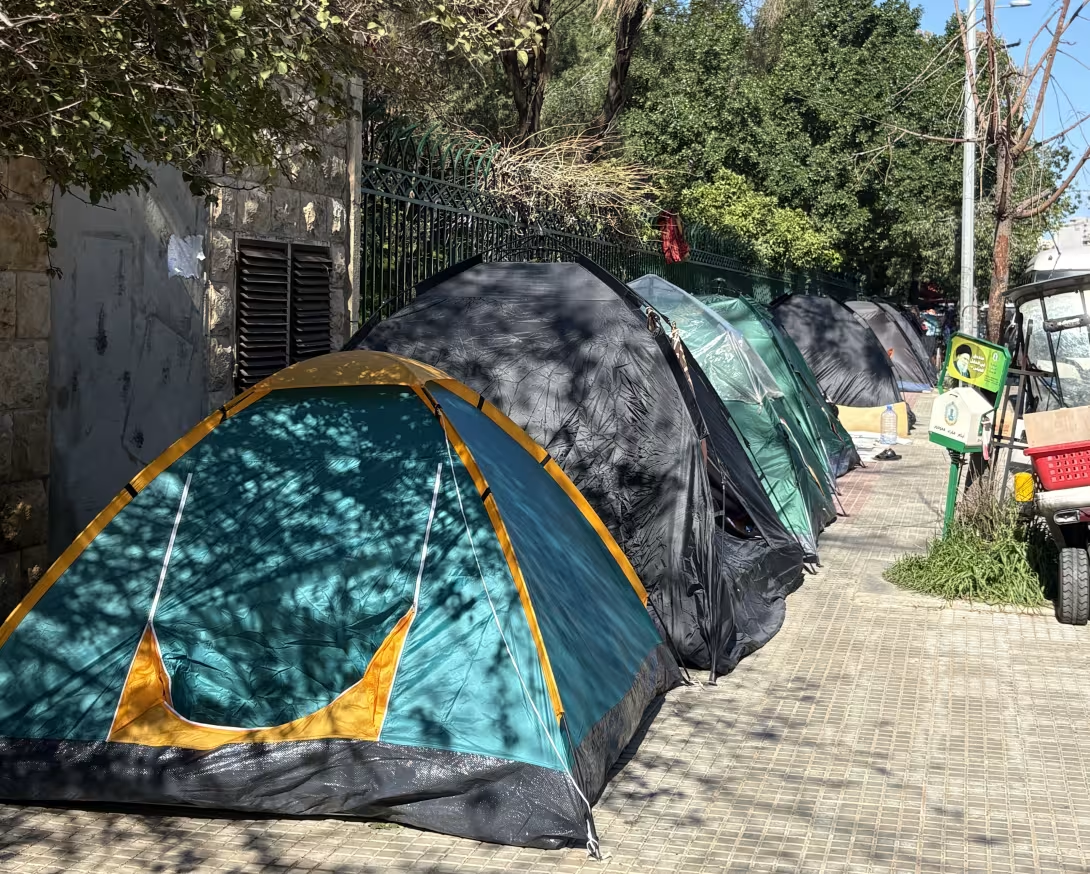
Horsh Beirut 2026. Source: Miriam Younes
Horsh Beirut is the largest public green space in Beirut. Originally a natural forest on the outskirts of the growing city, its history stretches back to the early 17th century during the Ottoman period, when it covered 1.2 million square meters. In the 1960s, the forest was fenced off and officially designated a "public park." However, much of it was destroyed during the Israeli invasion of 1982. Today, the Horsh spans 0.3 square kilometres and connects several diverse residential neighbourhoods, including Chiyah, Ghobeiry, Tariq El Jdeedeh, and Badaro. The park remained closed to the public from 1982 until 2015. After pressure from civil society reclaiming the Horsh as public space for Beirut citizens, it officially reopened in 2016.
My first encounter with Horsh Beirut was in autumn 2019, during the widespread protest movement in Lebanon and the early stages of the economic crisis gripping the country. Amid the chaos, confusion, and flickering hope of that moment, I would sometimes walk in the park to clear my head or meet friends. During these visits, I got to know a group of young women from Dahiyeh who gathered in the park to read the Quran and discuss what they had read. They were all devoutly religious young women in their early twenties and firm Hezbollah supporters. Over time, we exchanged brief conversations about the Horsh, daily life, and our respective reasons for being there. There was a degree of mutual sympathy between us, even though our worldviews could not have been more different. While I was hoping for a far-reaching social and political reinvention of Lebanon through the protests, the young women were convinced of the moral, religious and political righteousness of Hezbollah’s role in Lebanon, and therefore defenders of the status quo,
A few months later, the Horsh was closed to the public due to COVID-19, the protests gradually subsided, hopes for a new beginning faded, and Lebanon entered a prolonged cycle of crises and despair, from the August 4 2020 port explosion to the profound and prolonged impacts of the economic collapse. I never knew what happened to the group of young women.
Still, the Horsh remained a place I returned to regularly, largely because of its proximity to my home. Located in the middle of the loud and crowded city, the park is beautiful in every season: in autumn and winter, the rain turns it lush and fresh; and in spring, the trees and flowers come into bloom, filling the park with colour. I went primarily to enjoy the calm and to take a break from urban life. Yet the more regularly I visited, and the more I spoke with fellow regulars and observed the park and its visitors, the more I came to see how much it reflected the tensions, divisions, but also connections and proximity present in the social fabric of the country itself. Situated close to four socially, economically and confessionally diverse neighbourhoods, the Horsh had become a popular destination for the residents of these neighbourhoods, particularly on weekends, for picnics, sports, children's play, and relaxation. While these activities created opportunities for interaction and acquaintance among the park's varied visitors, they also provided pretexts for blaming the perennial other for whatever grievances the park gave rise to. From drug dealing, harassment, littering, and noise, to the destruction of nature, disregard for privacy, or simply unfamiliar behaviour and appearance, many visitors seemed to know precisely which group was responsible for the park falling short of what they felt it should be: safe, clean, beautiful, and well looked after.
In a sense, this dynamic extended beyond the human presence. I visited the park regularly to look after a growing population of stray animals, cats and dogs that had been abandoned there or had somehow found their way in. The dogs in particular were a constant source of contention. Some people came to the Horsh specifically to visit them, bringing food and giving them names; others insisted repeatedly that the park was for people, not animals, and that the strays posed a danger to other visitors.
Underlying all these grievances and disputes was a more fundamental question: who did the Horsh "belong" to, and what were the rules governing its use? In the absence of any clear guidelines on the use of public space and in a country where public space is itself scarce, each group or individual tended to answer that question on their own terms.
In autumn 2024, when the war between Hezbollah and Israel escalated over two months, many families displaced from the south or the Dahiyeh came to the Horsh to escape the daily bombardment. In the early days, the park was quickly transformed into a crowded open-air camp: people erected tents, stored basic belongings brought from their homes and shifted the routine of daily lives into the park. In addition to the resident stray animals, many displaced families had brought their pets: cats, dogs and even a rooster wandered freely through the grounds. Residents from the surrounding neighbourhoods largely adapted to this new reality with solidarity and empathy. Grassroots relief initiatives and NGOs passed through every day to attend to the needs of the displaced people, distributing food, water, clothing, and basic shelter supplies.
At a certain point, however, this dynamic shifted, and the question of the park’s “ownership” resurfaced: Word began to circulate that the municipality would only permit Lebanese families to remain in the Horsh. A few days later, when I visited, the non-Lebanese families (mainly Syrians and Palestinians) had moved their tents to outside the park’s entrance. Another week on, only a handful of Lebanese families remained inside the Horsh: most had been relocated to an official shelter in a school in Karantina. When I asked those still there how they had managed to stay, they told me they had used personal connections to avoid being evicted. They preferred the park over the official shelter because of its proximity to their homes, which allowed them to check on their properties and kept them in a familiar environment.
The day after the ceasefire was announced, I did my usual round through the park, expecting to say goodbye to the people I had seen every day over the previous two months. The park was empty. Everyone had left during the night or early that morning. Only a few remaining mattresses, empty tins, and plastic utensils indicated that just twenty-four hours earlier, the Horsh had been a makeshift shelter for dozens of displaced people. Routine returned quickly: the dogs and cats took up their usual positions near the entrance, waiting for food and attention, and the familiar regulars reappeared, exercising, meeting friends, or simply enjoying the park. The Horsh belonged once again to "us", whoever that may have been, and the same quarrels and disputes quietly resumed.
For approximately three weeks now, we have been at war again. As before, hundreds of thousands of people were forced to leave their homes in an instant, on a cold winter’s night. And as before, many made their way to the Horsh, seeking refuge from the bombs in the open space of the park. But the following day, things unfolded differently from the previous war: the municipality decided to close the park to the displaced. People were permitted to spend time there and use the bathrooms, but no one was allowed to erect a tent or sleep overnight. With an estimated one million people displaced across the country, the sight of an empty park surrounded by neighbourhoods being bombed daily seemed an absurd response to the question of who the Horsh belonged to. Hundreds of people settled in the area around the park instead and erected tents on the pavements outside. To this day, the park itself remains largely empty, while along its entrance and the broad surrounding sidewalks, tents, cars, clothes, and basic belongings are piled up, and people sit together, talk, and do what they can to make their temporary situation more bearable.
As last time, people with personal initiatives and NGOs quickly appeared to support those displaced. Yet the scene was noticeably different. Where the Horsh with its greenery and open space had previously offered the displaced some degree of privacy and calm, the pavement outside rapidly became overcrowded, with little room or respite. The exhaustion and distress on people's faces were hard to avoid. They are living with daily uncertainty, fear, and little sense of what comes next. Tensions surface repeatedly, among the displaced themselves, between them and passers-by, the stray animals, relief workers, and the park's guards, over space, privacy, food, aid, and politics. With the park's quiet, empty grounds visible in the background, the question of who the Horsh belongs to has been pushed out onto a harsh and overcrowded pavement, raising not only who is entitled to public space, but also how long the current situation can hold.
I still pass by nearly every day. I help with an initiative supporting the displaced people there, and I check on the stray animals, some of whom have formed an unlikely alliance with the new arrivals, sharing food, warmth, and company. A displaced family told me recently that two of the stray dogs had followed them back to their home in Chiyah when they went to collect some belongings. "They waited downstairs while we packed, and then walked back with us to the Horsh. I felt they wanted to protect us." They had bought the dog's food as a thank you. Stories like this are a reminder that the Horsh, even in times of conflict and crisis, remains a space where people and animals find one another, and where some small measure of comfort and consolation is still possible.
Date of publication
Location
Lebanon