Resources

Intervention Sectors
Resource Type
Displaying 1 - 20 of 113
International
Publishing Date
This report brings together insights gathered through extensive desk-based research conducted as part of the Fair Game project 2024 across six diverse countries: Italy, Lebanon, Morocco, Palestine, Portugal, and Romania. The main goal was to explore the complex challenges that excluded and vulnerable youth face in these unique national contexts. The research involved a thorough examination of existing interventions aimed at addressing these challenges. By evaluating their effectiveness, the study aims to establish a foundation for developing targeted training programs and recommending...
National
Publishing Date
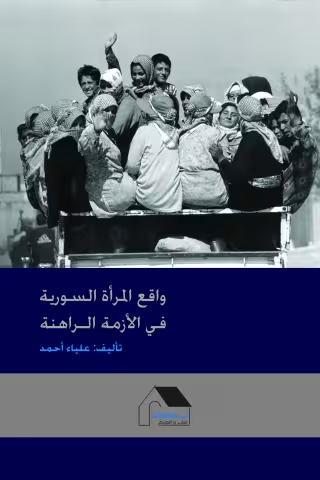
هل تغيّرت، أو تخلخلت، الصورة النمطية للمرأة في الواقع الراهن في سورية؟ هذا هو السؤال المؤسس لهذه الدراسة التي تسعى فيها الباحثة لرصد تحولات المكانة الاجتماعية للمرأة من خلال متابعتها لمدى المشاركة النسوية في الحياة العامة، في سورية. تركز الباحثة على فترة الأزمة الحالية متسائلة «هل يمكن أن يشكل انخراط المرأة السورية في الأزمة، موالاةً أو معارضة، معبراً إلى إنجاز بقية حقوقها... أم يزيد من معاناتها؟
National
Publishing Date
Lebanon may witness a remarkable rise in the number of women serving in Parliament come May 2018 due to initiatives from women’s groups, “civil society” activists, and the substantial number of female candidates – 113 at the start of the election period. However, as this briefing paper shows, Lebanese women continue to face numerous challenges in entering government. The new electoral law passed in June 2017 does not provide women with equal opportunity to be elected, and it is yet to be seen whether it will increase female representation in Parliament. Nevertheless, the historic number of...
National
Publishing Date

Working Paper | February 2014
The Dilemma of Human Rights In Lebanese Electoral Laws by Elie Al-Hindy
This study concludes with a number of recommendations with respect to the issues that need to be introduced to the debate and that can strengthen advocacy efforts by the different stakeholders involved. Reflecting on all of the above, and in light of the current political realities in Lebanon, including present sectarian demographics and political structure, the study concludes that the standards imposed on the new electoral law is impossible to meet, as no law, which this study has reviewed...

National
Publishing Date
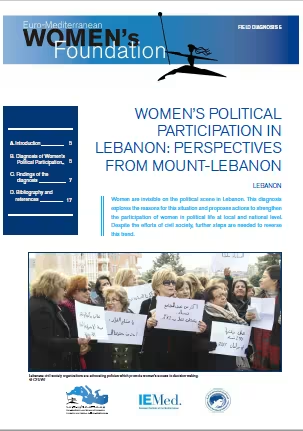
Although Lebanon is sometimes considered as the only democratic country in the Arab region with a free political environment and electoral system, the situation of women has not been strengthened enough for them to have a role on an equal footing with men. Lebanese women form a majority of 53% and they are actively participating in all aspects of Lebanese society. They enjoy equal constitutional rights with men and have the right to vote, hold public office, elect and be elected in municipal councils. Yet, this diagnosis, elaborated by the Committee for the Follow-Up on Women’s Issues (CFUWI)...
National
Publishing Date

In the absence of a clear national plan for Integrated Waste Management (IWM), and due to various political and governmental issues, Lebanon has had to face a serious waste crisis in 2015.  The paper scrutinizes events leading up to the 17th of July 2015, and the impact of its aftermath on Lebanon’s environment, infrastructure, health and landscape. Parallels are drawn throughout the paper to a similar crisis faced by residents of Campania, Italy.


This paper thoroughly analyzes Lebanon’s “waste profile” and benchmarks it against a spectrum of countries to further understand global trends in...

National
Publishing Date
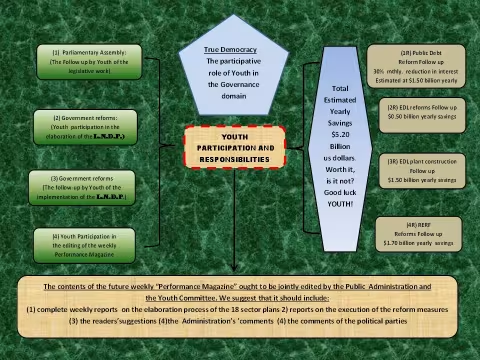
LET THE KIDS DO IT A lot has been said and printed about the role that is expected to be performed by YOUTH in the governance process, and here I am thinking generally of University undergraduates.  However, I do not recall reading any serious and studied proposals on the subject. It is as though, some of our esteemed dinosaur leaders consider the idea so “farfetched “that, for them, it is not really worth considering. They ask: “Do you seriously think that “kids” can tell us what to do or not do? The answers would be: First, these “kids”, as you call them, can come up with some fresh ideas...
National
Publishing Date

Working Paper | April 2015
Social Justice and the Arab Uprisings by Amaney A. Jamal and Michael Robbins
As the Arab Spring proceeded, massive changes swept across the region. Long-standing stability gave rise to ongoing chaos in some countries, most notably Syria and Libya, but also to a significant extent in Tunisia and Egypt. Meanwhile, Islamist parties won free and fair elections in Egypt and Tunisia and were allowed to come to power. These and other changes greatly altered the political landscape across the region. The importance of these changes cannot be overstated. Yet, amidst talk of a...

National
Publishing Date

Research Report | April 2015
In this paper, we analyze the susceptibility of agricultural outputs to future climate change in Lebanon, and the extent to which it propagates to the economic system as a whole. We use a methodological framework in which physical and economic models are integrated for assessing the higher-order economic impacts of projected climate changes. By using this integrated modeling approach, we are able to quantify the broader economic impacts in the country by considering not only the temporal dimension but also the regional disaggregation of the results. Our estimates...

National
Publishing Date

Working Paper | March 2015
Sustainable Transportation and Mega Sporting Events in Arab Countries: the Case of Qatar by Robert Wittkuhn and Danyel Reiche
​Qatar has successfully developed into a hub for mega sporting events; the most prestigious of them will be the FIFA World Cup in 2022. Qatar promotes it as the “first completely carbon-neutral” and “most compact” World Cup. Such statements emphasize a very small impact of transport on the event’s carbon footprint; but they also raise questions about the understanding and applicability of carbon neutrality. As motive for hosting mega events...

National
Publishing Date

Working Paper | February 2015
Commuters’ Behavior towards Upgraded Bus Services in Greater Beirut: Role of Itinerary and Implications for Greenhouse Gas Emissions, Social Welfare and Transport Policy by Ali Chalak, Hani Al-Naghi, Alexandra Irani, and Maya Abou-Zeid
Climate change is one of the most critical environmental challenges facing the world today. The transportation sector alone contributes to 22% of carbon emissions, of which 80% are contributed by road transportation. In this paper, we investigate the potential greenhouse gas (GHG) emissions reduction and social welfare gains...

National
Publishing Date

Working Paper | February 2015
Economic Impacts of Adopting a Sustainable Transport System in Beirut by Mazen Omran, Johnny Ojeil, and Youssef Fawaz
​The work carried out in this paper demonstrates the economic benefit of a sustainable transport system. It compared a scenario with and without such system, and calculated loss time as a result of being held up in congestion during key peak hours mainly due to relying entirely on the private car. The work demonstrates that in addition to reducing congestion levels a sustainable transport system will generate benefits related to travel time...

National
Publishing Date

Working Paper | February 2015
Getting to Campus: Sustainable Public Transportation and Relocating the American University in Cairo by Richard Tutwiler, Hagar Eldidi, Yumna Kassim, and Andrew Petrovich
​Cairo is one of the most congested cities in the world, and public transportation is one of its greatest challenges. Government strategies to alleviate congestion have stressed horizontal expansion into the surrounding desert areas and the construction of more and ever larger motorways. This paper uses the experience of the American University in Cairo, which physically relocated in 2008 from...

National
Publishing Date

Working Paper | February 2015
Harnessing Motorists' Potential Demand for Hybrid-Electric Vehicles in Lebanon: Policy Options, CO2 Emissions Reduction and Welfare Gains by Alexandra Irani and Ali Chalak
Public concern over deteriorating air quality and the associated local and global impacts has grown significantly in the past decade. Air quality degradation is linked first and foremost to the transportation sector in the Arab region with about 90% of total emissions of carbon monoxide resulting from transportation activities. In Lebanon’s capital, Beirut, current levels of ozone and smog...

National
Publishing Date

Working Paper | February 2015
Sustainable Transportation in the Arab World: International Benchmarking on Sustainable Transport Policies and their Impacts by Issam Kaysi and Farid Chaaban
​The world’s transport sector still suffers from unsustainable trends that lead to increased levels of greenhouse gas (GHG) emissions. There have been efforts, in the Arab world, as well as the rest of the world, to tackle the issue. Work done in the US and Europe exceeds that of the Arab world, and their efforts have been successful, and have thus succeeded in reducing GHG emissions. In the Arab world, most...

National
Publishing Date
This working paper analyzes the susceptibility of agricultural outputs to future climate change in Lebanon, and the extent to which it propagates to the economic system as a whole. A methodological framework in which physical and economic models are integrated for assessing the higher-order economic impacts of projected climate changes is used. The researchers then quantify the broader economic impacts in the country considering not only the temporal dimension but also the regional disaggregation of the results. The results show that there are potential high costs and risks associated with a...