Resources

Intervention Sectors
Resource Type
Displaying 1 - 20 of 111
International
Publishing Date
This report brings together insights gathered through extensive desk-based research conducted as part of the Fair Game project 2024 across six diverse countries: Italy, Lebanon, Morocco, Palestine, Portugal, and Romania. The main goal was to explore the complex challenges that excluded and vulnerable youth face in these unique national contexts. The research involved a thorough examination of existing interventions aimed at addressing these challenges. By evaluating their effectiveness, the study aims to establish a foundation for developing targeted training programs and recommending...
National
Publishing Date
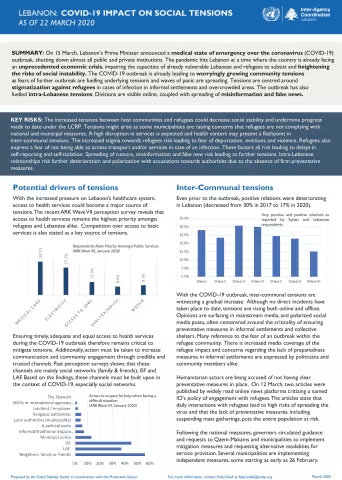
On 15 March, Lebanon’s Prime Minister announced a medical state of emergency over the coronavirus (COVID-19) outbreak, shutting down almost all public and private institutions. The pandemic hits Lebanon at a time where the country is already facing an unprecedented economic crisis, impairing the capacities of already vulnerable Lebanese and refugees to subsist and heightening the risks of social instability. The COVID-19 outbreak is already leading to worryingly growing community tensions as fears of further outbreak are fuelling underlying tensions and waves of panic are spreading. Tensions...
National
Publishing Date
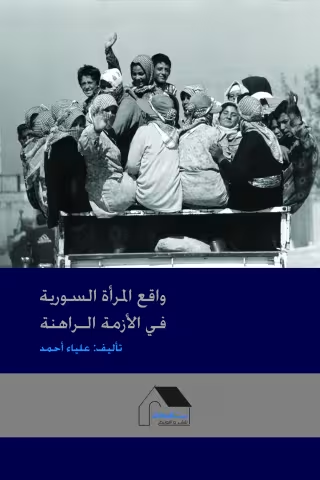
هل تغيّرت، أو تخلخلت، الصورة النمطية للمرأة في الواقع الراهن في سورية؟ هذا هو السؤال المؤسس لهذه الدراسة التي تسعى فيها الباحثة لرصد تحولات المكانة الاجتماعية للمرأة من خلال متابعتها لمدى المشاركة النسوية في الحياة العامة، في سورية. تركز الباحثة على فترة الأزمة الحالية متسائلة «هل يمكن أن يشكل انخراط المرأة السورية في الأزمة، موالاةً أو معارضة، معبراً إلى إنجاز بقية حقوقها... أم يزيد من معاناتها؟
National
Publishing Date
Lebanon may witness a remarkable rise in the number of women serving in Parliament come May 2018 due to initiatives from women’s groups, “civil society” activists, and the substantial number of female candidates – 113 at the start of the election period. However, as this briefing paper shows, Lebanese women continue to face numerous challenges in entering government. The new electoral law passed in June 2017 does not provide women with equal opportunity to be elected, and it is yet to be seen whether it will increase female representation in Parliament. Nevertheless, the historic number of...
National
Publishing Date

Working Paper | February 2014
The Dilemma of Human Rights In Lebanese Electoral Laws by Elie Al-Hindy
This study concludes with a number of recommendations with respect to the issues that need to be introduced to the debate and that can strengthen advocacy efforts by the different stakeholders involved. Reflecting on all of the above, and in light of the current political realities in Lebanon, including present sectarian demographics and political structure, the study concludes that the standards imposed on the new electoral law is impossible to meet, as no law, which this study has reviewed...

National
Publishing Date
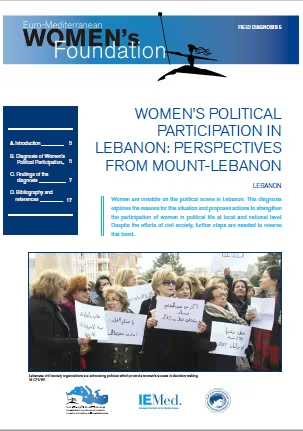
Although Lebanon is sometimes considered as the only democratic country in the Arab region with a free political environment and electoral system, the situation of women has not been strengthened enough for them to have a role on an equal footing with men. Lebanese women form a majority of 53% and they are actively participating in all aspects of Lebanese society. They enjoy equal constitutional rights with men and have the right to vote, hold public office, elect and be elected in municipal councils. Yet, this diagnosis, elaborated by the Committee for the Follow-Up on Women’s Issues (CFUWI)...
National
Publishing Date
This report aims to explore the fragmented organisation of healthcare services in Lebanon, for Syrian refugees. Although it is not an assessment of the Lebanese healthcare system, this report does nevertheless reflect on the challenges and underlying dynamics of the current Lebanese system, which are reproduced in the healthcare provision for Syrian refugees. In this sense, the report highlights the privatised, rather ad hoc, and irregular provision of healthcare in Lebanon, notably for Syrian refugees, which tends to take on a more curative rather than preventive approach, resulting in...
National
Publishing Date
Since the uprising in Syria in March 2011, over 4.3 million Syrians have fled to neighboring countries. Over a million have sought refuge in Lebanon, constituting almost a quarter of the Lebanese population and becoming the largest refugee population per capita in the world. With inequitable health coverage being a longstanding problem in Lebanon, Syrian refugee women’s health, and specifically their sexual and reproductive health, is disproportionately affected. An increase in gender-based violence and early marriage, a lack of access to emergency obstetric care, limited access to...