This report presents findings from a survey conducted from 3-11 July, 2017 with three distinct refugee groups in Lebanon: Syrian refugees; Palestine refugees from Syria; and Palestine refugees from Lebanon.
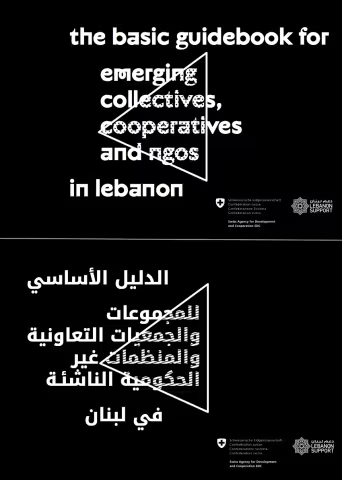
يهدف هذا الدليل الثنائي اللغة للتزويد بالأدوات والمهارات لتأسيس مجموعة أومؤسسة وتنظيم عملها في لبنان، ونُشرَ ضمن مشروع قاعدة المعرفة حول المجتمع المدني، بالشراكة مع الوكالة السويسرية للشراكة والتعاون (SDC).
يجمع تصميم الدليل بين اللغتين العربية والانكليزية من أجل التأكد من وصوله لأكبر عدد ممكن من الفاعلين. وقد صمّمته نايلا يحيا.
This resource published within Lebanon Support's Humanitarian Knowledge Base, in partnership with the Swiss Agency for Development and Cooperation (SDC), aims to provide the tools and know-how to establish an organisation or collective and operate in Lebanon. It provides the basics relevant to establishing and running an NGO or unregistered group in Lebanon.
The Guidebook, designed by Nayla Yehia, presents the information in both English and Arabic so that it has a wider reach.
This resource published within Lebanon Support's Humanitarian Knowledge Base, in partnership with the Swiss Agency for Development and Cooperation (SDC)
The 2015 Global Humanitarian Assistance (GHA) Report highlights that in 2013, 147 countries received humanitarian assistance, with countries from the Arab region, particularly those affected by the Syrian crisis, being the highest beneficiaries of aid.
The Lebanon Host Communities Support Project (LHSP) is a multi donor programme aimed at increasing stability and building the capacity of communities affected by the Syrian crisis to address tensions, prevent conflict and ensure peaceful co-existence.
Local actors experience conflicts first hand. Therefore, they have an intimate understanding of what conflict dynamics need to be addressed in order to build sustainable peace.
This working paper seeks to document and analyse collaboration mechanisms between local authorities and humanitarian actors in addressing the Syrian refugee crisis in urban and peri-urban settings in Lebanon.
Since the Syrian conflict began in 2011, 11 million people have been internally displaced or have fled to neighboring states. This has put an incredible strain on the hosting societies, particularly in Lebanon,Jordan, Iraq and Turkey.
ينتمي مفهوم المجتمع المدني إلى تلك المجموعة من المفاهيم التي كلما زاد حضورها في حياة الناس زاد عليهم غموضها، ما يحوّلها إلى أيقونة يحتشد الناس انتصارا لها وينبرون للدفاع عنها، خاصة في بلدان الاستبداد حيث يُحاصر المجتمع المدني ويُضَيّق عليه الخناق حتى يكاد يختنق ويتلاشى. والواقع أن لمفهوم المجتمع المدني دلالات متغيرة بتغيّر الأوضاع التي تمر بها الدولة والمجتمع. كذا هو الحال في منتقطنا حيث تختلف دلالة المجتمع المدني إبان بداية أحداث العنف اختلافا جذريا عما كانت عليه قبلها وكذلك عما آلت إليه الأوضاع اليوم. لكن يبقى وجود مجتمع مدني حر وفاعل شرطا أساسيا لتحقيق الديمقراطية المنشودة، ولا يبدو هذا...
The objective of the Civil Society Review is to bring civil society practitioners, experts, activists, and researchers together to develop knowledge, as well as to innovate new tools and practices so as to strengthen Lebanon’s civil society and its voice. The Civil Society Review produces evidence-based research and analysis and disseminates findings and recommendations to promote civic engagement, shape policies, and stimulate debate within civil society spheres in Lebanon.
Launched on 12 December 2014, the Core Humanitarian Standard on Quality and Accountability (CHS) describes the essential elements of principled, accountable and quality humanitarian action.
The private sector has long been a major contributor to humanitarian action. At the community level, businesses frequently use their materials and resources to aid people affected by crises. As local markets recover and supply chains are repaired, crisis-affected people are once again able to access basic goods and, in some cases, resume livelihoods. Large national, regional and multinational firms are also closely involved in supporting humanitarian objectives, whether indirectly, by resuming operations in crisis affected areas, or directly, by providing cash and in kind donations of goods or...
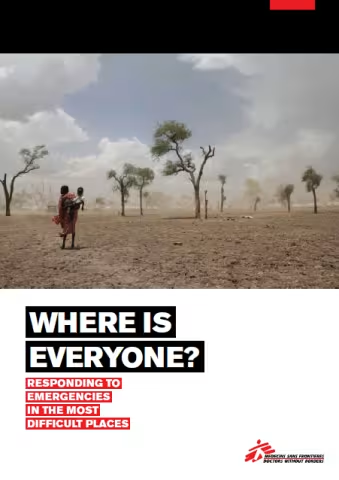
The humanitarian aid system is growing and expanding, and so surely its capacity to meet these challenges should also be growing.
Yet despite the enormous resources, in the more complex, less high-profile and difficult contexts, MSF teams in the field have seen that humanitarian responses to displacement emergencies have not occurred in a timely and effective way. This is especially the case in conflict areas.
These observations have prompted MSF to conduct this review, to better understand how the humanitarian system is responding to acute displacement emergencies. The review is based on...
Integrity’s research highlights that women’s networks and organisations in Syria are active across a range of service delivery sectors. In many cases these groups are either responding to gaps in services provided by other NGOs, civil society organisations (CSO), or other service delivery actors, or they are providing understanding and access to the specific needs of women and children beneficiaries that other groups cannot.
Women’s groups interviewed by Integrity are most active (62 per cent) in the education, skills training, and livelihoods sectors. These areas both help meet immediate...