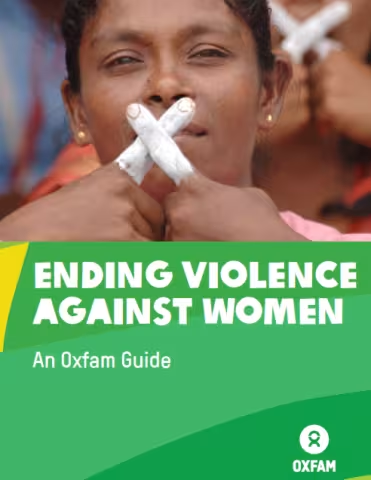
This guide is a resource for Oxfam staff, published in 2012, intended to inform and inspire their work, and to share with partners. It can be read and consulted individually – or used for discussion with peers.
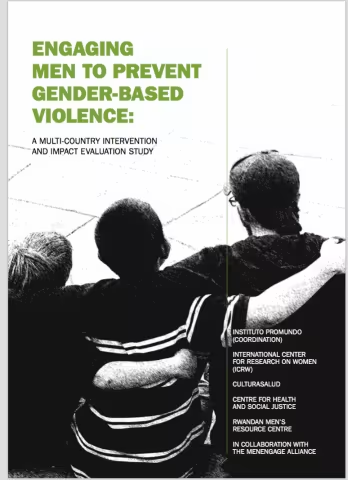
Over the span of three years, Instituto Promundo, with support from the United Nations Trust Fund to End Violence Against Women, implemented a multi-country project to engage men and boys in preventing violence against women and promote gender equality.
In this Brochure you will find an introduction to the aid effectiveness process, key milestones through which the concept was developed, Main Principles that define the concept, Challenges that face the implementation of aid effectiveness, and a highlight on the context of the
The report looks at different technologies related to the power, transport, agriculture and water sectors in Lebanon and assess their potential to reduce greenhouse gas emissions and increase resilience to climate change.
Titled “Let The Resolution Begin…. Live Gender Equity”, this resource is the annual report of ABAAD Resource Center for Gender Equity, which lists the accomplishments of the organization for the period between June 2011 and June 2012.
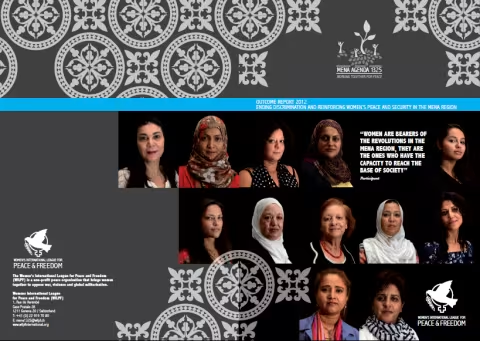
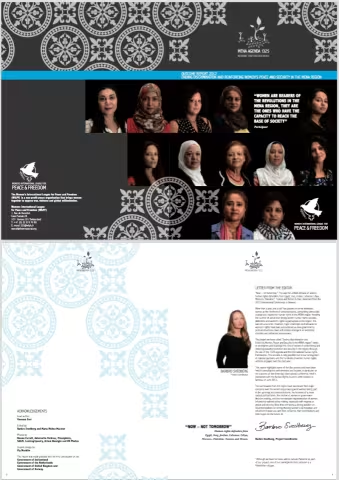
In late 2011, WILPF began to develop a programme to enhance the collective capacities of women’s rights organisations to respond to the unprecedented political events in the Middle East and North Africa (MENA).
ABAAD-Resource Center for Gender Equality, in partnership with Women's League for International Peace and Freedom (WILPF) and in collaboration with the United Nations Interim Forces (UNFIL) in South Lebanon, organized the National Consultation Meeting on May 10th, 2012 at Holi
It is well known that the cultural norms and the patriarchal society in Lebanon contribute to encouraging discrimination and any form of violence against women and children.
This Gender-based Violence Rapid Assessment conducted by International Rescue Committee in 2012 focuses on risks and violence faced by women and girls among the Syrian refugee population within Lebanon.
This brochure presents a brief introduction to the Universal Periodic Review (UPR) process and introduces the different stages of possible engagement by civil society groups with the process.
This resource is a United Nations Relief and Works Agency for Palestine Refugees in the Near East (UNRWA) reference training manual for frontline staff on how to work with GBV survivors.
This case study book entitled “Cases of Femicide before Lebanese Courts” was written by Azza Charara Baydoun and published by KAFA (enough) Violence & Exploitation in 2011.
Oxfam GB commissioned the pilot study discussed in this report in order to understand further the context that shapes men’s gender roles and affects their behaviours, practices, and attitudes towards gender equality, with an explicit focus on VAW.
Although Lebanon is known in the Middle East for its relative political openness and for the degree of freedom Lebanese women enjoy, it paradoxically has one of the lowest rates of women’s political engagement in the region.
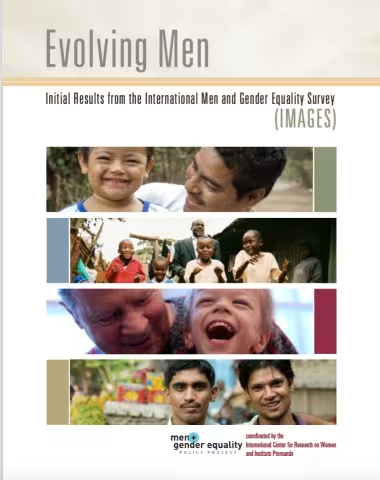
The International Men and Gender Equality Survey (IMAGES) is a comprehensive household questionnaire on men’s attitudes and practices – along with women’s opinions and reports of men’s practices – on a wide variety of topics related to gender equality.
The brief of this qualitative exploratory study was to conduct targeted interviews with female employers of migrant domestic workers, psychiatrists, lawyers and institutional stakeholders in Lebanon.
The report provides an overview of Lebanon’s greenhouse gas emissions per sector, and analyses the impacts of the country’s projected climatic changes on several economic, social and environmental sectors.
On December 9, 2009, a Lebanese criminal court sentenced a Lebanese woman to 15 days in jail for repeatedly beating Jonalin Malibago, her Filipina maid, three years earlier. Lebanese newspapers hailed the case a landmark victory for the country’s estimated 200,000 migrant domestic workers (MDWs), many of whom report abuse at the hands of their employers. The case illustrated the positive role that the judiciary can play in protecting MDWs, even though the sentence was lenient given the violation. But it also raised at least one significant question: was the Malibago verdict a rare instance of...