The objective of the Civil Society Review is to bring civil society practitioners, experts, activists, and researchers together to develop knowledge, as well as to innovate new tools and practices so as to strengthen Lebanon’s civil society and its voice. The Civil Society Review produces evidence-based research and analysis and disseminates findings and recommendations to promote civic engagement, shape policies, and stimulate debate within civil society spheres in Lebanon.
Integrity’s research highlights that women’s networks and organisations in Syria are active across a range of service delivery sectors. In many cases these groups are either responding to gaps in services provided by other NGOs, civil society organisations (CSO), or other service delivery actors, or they are providing understanding and access to the specific needs of women and children beneficiaries that other groups cannot.
Women’s groups interviewed by Integrity are most active (62 per cent) in the education, skills training, and livelihoods sectors. These areas both help meet immediate...
This report constitutes the final publication of the outcomes of the program "Development in Lebanon: Poverty Eradication, Gender Equity and Youth Participation; the Role of NGOs Civil Society and Other Actors".
This thesis investigates transnational campaigns from the international and state level to consider the existence of transnational activism in Lebanon’s women’s movement.
Since the unrest in Syria began in March 2011, the Bekaa Valley in Lebanon has hosted varying numbers of displaced Syrian families. Local actors such as municipalities and NGOs registered families for assistance received through regional and international donors.
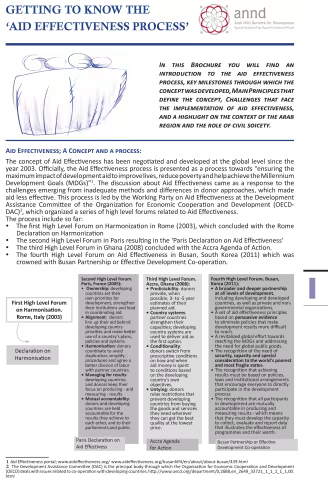
In this Brochure you will find an introduction to the aid effectiveness process, key milestones through which the concept was developed, Main Principles that define the concept, Challenges that face the implementation of aid effectiveness, and a highlight on the context of the
Titled “Let The Resolution Begin…. Live Gender Equity”, this resource is the annual report of ABAAD Resource Center for Gender Equity, which lists the accomplishments of the organization for the period between June 2011 and June 2012.
This brochure presents a brief introduction to the Universal Periodic Review (UPR) process and introduces the different stages of possible engagement by civil society groups with the process.
On December 9, 2009, a Lebanese criminal court sentenced a Lebanese woman to 15 days in jail for repeatedly beating Jonalin Malibago, her Filipina maid, three years earlier. Lebanese newspapers hailed the case a landmark victory for the country’s estimated 200,000 migrant domestic workers (MDWs), many of whom report abuse at the hands of their employers. The case illustrated the positive role that the judiciary can play in protecting MDWs, even though the sentence was lenient given the violation. But it also raised at least one significant question: was the Malibago verdict a rare instance of...
This publication is a compilation of reports prepared by group of civil society organizations in light of the review of Lebanon under the first-cycle of Universal Periodic Review (2010).The booklet includes the report reviewing conditions of economic and social rights in Leban
Using time-diary data from 25 countries, the authors demonstrate that there is a negative relationship between real GDP per capita and the female-male difference in total work time per day -- the sum of work for pay and work at home.
هذا الكتاب هو دراسة قامت بها عزّة شرارة بيضون سنة2002 ، و تهدف الى رصد بعض خصائص العمل الاجتماعي النسائي في لبنان في الزمن الحديث، زمن ما بعد الحرب اللبنانية، و ذلك للبحث في مساهمة النساء الناشطات في المنظمات غير الحكومية التي تشكلت في التسعينات.
To help expand the focus of the social protection debate to include the informal sector, particularly women workers, the ILO global programme STEP, "Strategies and Tools against Social Exclusion and Poverty" and the global network called Women in Informal Employment: Globalizi