Resources

Intervention Sectors
Displaying 101 - 120 of 205
National
Publishing Date
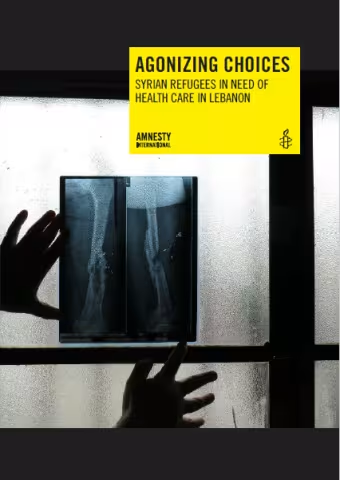
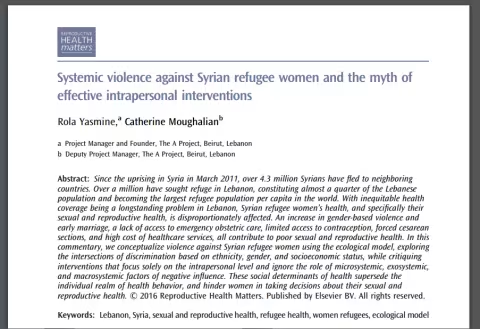
Since the uprising in Syria in March 2011, over 4.3 million Syrians have fled to neighboring countries. Over a million have sought refuge in Lebanon, constituting almost a quarter of the Lebanese population and becoming the largest refugee population per capita in the world. With inequitable health coverage being a longstanding problem in Lebanon, Syrian refugee women’s health, and specifically their sexual and reproductive health, is disproportionately affected. An increase in gender-based violence and early marriage, a lack of access to emergency obstetric care, limited access to...
National
Publishing Date
يوجد في لبنان 21 سجنا وأربعة من هذه السجون مخصصة للنساء. و هناك سجنان اضافيان للأحداث. انّ الكشف النفسي و الرعاية الصحية النفسية غائبان في السجون اللبنانية. نأمل أن التوصيات الصادرة في هذه الدراسة تصبح واقعا كما أنها ستغير حياة العديد من الأشخاص المنسية خلف القضبان وستمنع "حكم بالسجن مدى الحياة" مماثل في المستقبل للسجناء.
National
Publishing Date
Lebanon has a total of 212 prisons, out of which 4 are specific to women. And there are 2 additional prisons dedicated to minors. Mental health screening and care is absent in Lebanese prisons. Catharsis hopes the recommendations from this study become a reality as they will change the live of many forgotten person behind bars, some of whom have been in prison for over 35 years, and it will prevent a similar “life sentence” fate for future mentally ill inmates.
National
Publishing Date
GVC and YAB have implemented a pilot initiative in 6 public schools in order to provide directors, teachers, special educators and social workers with technical tools and expertise to encourage the inclusion of children with special needs. Almost 60 children have been included in regular classes all along the implementation (2012-2015). At the same time, the project involved parents and communities where the 6 schools are located to raise culture of diversity and respect and to enhance participation of children with special needs at all levels of social and cultural life.
National
Publishing Date
This document represents the strategic plan of the Middle East and North Africa Harm Reduction Association,MENAHRA, for the period of July 2014 till December 2019. The development of a revised strategic plan was necessary due to the new challenges faced, and changing contexts in which MENAHRA has been operating in the past few years. Established in 2007 as a network of organisations with a central Secretariat in Beirut and three Knowledge Hubs in Iran, Lebanon and Morocco,MENAHRA has taken on additional roles over the past years, including the management of a large regional HIV grant. The...
National
Publishing Date

Policy Brief | August 2014
Jeanne d’Arc Street; A Model Pedestrian-Friendly Street for all of Beirut by Cynthia Myntti and
Mounir Mabsout
Walking, it has been said, is the ultimate form of sustainable public transportation. Beirut, however, is one of the most pedestrian unfriendly cities in the world. Many streets do not even have sidewalks, and where they exist, they are often broken, or obstructed, or hazardous when wet. In 2010, two units at AUB, the Neighborhood Initiative and the Center for Civic Engagement and Community Service, joined forces to design Beirut’s first barrier-free walkway...

National
Publishing Date
The private sector has long been a major contributor to humanitarian action. At the community level, businesses frequently use their materials and resources to aid people affected by crises. As local markets recover and supply chains are repaired, crisis-affected people are once again able to access basic goods and, in some cases, resume livelihoods. Large national, regional and multinational firms are also closely involved in supporting humanitarian objectives, whether indirectly, by resuming operations in crisis affected areas, or directly, by providing cash and in kind donations of goods or...
National
Publishing Date
The humanitarian aid system is growing and expanding, and so surely its capacity to meet these challenges should also be growing. Yet despite the enormous resources, in the more complex, less high-profile and difficult contexts, MSF teams in the field have seen that humanitarian responses to displacement emergencies have not occurred in a timely and effective way. This is especially the case in conflict areas. These observations have prompted MSF to conduct this review, to better understand how the humanitarian system is responding to acute displacement emergencies. The review is based on...
National
Publishing Date
About the Zero Project: For a World without Barriers The Zero Project was initiated by the Essl Foundation in 2010. It has been run in partnership with the World Future Council (WFC) since 2011 and the European Foundation Centre (EFC) since 2013. The mission of the Zero Project is to work for a world without barriers, according to the principles and Articles of the UN CRPD.