This report seeks to provide an overview of Lebanon’s current policy towards Syrian refugees, and to explore the new rules and regulations issued by General Security regarding the entry, residency, and departure of Syrian nationals. It also analyses the challenges pertaining to the current policy and its impact on the daily lives of Syrian refugees, with a special focus on their emerging illegality, their struggle for decent livelihood and working conditions, and increased informality and insecurity.
It is the first of a series of reports to be published in 2016, the 2nd report of the series...
The purpose of this policy brief is to inform policy formulation on local level security provision and refugee protection, and to propose modalities for upgrading the sys- tems of the Lebanese security institutions in a way that strengthens protection of the Lebanese communities and the Syrian refugees they host. Based on eld research conducted between February and May 2016 in three locations across Lebanon, this brief analyses the challenges to protecting local communities and refugees in a hybrid system, in which formal and informal security actors coexist and implement a mix of security...
This report aims to analyse how formal and informal security providers implement their respective social order agendas through a security “assemblage”. It also aims to inform the debate on refugee protection and security provision in urban settings, in the context of Lebanon’s hybrid security system. The accounts collected illustrate how state security institutions tacitly accept – or even rely on – informal security actors, managing at times to achieve their political and strategic goals through decentralised and/or illegal forms of control. In this vein, local municipalities imposed curfews...
LONDON CONFERENCE – LEBANON STATEMENT OF INTENT Presented by the Republic of Lebanon: Supporting Syria & The Region
Summary: The Government of Lebanon affirms that the success of the Conference in London will depend on how international partners respond to this vision and support Lebanon to uphold the central pillars of providing humanitarian assistance, education for all, and the expansion of economic opportunities and jobs. The Government urges that the international community provide multi-annual funding of $4.9bn to cover this year’s Lebanon Crisis Response Plan and plans set out in this...
This report summarizes the conflict context of the Hasbaya and Marjaayoun Qazas of the Nabatieh Governorate, a religiously and politically diverse area which has for decades been at the forefront of regional dynamics and conflicts.A long history of coexistence between diverse
The influence of terrorist groups operating on the Lebanese-Syrian border, Hezbollah’s involvement in Syria, and the increasing sense of humiliation and powerlessness amongst Sunnis since Hezbollah’s takeover of west Beirut in 2008 is breeding concern about the radicalization
This cross sectional survey was conducted among Syrian refugees living in Lebanon, to monitor access to and utilization of key health services. Refugees in Lebanon are predominantly living in urban areas and informal settlements and there are no refugee camps.
The Lebanon Host Communities Support Project (LHSP) is a multi donor programme aimed at increasing stability and building the capacity of communities affected by the Syrian crisis to address tensions, prevent conflict and ensure peaceful co-existence.
In October 2014, Lebanon’s Council of Ministers adopted a comprehensive policy on Syrian displacement, one explicit goal of which is to decrease the number of Syrians in Lebanon by reducing access to territory and encouraging return to Syria.
The Syrian conflict has forcibly displaced more than 11 million people to neighbouring countries such as Turkey, Lebanon, Jordan, Iraq and Egypt, and elsewhere both regionally and globally.
Lebanon has had an ambiguous approach to the more than one million Syrians seeking protection in the country since 2011. The country is neither party to the 1951 Convention relating to the Status of Refugees, nor does it have any national legislation dealing with refugees.
This working paper seeks to document and analyse collaboration mechanisms between local authorities and humanitarian actors in addressing the Syrian refugee crisis in urban and peri-urban settings in Lebanon.
This document provides information about the situation of Palestine refugees in Lebanon, including non-registered Palestinian refugees, undocumented (“non-ID”) Palestinians, and Palestine refugees from Syria.
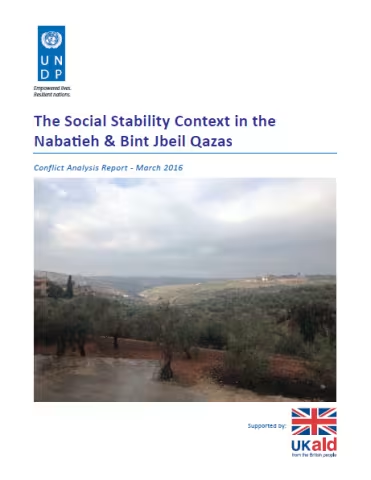
This report presents a brief analysis of the social stability context in the Qazas of Nabatieh and Bint Jbeil in the Nabatieh governorate, a sparsely populated religiously and politically homogenous area which hosts a small number of Syrian refugees.
The concept of resilience offers a framework that facilitates cross-institutional and cross-disciplinary dialogue and pushes us to examine systems that influence complex situations.