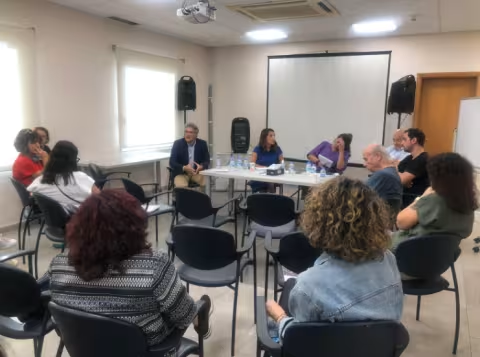
On September 25, 2025, CeSSRA convened a roundtable discussion titled “The End of the Grant Era: Implications and Potential for Civil Society Actors in Lebanon,” bringing together local civil society actors to reflect on the shifting funding landscape and its impact on the sector.
مساعدة ذوي الإعاقة العقلیّة (الإخوة) في جمیع مجالات حیاتھم من خلال توفیر الدعم العملي والعاطفي بتوجیه من مسؤول البيت، والمساعدة في تطویر مقدراتھم بخلق بیئة محفزة ورعایة مناسبة.
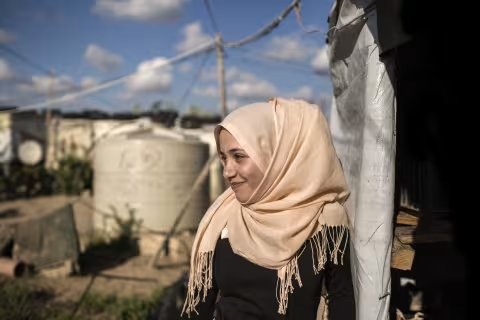
Terre des hommes foundation has been present in Lebanon since 1977. We provide life saving child protection assistance to the most vulnerable children and their families regardless of their nationality, ethnic origin and religious affiliation. Through our child protection in migration and access to justice programmes, our staff support victims of physical and sexual abuse, worst forms of child labor, child marriage, severe neglect and children in contact or conflict with the law. We work with children, their families, communities, NGO and UN partners, local authorities and religious leaders .
This project aims to (1) bring statistical transparency to youth’s opinions, attitudes, feelings, and perceptions about social, cultural, political, and familial freedom of speech barriers within our society, and find what activities facilitate youth’s freedom of speech; (2) create discussion and widespread accountability by engaging the online and offline community, institutional stakeholders, and youth though an advocacy Call to Action based on our research findings, and (3) provide evidence that creative civic spaces are an integral part of our community and change negative attitudes...
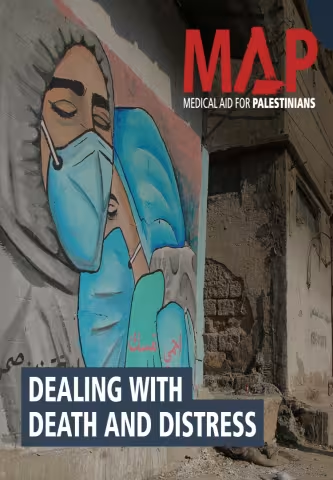
Based on interviews conducted with doctors, nurses and other frontline staff across West Bank, East Jerusalem and Gaza, the paper exposes how the stresses and strains of protracted COVID-19 response have compounded existing challenges of working in a health system already rendered fragile, fragmented and resource-deprived by perpetual occupation and blockade, to cause a deepening wellbeing crisis among the Palestinian healthcare workforce.
We Rise through Art is a handbook produced under the project with the same title in response to Beirut's explosion, highlighting activities and tools that can be adopted by trainers, coaches and facilitators with pre-adolescents and children under arts, sports and recreation.
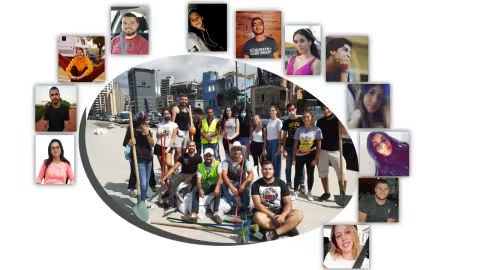
Beirut Explosion: Greatest Tragedies Come With Greatest Acts of Kindness.
Youth from a Sports and Youth Association (Chabibeh Sporting Club) become volunteers and share stories of compassion and pain mixed together to shed light on the darkest hour of their country.
We Play for Peace is a handbook produced under the project with the same title highlighting activities and tools that can be adopted by trainers, coaches and facilitators with pre-adolescents and children under arts, sports and recreation.
The LCRP Business Continuity Plan for COVID-19 reviews ongoing impact on LCRP operations and outlines risks and critical interventions needed to ensure life-saving access to services and protection for the most vulnerable displaced persons from Syria and vulnerable Lebanese during COVID-19 situation.
This policy brief was developed based on an in-depth report titled “Women’s Political Participation: Exclusion and Reproduction of Social Roles. Case Studies from Lebanon;” in addition to discussions and insights gathered during a consultation workshop held on 8 November 2018, and which marked the participation of women who had taken part of the research, as well as activists, representatives of civil society organisations, and academics.
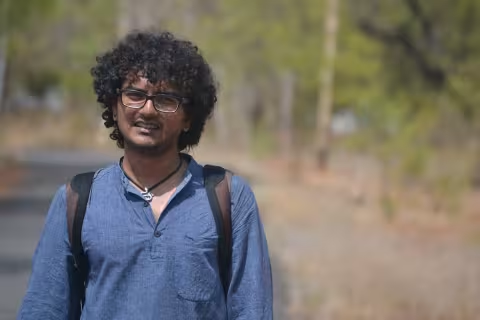
MOSAIC had the pleasure and privilege to speak with activist Gopi Shankar Madurai moments after the Supreme Court in India decriminalized Section 377 of the Penal Code.
With globalisation, the mobility of people has grown, and women are essential actors in this migratory phenomenon. This article focuses on the role of women in migration and the role of migration in advancing women’s rights to achieve gender equality.
Based on the findings of participatory protection research that Oxfam undertook with refugees in Lebanon between late 2016 and early 2017, this paper explores refugees’ own definitions and conceptions of safety, and highlights refugee perspectives on how the international comm
Lebanon has had an ambiguous approach to the more than one million Syrians seeking protection in the country since 2011. The country is neither party to the 1951 Convention relating to the Status of Refugees, nor does it have any national legislation dealing with refugees.
This working paper seeks to document and analyse collaboration mechanisms between local authorities and humanitarian actors in addressing the Syrian refugee crisis in urban and peri-urban settings in Lebanon.