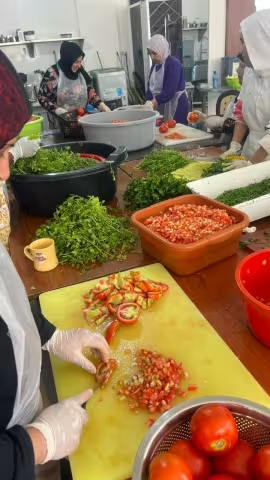
In the wake of Lebanon’s compounded humanitarian crisis, the Community Kitchen Initiative emerged as a localized, life-saving response to ensure that food-insecure populations had access to hot, nutritious, and culturally appropriate meals. Operational since March 2025 till present, this intervention served as a vital daily service across Nabatiyeh, South Lebanon, Mount Lebanon, and Baalbek-Hermel. Led by SPHERE Building Tomorrow (SBT), the project leveraged community-based kitchens and volunteer networks to deliver food assistance while promoting livelihoods and strengthening local food...
Findings in the "Analysis on Stunting Among Syrian Refugee Children" showed that risk factors perceived to be contributing to stunting levels among Syrian refugee children included those at the individual and household level with poor maternal nutrition, household food insecurity and inadequate complementary feeding practices as the factors perceived to be contributing the most to stunting among Syrian children. On the other hand, at the institutional and community level, market food prices, poverty, income, employment and livelihoods were the factors perceived to be contributing the most to...
دليل.فيلم هو مصدر مفتوح من تصميم بيروت دي سي وشركائها، يهدف إلى مساعدة صنّاع الأفلام العرب على إنتاج أفلام تصل إلى الجماهير على امتداد المدن العربية والعالم وتكون مراعية لمعايير الحفاظ على البيئة
daleel.film is the guide of guides: an open resource made by Beirut DC and partners to help Arab filmmakers make great socially and environmentally engaged films that reach audiences in every Arab city and the world
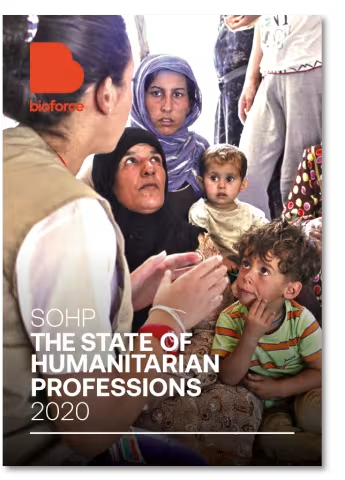
The State of Humanitarian Professions 2020 (SOHP) is the result of a year-long consultation with more than 1,500 humanitarian professionals. For the first time, this study gathers and analyses key figures on 24 humanitarian professions, as well as on recruitment practices and professional development in the sector. In addition, the SOHP study demonstrates the need to coordinate on the challenges of professionalising humanitarian teams, with 19 recommendations to be discovered in the final report.
“More than 60% of Syrian refugees households comprise a person with disabilities and 1/5 Syrian refugees has a disability in Lebanon and Jordan”, shows a large study conducted by Humanity & Inclusion (HI) and iMMAP.
This is an assessment done in the detention centers and prisons in south Lebanon in coordination with the prisons department in the ministry of interior through which the WASH situation inside these prisons and centers was detected, needs and priorities were defined and possible rehabilitation and enhancement explored.
The objective of the Civil Society Review is to bring civil society practitioners, experts, activists, and researchers together to develop knowledge, as well as to innovate new tools and practices so as to strengthen Lebanon’s civil society and its voice. The Civil Society Review produces evidence-based research and analysis and disseminates findings and recommendations to promote civic engagement, shape policies, and stimulate debate within civil society spheres in Lebanon.
This booklet comprises of the presentations and papers that were presented and discussed during the seminar that was held in Beirut in October 2015, titled “Regional Seminar on Child
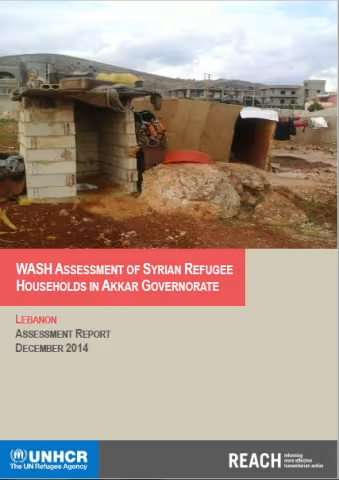
As the Syrian Crisis enters its fourth year, numerous water, sanitation, and hygiene (WASH) needs remain to be filled among Syrian refugees living in Lebanon, who now number more than 1.1 million.
The continuing unrest in Syria is resulting in a growing influx of Syrian refugees to Lebanon. The United Nations High Commissioner for Refugees has registered over 57,000 Syrian refugees in Lebanon (September 7, 2012) while many refugees are awaiting registration.