Resources

Theme
Displaying 1 - 20 of 49
National
Publishing Date
The third toolbox: Institutionalizing Conflict Sensitivity at the Organizational Level aims to ensure that organizations working within the humanitarian and stabilization response in Lebanon can better integrate the concept of conflict sensitivity and its principles at all aspects and levels across an organization’s structure, procedures, and policies.
International
Publishing Date
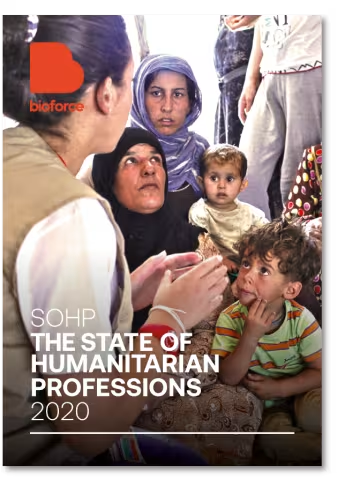
The State of Humanitarian Professions 2020 (SOHP) is the result of a year-long consultation with more than 1,500 humanitarian professionals. For the first time, this study gathers and analyses key figures on 24 humanitarian professions, as well as on recruitment practices and professional development in the sector. In addition, the SOHP study demonstrates the need to coordinate on the challenges of professionalising humanitarian teams, with 19 recommendations to be discovered in the final report.
National
Publishing Date
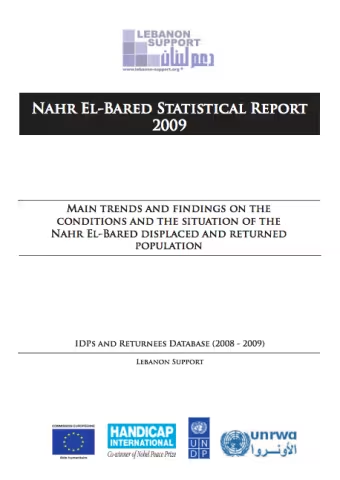
This report aims to provide statistical and analytical tools for the recovery community working in North Lebanon, specifically those working with the Nahr el-Bared displaced and returnee population. The information will allow for better assessment of current needs and gaps, which will eventually support the development of appropriate strategies of intervention on both the short and long term.
National
Publishing Date
The July war 2006, lasted 34 days, and led to the displacement of 915,762 (almost 25% of the Lebanese population) persons, relocating into public and private schools all over the country. With the coming into force of the cease fire in August 14th 2006, there was a rapid return of the displaced to the south.
National
Publishing Date
Integrity’s research highlights that the truces agreed in several locations across Syria in the early months of 2014 do not represent the localised beginnings of a peacebuilding process. These agreements—and the negotiation and implementation processes that delivered them—were not built upon good practice and were significantly undermined by a lack of political will for peace from the outset. For opposition stakeholders, the truce agreements were a reaction to extreme levels of civilian suffering and a military capacity weakened by lengthy, government-enforced sieges. In all areas researched...
National
Publishing Date
Les politiques de coopération au développement des bailleurs étatiques placent de plus en plus le secteur marchand comme un acteur clé du développement, à la fois comme un partenaire financier ou opérationnel mais aussi comme un objectif en soi. Sa croissance dans les pays du Sud, que ce soit dans le domaine productif ou de la fourniture de services, y compris pour de la délégation de services publics ou l’offre de services bancaires, est considérée comme un indicateur positif. Les gouvernements des pays membres de l’UE cherchent ainsi à maximiser son rôle comme catalyseur ou «substitut» de...