IFI Research and Policy Memo #2 | January 2009
Governments Should Practice 'Water Demand Management' to Rescue Region's Water ResourcesHamed Assaf
Surging populations and increasing living standards in the Middle East are exacerbating the region’s water problem as countries begin to expect more of scarce and poorly managed water, warned Dr. Hamed Assaf, a professor of water resources engineering at the American University of Beirut. High water demand, negligence of water quality, and over-pumping are more serious threats to the region’s water supply than are the potential impacts of climate...
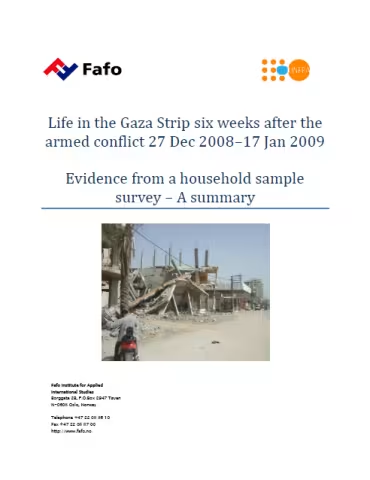
This multi-topic household sample survey was implemented to collect data to document the living conditions in the Gaza Strip in the wake of Israel’s assault on 27 December and the ensuing armed conflict.
Following the Nahr EL Bared War, LPDC launched in 2008 a workshop mapping the recovery and development initiatives in the camp's area. They followed up in 2009 with another workshop reviewing the development projects that took place in the NBC area.
2009 مذكرات للباحثين وصناع القرار #2 | كانون الثاني
على الحكومات أن تمارس "إدارة الطلب على المياه" كي تنقذ الموارد المائية للمنطقة من التغير المناخيحامد عساف
حذر البروفيسور حامد عساف من تفاقم مشكلة المياه في الشرق الاوسط يوماً بعد يوم، في ظل الزيادات السكانية وازدياد المتطلبات والمستوى المعيشي، مما يعني أنه على دول المنطقة توقع المزيد من الشح وتبعات سوء الإدارة في مواردها المائيةّ
وجاء كلام عساف، الدكتور برتبة بروفيسور في هندسة الموارد المائية في الجامعة الاميركية في بيروت، خلال محاضرته التي نظمها معهد عصام فارس للسياسات العامة والشؤون الدولية
The report assesses the progress made in the achievement of the Millennium Development Goals (MDGs) based on new national data which was formulated after the first MDGR that was published in 2003.
The fourth National Human Development Report, “Toward a Citizen’s State”, addresses citizenship in Lebanon through three principle perspectives: citizenship and sectarian state, socio-economic citizenship and citizenship and culture and education.
This report highlights the post war status of private sector businesses represented in the Palestinian Federation of Industries (PFI) in the Gaza Strip.
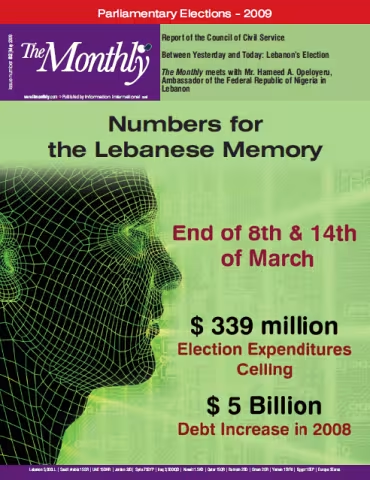
Parliamentary elections of 2009 and the year 2008 in review. The evenings of tuesday and Wednesday, April 7/8 marked the last day to register as a candidate for the Lebanese Parliamentary Elections scheduled on Sunday June 7, 2009.
Review of marginalisation of people with disabilities in Lebanon, Syria and Jordan. Using a social exclusion conceptual framework, this paper identifies several causes of marginalization of people with disabilities in the context of the MENA region.
This paper examines the impact of a rise in the Value Added Tax (VAT) on poverty and inequality in Lebanon. It develops an empirical model based on consumer demand theory and uses only household survey data on expenditures and spatial price indexes.
Research and Policy Memo #2 | January 2009
Public Sector Can Reduce Push Factors that Drive Youth Emigration Jad Chaaban
Young men and women prefer to leave Lebanon either temporarily or permanently to work abroad, leading to a decline in the country’s human capital and welfare. While the factors that attract youth abroad cannot be altered, the onus rests on public institutions in Lebanon to reduce the internal “push” factors that drive youth away.
“The Lebanese population’s age pyramid shows a shrinking trend in the 20-35 age categories,” said Jad Chaaban, a leading economist and researcher...
The aim of the “Socio-Economic Assessment in Nahr el-Bared surrounding areas” report is to provide an assessment of the pre and post conflict conditions of households located in the vicinity of Nahr el Bared camp for a variety of livelihood aspects including: housing, health,
IFI Paper | January 2009
UNIFIL II: Emerging and Evolving European Engagement in Lebanon and the Middle EastKarim Makdisi, Timur Göksel, Hans Bastian Hauck, and Stuart Reigeluth
There has been a long-standing debate on the merits and drawbacks of UNIFIL, the UN “interim” peacekeeping operation established by UN Security Council (UNSC) Resolutions 425 and 426 in the aftermath of Israel’s 1978 invasion of Lebanon. Following the 2006 Israel-Lebanon War, this debate intensified as UNIFIL’s original mandate was made more “robust” by UNSC Resolution 1701, which marked a new phase of UN peacekeeping...
This essay proposes to re-orient feminist debates on epistemology towards the care-security nexus as a pathway that can plausibly provide an integral understanding of a human-centred and eco-minded security.
Research and Policy Memo #3 | December 2008
Poor education, socio-economic restrictions threaten Palestinian youth in Lebanon: the case of Bourj el Barajneh campJihad Makhoul,and Yara Jarallah
If the quality of education offered to Palestinian refugees, and employment and ownership restrictions remain as they are, adolescents between the ages of 13 and 19 will resort to coping mechanisms such as drug abuse that young men in the camp suffer from today, says a research study conducted by Jihad Makhoul, DrPH, and Yara Jarallah, MS, in the Bourj el Barajneh refugee camp. The study is based on in...
مذكرات للباحثين و صناع القرار #1 | تشرين الثاني 2008
شباب مصريون يعيدون اكتشاف المشاركة المدنية، ويؤسسون لأشكال جديدة من الخدمة العامبربارة إبراهيم
يمثل جيل الحركات الشبابية المصرية الحالي أكبر المجموعات الشبابية التي تخوض معركة اثبات الوجود في العالم العربي. أدواتهم تتراوح بين الخدمات الاجتماعية التقليدية، و تقنيات الاتصال الجديدة في سبيل مواجهة الحظر المفروض عليهم من قبل الأنظمة السياسية والعائلية. وهذه الحركات هي التجربة التي سلطت الضوء عليها الدكتورة بربارة ابراهيم ومجموعة أخرى من الباحثين في مصر
ويسود في عالمنا ”اجتاه لمعاملة الشباب وقضايا الشباب بطريقة جد موعظية، ومبسطة،“ بحسب إبراهيم،...
Research and Policy Memo #1 | November 2008
Young Egyptians reinvent civic engagement, leading to new forms of public serviceBarbara Ibrahim
As the largest ever cohort of young people in the Arab World struggles to find its place in society, youth are forging arenas for public participation that draw upon new media and traditional social service. Initiated by young people, this movement responds to the exclusion they feel from family and state structures that block their public participation. It is a new brand of youth movements that Dr. Barbara Ibrahim and other researchers have identified in...