This report aims to provide statistical and analytical tools for the recovery community working in North Lebanon, specifically those working with the Nahr el-Bared displaced and returnee population. The information will allow for better assessment of current needs and gaps, which will eventually support the development of appropriate strategies of intervention on both the short and long term.
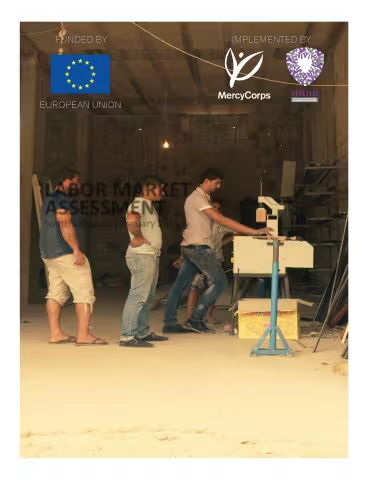
This report presents the findings of the labour market study in Bar Elias and the Bekaa, focusing on the labour activities, initiatives, and aspirations of current B&Z beneficiaries and Syrian refugee youth and women heads of household respondents that could potentially be
This report examines both the historical development and current situation of Syrians working in Lebanon through the analysis of policies established and implemented by the Lebanese government. While the report is not an assessment of these policies, it nevertheless reflects on its impact on Syrians’ working conditions and livelihoods. In this vein, this report notably focuses on emerging dynamics of increased informality, exploitation, and dependence.
It is part of a series of reports to be published in 2016, the 1st of which being "Formal Informality, Brokering Mechanisms, and Illegality...
Bringing together the years of regional and international experience within civil society activities, Besme was settled in Lebanon in September 2014, in order to contribute to the peaceful settlement of regional conflicts in Middle East. Through a route, which is full of difficulties, we managed to leave the year of 2015 behind, with successful and effective projects. We reckon 2015 as a year of investment for Besme. Reinvigorating the individual connections of management team at national, regional and international levels, we assume that a great step forward was taken for future. In the road...
Over 250,000 migrant women are employed by private households in Lebanon to carry out household tasks such as cleaning, cooking, and caring for children and the elderly.
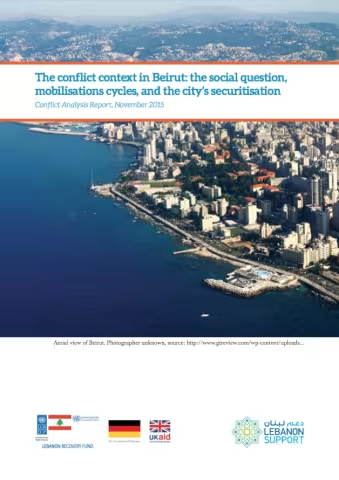
This report provides an analysis of the history and current situation of the conflict context, actors and dynamics in Beirut, Lebanon. The report seeks to shed light on the main actors, topics of contestation, conflict and mobilisation in its historical becoming as well as current expressions. The report includes a special focus on the social question, subsequent political and social mobilisation, gender issues, the securitisation of the city, as well as the interactions between the Lebanese host community and Syrian refugees and their unfolding within the last four years (since 2011).
This study was based on a comprehensive assessment of the vocational needs as well as the labor absorption capacity mainly with business owners in the area of intervention and individual workers and vocational trainings candidates following different assessment and data collection methodologies such as key informant interviews, focus groups, and individual assessments