This report presents findings from a survey conducted from 3-11 July, 2017 with three distinct refugee groups in Lebanon: Syrian refugees; Palestine refugees from Syria; and Palestine refugees from Lebanon.
The Lebanon Host Communities Support Project (LHSP) is a multi donor programme aimed at increasing stability and building the capacity of communities affected by the Syrian crisis to address tensions, prevent conflict and ensure peaceful co-existence.
This working paper seeks to document and analyse collaboration mechanisms between local authorities and humanitarian actors in addressing the Syrian refugee crisis in urban and peri-urban settings in Lebanon.
Since the Syrian conflict began in 2011, 11 million people have been internally displaced or have fled to neighboring states. This has put an incredible strain on the hosting societies, particularly in Lebanon,Jordan, Iraq and Turkey.
The continuing unrest in Syria is resulting in a growing influx of Syrian refugees to Lebanon. The United Nations High Commissioner for Refugees has registered over 57,000 Syrian refugees in Lebanon (September 7, 2012) while many refugees are awaiting registration.
Swiss Solidar undertook a multi-sectoral needs assessment in August 2013 to assess the humanitarian needs of Syrian refugees residing in Nabatieh and Jezzine Districts in Southern Lebanon.
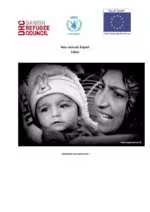
The average number of assisted families during the a/m period is 46% of the overall number of families reportedly arrived to DRC North Lebanon operational area (Akkar region).
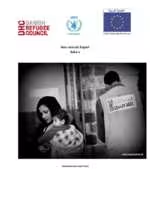
The average number of assisted families during the a/m period is 35% of the overall number of families reportedly arrived to DRC Bekaa operational area.
This operational guidance note is anchored on the principles of universal health care for all persons of concern fleeing the ongoing conflict in Syria and in need of international protection in Lebanon.
Since March 2011 and the continuously escalating crisis in Syria, Lebanon (along with Jordan, Iraq and Turkey) has been a refuge area for Syrian families fleeing the instability and violence in their country.
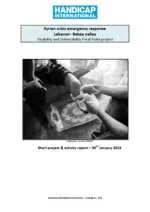
Disability & Vulnerability Focal Point (DVFP) have been developed based on the observation that one of the greatest difficulties following a crisis is not only to identify and to access to vulnerable people including people with disabilities, but also to accompany them wit
The human rights situation in the Syrian Arab Republic has deteriorated significantly since November 2011, causing further suffering to the Syrian people. Widespread violence and increasingly aggravated socio-economic conditions have left many communities in a perilous state.
As of the end of April 2012, the number of Syrian families displaced in the Bekaa has increased to 2,800 households. Families registered with local partners receive kits of dry food, but they have requested more variety and choice in food items.
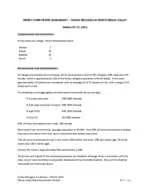
28 refugee households were surveyed, which represented a total of 501 refugees, 48% male and 52% female, which is approximately 11% of the Syrian refugee population in North Bekaa.