This report brings together insights gathered through extensive desk-based research conducted as part of the Fair Game project 2024 across six diverse countries: Italy, Lebanon, Morocco, Palestine, Portugal, and Romania. The main goal was to explore the complex challenges that excluded and vulnerable youth face in these unique national contexts.
The research involved a thorough examination of existing interventions aimed at addressing these challenges. By evaluating their effectiveness, the study aims to establish a foundation for developing targeted training programs and recommending...
يهدف هذا البحث العمليّ المنحى إلى إعلام الممارِسين وصانعي القرار بشأن وضع الحماية الاجتماعيّة واحتياجاتها والثغرات الموجودة فيها، وذلك بالنسبة إلى العاملين في قطاع المجتمع المدنيّ. يقدّم هذا البحث توصيات مستهدَفة تهدف إلى تعزيز وصول العاملين في قطاع المجتمع المدنيّ إلى الحماية الاجتماعيّة، كما تستهدف الدولة، جماعة المانحين والمنظّمات غير الحكوميّة الدّولية، والمنظّمات غير الحكوميّة المحليّة.
This action-oriented research aims to inform practitioners and decision makers on social protection status, needs and gaps of workers in the civil society sector. It formulates targeted recommendations that aim at enhancing access to civil society workers to social protection, and that target the Lebanese state, the donor community and international NGOs, and local NGOs.
The report examines how economic and financial policies of the EU affect the economies of Southern Mediterranean countries. It’s interesting to note the shortcomings of these policies with regard to civil and political rights.
The second report is an evaluation of civil society initiatives on economic and social rights, including a series of civil society initiatives focusing on
The report entitled challenges for civil society and the promotion of economic and social rights, brings together recommendations from civil society actors and academics to strengthen Euro-Mediterra
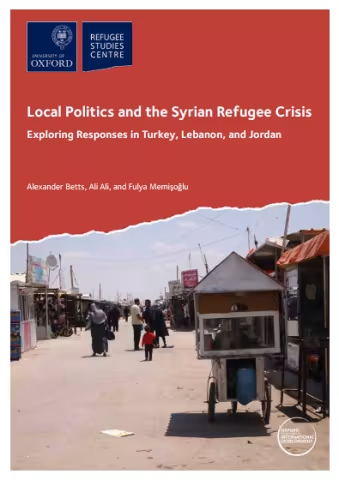
Refugee protection is inherently political. While international law and values inevitably influence governments’ decisions about how to respond to refugees, so too do power and interests.
This report presents findings from a survey conducted from 3-11 July, 2017 with three distinct refugee groups in Lebanon: Syrian refugees; Palestine refugees from Syria; and Palestine refugees from Lebanon.
This policy brief analyses the socio-political implications of the so-called October policies, and suggests legislative, political, and practical measures to improve the situation of Syrian refugees in Lebanon. It also aims to inform policy formulation regarding Syrian refugees from a human rights-based perspective, while discussing modalities for enhanced programming at the civil society level.
This policy brief is the fourth publication of a research project investigating the social effects of political and legal measures on Syrian refugees’ daily lives. The brief is based on a consultative...
This document is an adaption of a speech delivered on May 12, 2015 at the launch of a report by the Syrian Justice and Accountability Center (SJAC) entitled ”A Step Towards Justice: Current Accountability Options for Crimes under International Law Committed in Syria.” The repo
The Lebanon Host Communities Support Project (LHSP) is a multi donor programme aimed at increasing stability and building the capacity of communities affected by the Syrian crisis to address tensions, prevent conflict and ensure peaceful co-existence.
The concept of resilience offers a framework that facilitates cross-institutional and cross-disciplinary dialogue and pushes us to examine systems that influence complex situations.
Since the Syrian conflict began in 2011, 11 million people have been internally displaced or have fled to neighboring states. This has put an incredible strain on the hosting societies, particularly in Lebanon,Jordan, Iraq and Turkey.
The private sector has long been a major contributor to humanitarian action. At the community level, businesses frequently use their materials and resources to aid people affected by crises. As local markets recover and supply chains are repaired, crisis-affected people are once again able to access basic goods and, in some cases, resume livelihoods. Large national, regional and multinational firms are also closely involved in supporting humanitarian objectives, whether indirectly, by resuming operations in crisis affected areas, or directly, by providing cash and in kind donations of goods or...
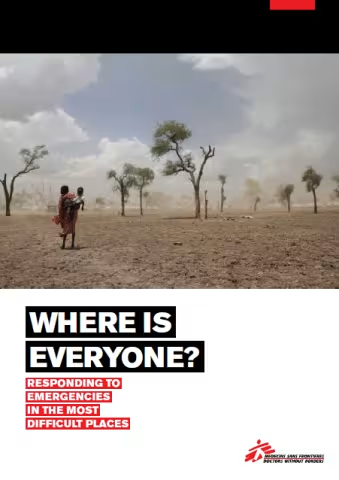
The humanitarian aid system is growing and expanding, and so surely its capacity to meet these challenges should also be growing.
Yet despite the enormous resources, in the more complex, less high-profile and difficult contexts, MSF teams in the field have seen that humanitarian responses to displacement emergencies have not occurred in a timely and effective way. This is especially the case in conflict areas.
These observations have prompted MSF to conduct this review, to better understand how the humanitarian system is responding to acute displacement emergencies. The review is based on...
Les politiques de coopération au développement des bailleurs étatiques placent de plus en plus le secteur marchand comme un acteur clé du développement, à la fois comme un partenaire financier ou opérationnel mais aussi comme un objectif en soi. Sa croissance dans les pays du Sud, que ce soit dans le domaine productif ou de la fourniture de services, y compris pour de la délégation de services publics ou l’offre de services bancaires, est considérée comme un indicateur positif. Les gouvernements des pays membres de l’UE cherchent ainsi à maximiser son rôle comme catalyseur ou «substitut» de...