The resource is a package that includes a manual, a training format, and a toolkit developed under the DEVMIGRA Erasmus+ CBY project by partners from Spain, Italy, Lebanon, and Jordan.
The first newsletter of the DEVMIGRA project introduces our project that aims to empower youth workers and first-generation young migrants by providing support for integration and skill development. We aim to inform you about our project's objectives, partners, project’s topics and target groups.
The DEVMIGRA project is dedicated to empowering youth workers and first-generation young migrants by fostering integration and skill development. Our goal is to enhance employability, strengthen key competencies, and support the social inclusion of young migrants in their new communities. In this edition, you’ll find the latest project updates, highlights from our recent training course, key project results, and information about upcoming local events
The second Newsletter of the DEVMIGRA project, which aims to empower youth workers and first-generation young migrants by providing support for integration and skill development. The project seeks to enhance employability, promote skills, and facilitate integration into society for young migrants. In this newsletter, you will be reading about project updates, meetings, events and results.
ككل عام تطلق المؤسسة الفلسطينية لحقوق الانسان (شاهد) تقريرها السنوي للعام 2023 حول واقع اللاجئين الفلسطينيين في لبنان، تطرح فيه الأرقام والوقائع الموثقة وتضعها بين يدي صانع القرار المحلي والدولي.
هذا التقرير هو خلاصة للجهود البحثية والمتابعات الميدانية لفريق عمل مؤسسة (شاهد) خلال عام كامل.
“More than 60% of Syrian refugees households comprise a person with disabilities and 1/5 Syrian refugees has a disability in Lebanon and Jordan”, shows a large study conducted by Humanity & Inclusion (HI) and iMMAP.
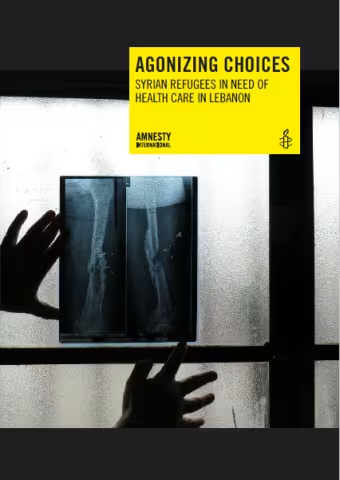
This report aims to explore the fragmented organisation of healthcare services in Lebanon, for Syrian refugees. Although it is not an assessment of the Lebanese healthcare system, this report does nevertheless reflect on the challenges and underlying dynamics of the current Lebanese system, which are reproduced in the healthcare provision for Syrian refugees. In this sense, the report highlights the privatised, rather ad hoc, and irregular provision of healthcare in Lebanon, notably for Syrian refugees, which tends to take on a more curative rather than preventive approach, resulting in...
This cross sectional survey was conducted among Syrian refugees living in Lebanon, to monitor access to and utilization of key health services. Refugees in Lebanon are predominantly living in urban areas and informal settlements and there are no refugee camps.
This study sought to characterize the physical and emotional conditions, dietary habits, coping practices, and living conditions of this elderly population arriving in Lebano
The continuing unrest in Syria is resulting in a growing influx of Syrian refugees to Lebanon. The United Nations High Commissioner for Refugees has registered over 57,000 Syrian refugees in Lebanon (September 7, 2012) while many refugees are awaiting registration.
The number of Syrian refugees registered in Lebanon has more than quadrupled over the past six months. On January 1, 2013 Lebanon was hosting some 130,000 refugees; today that figure stands at more than 600,000.
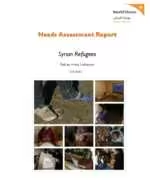
The purpose of the needs assessment conducted in the Bekaa area is to identify the needs of Syrian refugees (SR), in terms of food, non food items (NFIs), shelter, water and education.
This operational guidance note is anchored on the principles of universal health care for all persons of concern fleeing the ongoing conflict in Syria and in need of international protection in Lebanon.