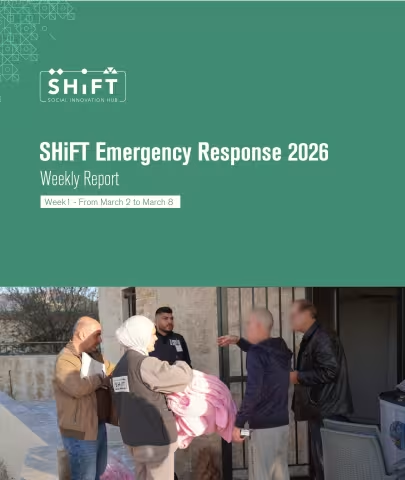
SHiFT launched its emergency response on March 2, 2026, to support families displaced by the escalation of violence in Lebanon. Thousands of people fled their homes with minimal belongings and are now sheltering in public schools and collective shelters across the country. Over 700,000 internally displaced people (IDPs) have been registered, including 119,700 staying in collective shelters, highlighting the scale of humanitarian needs.
We are reaching out to you—the visionaries, the tech architects, the diaspora, and the global believers—to join us as Founding Trustees ion the 961aiPivot. We don't want a "donation" that disappears into a temporary fix. We want a partnership that builds a permanent, sovereign infrastructure. We want you to stand with us as we decouple our talent from our troubles. When you partner with us, you aren't just funding a platform; you are anchoring a soul to its soil. You are proving that a nation’s spirit cannot be switched off by a power outage. You are helping us build a Lebanon that doesn't...
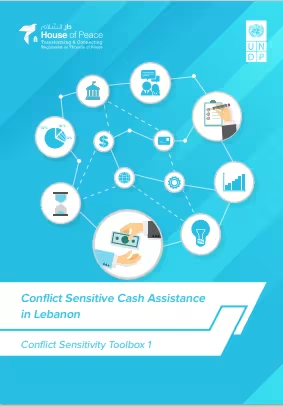
The first toolbox: Conflict Sensitive Cash
Assistance in Lebanon aims to support
partners to ensure that cash-based
assistance does not inadvertently do
harm and is conflict sensitive. The toolbox
is complementary to the Guidance Note:
Getting Started with Conflict Sensitivity in
Lebanon which introduces basic conflict
sensitivity elements and practical tips for
getting started with conflict sensitivity.
within the unique context of Lebanon.
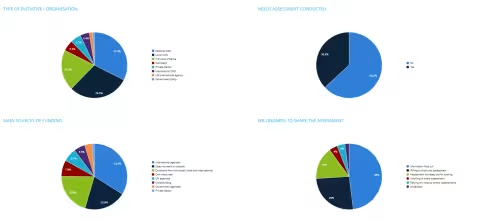
The mapping below documents organisational and individual solidarity initiatives and interventions in the aftermath of the Beirut blast on August 4th, 2020.
Each initiative is mapped according to a set of categories, including type of initiative, area of intervention, geographic area covered, needs assessment conducted, and identified priorities. The below data aims to enhance transparency and collaboration among civil society actors, but also strengthen coordination, in order to reduce duplication and identify priorities for action.
Data was collected by Lebanon Support (through Daleel...
Economic integration is an important means to generate income and employment, to boost investment and to spur structural transformation toward more diversified and broad-based economic models.
The Arab region continues to manage uncertainties on its path towards an inclusive and sustainable growth trajectory: geopolitical tensions persist, and global interest rates have soared.
The July war 2006, lasted 34 days, and led to the displacement of 915,762 (almost 25% of the Lebanese population) persons, relocating into public and private schools all over the country. With the coming into force of the cease fire in August 14th 2006, there was a rapid return of the displaced to the south.