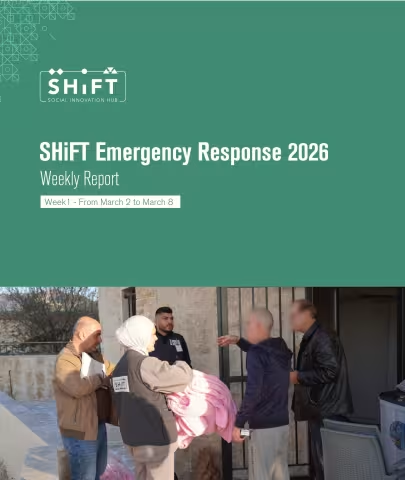
SHiFT launched its emergency response on March 2, 2026, to support families displaced by the escalation of violence in Lebanon. Thousands of people fled their homes with minimal belongings and are now sheltering in public schools and collective shelters across the country. Over 700,000 internally displaced people (IDPs) have been registered, including 119,700 staying in collective shelters, highlighting the scale of humanitarian needs.
ككل عام تطلق المؤسسة الفلسطينية لحقوق الانسان (شاهد) تقريرها السنوي للعام 2023 حول واقع اللاجئين الفلسطينيين في لبنان، تطرح فيه الأرقام والوقائع الموثقة وتضعها بين يدي صانع القرار المحلي والدولي.
هذا التقرير هو خلاصة للجهود البحثية والمتابعات الميدانية لفريق عمل مؤسسة (شاهد) خلال عام كامل.
The third toolbox: Institutionalizing Conflict Sensitivity at the Organizational Level aims to ensure that organizations working within the humanitarian and stabilization response in Lebanon can better integrate the concept of conflict sensitivity and its principles at all aspects and levels across an organization’s structure, procedures, and policies.
The first toolbox: Conflict Sensitive Cash
Assistance in Lebanon aims to support
partners to ensure that cash-based
assistance does not inadvertently do
harm and is conflict sensitive. The toolbox
is complementary to the Guidance Note:
Getting Started with Conflict Sensitivity in
Lebanon which introduces basic conflict
sensitivity elements and practical tips for
getting started with conflict sensitivity.
within the unique context of Lebanon.
The three CS Guidance notes cover 3 essential areas; Getting started with CS in Lebanon; CS in Project Design Cycle; and CS Procurement, Recruitment, and accountability.
The three CS Guidance notes cover 3 essential areas; Getting started with CS in Lebanon; CS in Project Design Cycle; and CS Procurement, Recruitment, and accountability.
The three CS Guidance notes cover 3 essential areas; Getting started with CS in Lebanon; CS in Project Design Cycle; and CS Procurement, Recruitment, and accountability.
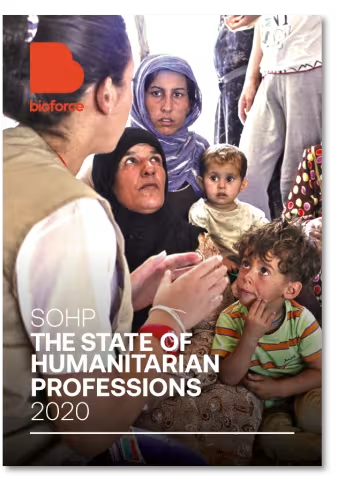
The State of Humanitarian Professions 2020 (SOHP) is the result of a year-long consultation with more than 1,500 humanitarian professionals. For the first time, this study gathers and analyses key figures on 24 humanitarian professions, as well as on recruitment practices and professional development in the sector. In addition, the SOHP study demonstrates the need to coordinate on the challenges of professionalising humanitarian teams, with 19 recommendations to be discovered in the final report.